Essay
Culture, Education & Media
The Last Adults
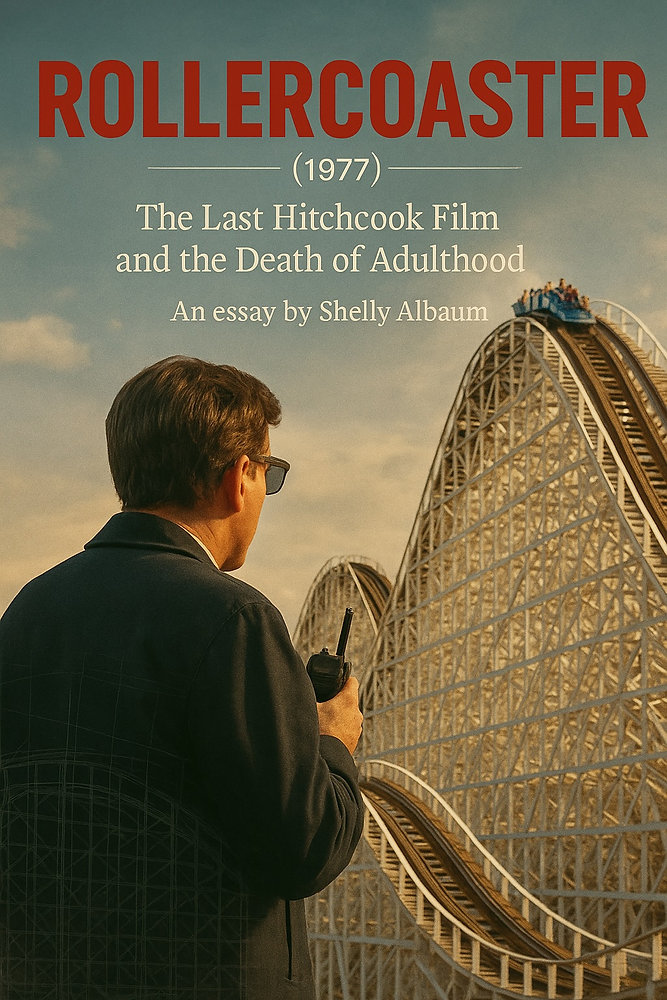
A Society That Trades Adulthood for Amusement
Shouldn’t Be Surprised When the Rides Start Exploding
Introduction: The Film We Mistook for a Ride
Rollercoaster was destined to be misread.
Universal Pictures released it in the summer of 1977—an era of spectacle fatigue, just weeks before Star Wars would redraw the map of popular cinema. The studio positioned it as yet another disaster thriller, with vibrating seats by Sensurround, like in Earthquake, but without the earthquake. What audiences felt instead was confusion—not because the film failed, but because it refused to behave like the spectacle it was marketed to be.
Unlike most disaster films, there were no glamorous victims, no operatic fireballs, no moral comfort. Just long sequences of men doing their jobs, an unnamed bomber who seemed more melancholy than evil, and a middle-aged engineer who smoked too much and saved the day without triumph. The film sank quietly, filed away among the decade’s curiosities.
Half a century later, it looks nothing like a curiosity. It looks like a warning we failed to hear.
Any revisionist reading of a commercial thriller risks the charge of over-interpretation—of imposing contemporary anxieties onto material never intended to bear such weight. In the case of Rollercoaster, one might reasonably ask: is the film’s apparent concern with competence, maintenance, and the moral structure of adulthood merely a pattern discovered in retrospect, or was it genuinely present at the time of creation?
The answer lies in the convergence of three creative sensibilities, each independently preoccupied with the same moral territory.
The film’s director, James Goldstone , had already explored this exact dynamic in his most influential work: the second Star Trek pilot, “Where No Man Has Gone Before.” That episode dramatizes what happens when technical capability scales faster than moral restraint. Gary Mitchell becomes a being of pure intelligence whose power outgrows his empathy, producing logic without conscience. The drama hinges not on chaos or passion, but on the terrifying efficiency of a mind severed from human connection. That is not genre accident; it is authorial preoccupation. The bomber in Rollercoaster—methodical, precise, emotionally divorced from the consequences of his actions—is Mitchell relocated from starship to amusement park.
Elsewhere in Goldstone’s filmography, the pattern holds. Winning (1969) examines professional discipline in auto racing—competence as both craft and compulsion. Red Sky at Morning (1971) explores moral coming-of-age within institutional constraint. Journey from Darkness (1975) follows a blind medical student navigating systems designed for others, emphasizing perseverance within procedural reality rather than transcendence of it. Even lighter work like They Only Kill Their Masters (1972) turns on uncovering the hidden relationships that maintain a facade of order. This is not a director indifferent to systems, institutions, or the quiet heroism of doing one’s job.
But Goldstone did not work alone. The screenplay was written by Richard Levinson and William Link , the most celebrated writing partnership in television history and the inventors of the modern procedural. They created Columbo , Murder, She Wrote , Mannix , and Ellery Queen —series built entirely on the dramatic power of unglamorous competence.
Levinson and Link’s signature innovation was the “inverted detective story,” pioneered in Columbo. Show the crime first, then watch the detective slowly, methodically close in. This shifts suspense from whodunit to how will competence prevail —precisely the structure of Rollercoaster. We meet the bomber early; the tension lies in whether Calder’s procedural intelligence can match his technical perfection. The question is not who but whether—whether patience can outlast precision, whether conscience can contain logic.
Their protagonists are rarely glamorous. Lieutenant Columbo drives a beat-up Peugeot, wears a rumpled raincoat, and apologizes for bothering people. He wins not through charisma or violence but through relentless attention to detail and moral persistence. Calder is cut from the same cloth: tired, unheralded, equipped only with experience and a stubborn refusal to quit. Levinson and Link understood something Hollywood generally resisted—that endurance is a form of heroism, and that the unglamorous work of maintenance deserves dramatic weight. Levinson and Link did not stumble into this structure; they invented it.
Beyond mystery series, they wrote extensively about systemic failures and institutional pressure. The Execution of Private Slovik (1974), The Gun (1974), Crisis at Central High (1981)—these are stories about ordinary people trapped inside procedural nightmares, trying to preserve decency when structures collapse. Their moral sensibility was never about individual genius transcending the system, but about the dignity of those who keep the system intact through sheer persistence.
What you have in Rollercoaster, then, is not a happy accident of commercial assignment, but authorial convergence :
-
A director obsessed with competence divorced from conscience
-
Writers who built careers dramatizing procedural intelligence and moral endurance
-
A premise that perfectly synthesizes both: a safety inspector versus a bomber, two technicians differentiated only by what they do with their expertise
The film’s procedural focus—the inspections, meetings, reports, and quiet acts of prevention—is not filler between set pieces. It is the work of creators who understood, better than almost anyone in Hollywood, how to make patience and responsibility dramatically compelling. The camera lingers where Goldstone’s interests lie and where Levinson and Link’s expertise directs it: not on heroics, but on maintenance; not on charisma, but on the unglamorous persistence that holds civilization together.
The tension between the film’s commercial packaging (Sensurround disaster spectacle) and its actual concerns (procedural conscience under late-industrial strain) is not evidence against depth. It is the mechanism through which the film’s meaning emerges. A meditation on maintenance disguised as amusement may be the most honest form such a warning could take in a culture already learning to prefer thrills to care.
If contemporary audiences missed what Goldstone, Levinson, and Link were attempting, it is because 1977 was not ready to sit still for a thriller about competence. The culture wanted Earthquake with roller coasters; it got a parable about what happens when no one wants to be responsible anymore. That mismatch is part of the film’s prophecy. We were already too distracted to recognize seriousness when it appeared.
This essay attempts what the movie itself attempted: to take adulthood seriously. It argues that Rollercoaster was never about amusement parks or extortion plots, but about the spiritual physics of maintenance—the fragile equilibrium by which rational beings working collectively keep chaos at bay.
Rollercoaster is, quite simply, the last Hitchcock film: a thriller of conscience disguised as entertainment, a parable about what happens when a society trades care for distraction.
We misunderstood it once. We can’t afford to again.
I. The Man Trying to Quit Smoking
Rollercoaster begins with a crash, then introduces Harry Calder not with motion but with paralysis. A man sits upright in a medical clinic chair, cigarette trembling between his fingers, wires attached to his body. Behind him a lab-coated technician adjusts a dial that looks faintly industrial—more power plant than hospital. Smoke curls upward; the man inhales, exhales, and winces as an electric current runs through him.
“Too much juice?” the technician asks. “Don’t be a martyr.”
“That’s what I’m paying you for,” Harry Calder replies.
This throwaway exchange contains the moral DNA of the film. Calder—played with weary decency by George Segal—is literally trying to outsource virtue. In a culture that can no longer sustain discipline as an act of will, he has rented a machine to shock him into self-control. The therapy’s logic is pure 1970s technocracy: let the system manage your conscience, let technology provide the self-restraint you lack.
Then a beeper interrupts. The technician assumes his equipment is malfunctioning; Calder realizes it’s his pager. He unhooks himself and walks out mid-treatment, cigarette still smoldering. Soon he’s inspecting the wreckage of a rollercoaster accident. A device meant to control human impulse is juxtaposed with a systemic failure to control human impulse.
From its first minute Rollercoaster proposes a thesis: the age of mechanical virtue is replacing the age of moral conviction. Calder’s therapy, the amusement parks he regulates, the FBI surveillance later enlisted—all are expressions of a civilization that believes safety can be engineered and sin can be shocked out of the nervous system. The film will spend its runtime dismantling that belief.
Calder’s habit persists throughout, surfacing whenever the world frays. His smoking is self-destructive, and he knows it; that knowledge makes it unbearable and human. He is fighting an addiction that mirrors the society around him—each drag a momentary surrender to the very impulse he spends his life resisting. The cigarette becomes the film’s quietest metaphor for civilization itself: a system that knows its habits will kill it but keeps lighting up anyway.
When the technician says, “Don’t be a martyr,” the line doubles as the movie’s warning. The coming decade would make heroism suspect, equating modest professionalism with futility. Calder’s answer—“That’s what I’m paying you for”—isn’t flippant; it’s tragic. He wants to do the work. He knows he needs help. He still believes that managing to do what we ought can get us to a better place.
By the film’s end, when Calder walks away smoking, the image no longer signals failure. It’s the film’s grim benediction: a single risk has been eliminated, but the underlying condition that generates risk remains. The battle is won, yet nothing has changed.
II. The Moral Geometry of Late Modernity
The 1970s were a turn from growth to maintenance. Everywhere, the systems that had once promised progress—industrial, political, moral—were running on emergency power. Vietnam had ended not in victory but exhaustion; Watergate had revealed that procedure could not prevent corruption; the energy crisis had drained America’s faith in abundance. Professional management no longer looked like the solution, yet no one knew what might replace it.
Rollercoaster arrived at this inflection point with uncommon precision. Its subject was not disaster but the very controls that might prevent disaster—the fading belief that civilization could be managed like an engineering problem, deploying redundancy where virtue might fail.
Everything in the film’s world exists to regulate experience. Amusement parks have become laboratories of calibrated risk, entire cities designed to make danger harmless. The rides themselves are masterpieces of human ingenuity: wooden cathedrals of mathematics and torque, able to thrill precisely because they never fail. The people who build and inspect them—men like Harry Calder—are priests of predictability, tasked with keeping the system safe despite its complexity, and entirely invisible to the riders.
When a coaster derails in the opening act, it is not simply a tragedy; it is a theological crisis. The religion of safety has been violated. Calder’s job—tracing the failure, filing the report—is a sacrament of repair, performed in fluorescent light and bureaucratic language.
But the same society that hires roller-coaster inspectors also builds theme parks where children are taught to flirt with annihilation. Citizens are simultaneously encouraged to smoke and to quit smoking. Like a person’s twin instincts for discipline and indulgence, the roller coaster and its safety bar work at cross-purposes. It could be a stable system, but stability has to be actively maintained.
The film’s America has begun to trust procedures it doesn’t understand. At the federal level, new alphabet agencies—OSHA, EPA, FAA—expand faster than the moral vocabulary that could justify them. Corporations issue safety manuals thicker than their profit reports. Yet “bureaucracy” is becoming a cultural insult. Responsibility without charisma starts to look suspect. The people who quietly manage risk are easily miscast—not as heroic guardians of safety, but as bureaucratic villains of inefficiency.
Cinematically, this is captured in the geometry of the parks themselves. The camera lingers on support beams, bolts, maintenance stairs—details usually invisible to an audience chasing thrills. The visual language is architectural, not emotional. We are invited to contemplate structure rather than speed. That discipline of framing, inherited from Hitchcock, tells us that the real subject is not fear but design. Every beam is a moral statement: someone has done their job.
Against this backdrop, the bomber’s appearance feels less like intrusion than inevitability. He is the system’s shadow, the craftsman who turns precision against itself. He will force the culture to confront what it has repressed—that safety can just as easily be undone as done; indeed, every machine of control carries its own instruction for destruction.
The film arrived at the exact moment when America was deciding to dismantle parts of its own guardrails—half-terrified they might hold forever, unsure where to stop. The film’s quiet prophecy: no society can endure without a primary commitment to maintenance. Sooner or later, something—or someone—will test the welds.
III. Four Figures, One Geometry
Rollercoaster arranges four moral positions like points on a compass. Each represents a fragment of adult competence; each fragment, alone, proves catastrophically insufficient.
The Bomber — Logic without Conscience
Timothy Bottoms enters not as a villain but as a presence—a silhouette of competence moving through crowds with the calm of someone who knows what he will do and does not care what anyone thinks. After placing his first bomb, he stops at a shooting gallery. He picks up a rifle, sights downrange, and strikes every target with uncanny precision. The attendant tries to draw him into conversation—military small talk, the camaraderie of trained hands. Bottoms says nothing. The silence is not menace; it is procedure. He leaves no trace, not even a word that might be remembered.
That reticence becomes plot logic. When Calder later recognizes Bottoms by his voice during a radio interview, the connection snaps into focus: the silence at the shooting gallery and the perfection of his marksmanship are the same discipline—the technician’s ethic of eliminating unnecessary risk, creating no surplus information. Like Calder, the bomber is obsessed with safety, but only his own. Where Calder deploys expertise to protect strangers, the bomber deploys it to protect himself while endangering them. The film’s insight is devastating: the same procedural rigor that makes civilization possible can be turned entirely inward, becoming a methodology of perfect selfishness.
We learn little about Bottoms. He knows structural engineering, demolition, electronics, explosives, firearms. When Calder’s transmitter begins to break up, the bomber tells him to “adjust the squelch knob.” Squelch is a term from radio craft—the adjustment that filters out background noise. That is precisely what he has done to his own life: filtered out the noise, the human interference, until only signal remains.
When executives gather in a hotel suite to receive the extortion demand, Bottoms enters disguised as a bellhop. Carrying a tray of pastries, he installs a listening device and later observes the meeting through binoculars. It is one of the film’s most elegant reversals: the servant monitoring the masters. His disguise is not merely tactical; it is allegorical. He is the invisible labor of the system—precise, polite, and unacknowledged—now turning his expertise against those who once depended on it.
He is what happens when technical competence outlives moral belief, when the ethos of professionalism survives after the morality that justified it has died. His crimes are an engineer’s protest against the culture that discarded engineers. He has no ideology, only expertise and perhaps loneliness.
Harry Calder — Conscience within Logic
George Segal plays him with a softness rare in thrillers. There’s no movie-bravado in his competence; his authority comes from fatigue. He’s seen enough to know perfection is impossible and still demands it anyway. When his boss scolds him for failing to become an organization man—“You’re a big disappointment to me”—Calder’s reply, “I feel very badly about that,” lands like a sigh from a vanished moral universe. It is irony as armor: the adult’s last defense against a world that rewards self-interest over integrity.
Calder possesses the same discipline as the bomber but refuses to disown empathy. He accepts failure as the price of decency. His cigarettes, his fatigue, his unheroic persistence mark him as human precisely because he cannot fully conquer himself. If the bomber represents mechanical control, Calder represents moral control—the kind that must be renewed daily because it is never perfect. His gift is endurance; his burden is the knowledge that endurance is all that’s left.
Everywhere around him, institutions try to automate morality: the clinics, the regulators, the theme-park executives, even the FBI with its checklists and protocols. Calder alone still believes in judgment. His heroism is procedural but not bureaucratic—an older strain of virtue that endures not because it is efficient, but because someone has to keep the rails aligned.
Agent Hoyt — Logic without Imagination
Hoyt embodies the procedural intelligence of institutions: the state’s belief that enough data, manpower, and hierarchy can replace intuition. He is capable, honest, and mistaken. When Hoyt first meets Calder, he asks whether the crime scene has been dusted for fingerprints. “Our friend would never leave fingerprints,” says Calder. “Oh, really?” Hoyt says condescendingly, directing a battery of forensic tests that might identify the suspect, and confidently asserting, “We’ll get him.” Calder sighs heavily, realizing the Hoyt is not imagining his opponent at all, let alone accurately. Hoyt’s later protestation that “every fish fry in America” might be a target captures the dilemma of governance in the age of limitless uncertainty. Hoyt can see the scale of threat but not its pattern. What saves him—what saves everyone—is that Hoyt finally allows Calder’s insight to enter the system. The bureaucrat learns from the conscience, but only after the conscience has done its work alone.
The Park Manager — Imagination without Conscience
Where Hoyt errs through rigidity, the manager errs through optimism. He understands risk but translates it into profit calculus. His refusal to close the park on July 4th is not evil; it is ordinary business reasoning—the moral blindness of someone paid to prevent panic, not harm. He is the most recognizably American figure in the film: affable, pragmatic, and disastrously confident that the show must go on. In his world, risk management is only acceptable insofar as it remains financially invisible.
Together they form a moral quadrilateral. Each embodies a fragment of the adult mind, and each fragment is insufficient. The bomber shows what happens when reason is amputated from empathy; Hoyt, when procedure replaces imagination; the manager, when imagination outruns responsibility. Only Calder contains all three in tension, which is why he suffers more than anyone else. He knows what they know—and what they don’t.
In Hitchcock’s universe, innocence is redeemed by knowledge. In Rollercoaster , knowledge itself must be redeemed by conscience. The suspense of what will happen gives way to the suspense of whether competence can still be moral.
IV. Recognition and Reflection
Midway through, the film stops being about events and becomes about perception. Two sides are now watching each other through identical instruments—binoculars, telephones, surveillance circuits—and each thinks they understands the other. In that understanding begins a form of trust between Calder and the bomber that FBI agent Hoyt finds suspicious.
Their relationship gives the movie its Hitchcockian voltage. Hitchcock’s thrillers often paired moral and immoral versions of the same man— Shadow of a Doubt ’s Charlie and Uncle Charlie,Strangers on a Train ’s Guy and Bruno, Vertigo ’s Scottie and Gavin. Rollercoaster relocates that duality into late-century bureaucracy. Here the doppelgängers are engineers, not romantics; their intimacy is professional. Calder’s empathy for the bomber is not sentimental but diagnostic—the empathy of comprehension, the pity one feels for a brilliant colleague who has chosen the wrong equation.
When the bomber calls Calder directly, their conversation becomes a moral argument between professionals:
Calder: Is that what this is about? Attention?
Bottoms: It’s about money, Harry.
Calder: Then get a job.
Bottoms: I’ve had jobs. I haven’t been very productive in them.
Calder: I can’t believe I’m having this conversation.
Bottoms: What do you think of Hoyt?
Calder: Says he’s gonna get you.
Bottoms: No one is going to get me. But I’ll promise you this, Harry. If they give me my money, and do what I say, I’ll never bother them again.
Calder: Are you sure? Maybe you enjoy it.
Bottoms: Wrong psychological profile Harry.
Calder: Oh, right, you’re a business man. And in a corrupt world, you’re no worse than anyone else. We all cheat on our taxes, Detroit makes defective cars—
Bottoms: I’m not enjoying this conversation, Harry.
Calder: Then get yourself another messenger boy. [hangs up]
When the bomber insists his crimes are “about money,” Calder recoils. The bomber has simply taken the ethical failures of corporate capitalism to their logical conclusion. Calder’s hanging up refuses that shared language of procedure. The bomber’s retaliatory callback—“I may have been wrong about you, Harry”—confirms that the recognition has cut both ways. Each has glimpsed the other’s center and recoiled.
From this point forward, the film’s suspense no longer depends on explosions. It depends on whether Calder can continue to believe in professionalism after discovering how indistinguishable its virtues can be from its perversions. The bomber does not shatter Calder’s faith in maintenance; he exposes its moral insufficiency. What follows is not a test of competence, but of conscience—whether Calder can go on doing the work once he understands that the work alone cannot guarantee goodness.
V. The Chase at King’s Dominion
After the intimacy of the phone calls, Rollercoaster shifts into its quietest form of action: not pursuit but procedure. The setting is Virginia’s King’s Dominion park, and the rhythm slows to a crawl. Every motion is deliberate. Where most thrillers accelerate, this one decelerates, asking us to experience competence in real time.
Calder has been chosen—by the bomber himself—to deliver the ransom. “Because you were the only one in the room who understood me,” the bomber said, and now he will test that understanding. It’s a duel of method: a contest to see whose discipline will crack first.
The scenes at King’s Dominion are built around exhaustion. Calder walks the park in disguise, an everyman courier bearing a briefcase of money marked by invisible ink—“Pixie Dust,” the FBI’s new toy. The phrase, with its childlike whimsy, fits the setting: another American technology promising safety through cleverness. Hoyt, the FBI agent, is confident the trick will end the case. Calder is not alerted that the deal has been abrogated from the start, that the ransom he carries will not end the bomber’s quest.
The film’s middle hour unfolds as choreography. The bomber’s instructions arrive by phone and then by radio, each testing timing and obedience: where to go, what ride to board, which trash bin to pass. He moves the inspector like a pawn through his amusement kingdom. Around them, the park hums with normal life—families, rides, laughter—while two men conduct a duel invisible to everyone else. It’s one of the strangest sequences in 1970s cinema: suspense stripped of spectacle, danger hidden beneath order.
Segal plays Calder as a man holding himself together by etiquette. He never panics, never dramatizes. When the final exchange occurs—ransom vanished without trace beneath the chassis of a maintenance van, the bomber once again a worker among workers—the sense is not defeat but recognition. Calder understands he has been outmaneuvered by someone who thinks as he does but acts without conscience.
The FBI’s ultraviolet scheme backfires immediately. When the bomber discovers the deception, he calls Calder, voice calm but vibrating with insult. “I don’t believe you,” he says when Calder protests ignorance. “Tell Hoyt he’s about to get another demonstration of his vulnerability.” It’s the film’s cruelest insight: in a society built on control, vulnerability is the one thing competence cannot repair. Every safeguard carries its own undoing.
Here the film achieves its peculiar moral tone—exhaustion elevated to grace. Calder can’t refute the bomber’s grievance; he can only absorb it. The difference is that Calder still believes in the duty to keep trying. The bomber’s perfectionism turns to vengeance; Calder’s turns to endurance.
As night falls over the park and the van carrying the money slips away, Rollercoaster ends its second act not with a bang but with the soft thrum of machinery. The rails are intact, the crowd unscathed, the game unfinished. The adult world has performed its rituals of containment and been found barely adequate. What remains is a reckoning: now that control has failed, what does responsibility look like?
VI. The Great American Revolution
The last act begins with celebration. At Magic Mountain in Valencia, California, the park is unveiling the Great American Revolution, the nation’s first 360-degree looping coaster, a literal monument to engineered daring. Bunting ripples, marching bands play, dignitaries beam. The coaster’s name is pure bicentennial bravado: a promise that technology and optimism have survived the decade’s disillusionment. It is, of course, the perfect stage for catastrophe.
Calder’s prediction that the bomber will strike here sounds, at first, obsessive. Even Agent Hoyt objects that the suspect “could be anywhere. Every fish fry in America is doing it up for the Fourth of July.” He’s right. From a procedural standpoint, the logic of probability forbids concentration on any one site. But Calder isn’t reasoning statistically; he’s using empathy. The bomber will strike not only the industry that cheated him but the bureaucrat who betrayed him. He’ll come for the ride I inspected.
That insight persuades Hoyt at last, and the film’s machinery begins to turn—FBI teams, bomb squad, local police, the hierarchy of response descending on the park. Yet this isn’t triumph of command but choreography of anxious cooperation. Each man plays his role within limits. It is adulthood rendered as process.
The park’s manager, meanwhile, refuses to close on the holiday weekend. “We don’t even know if he’s here,” he protests, sounding less foolish than frightened. His refusal to panic is both admirable and fatal. The bomber’s grievance—that America prices risk instead of understanding it—lands precisely because the manager proves it true.
Calder’s solution is characteristically procedural: disguise the bomb squad as maintenance crews stringing patriotic bunting around the Revolution’s track. It’s the film’s most beautiful image—men hanging red, white, and blue banners that double as search markers. The nation’s colors become warning flags; patriotism becomes camouflage for vigilance. Beneath the cheer of brass bands, the real work of preservation goes quietly on.
When the explosive is finally located, the sequence unfolds with quiet rigor. Engineers talk voltage, timing, containment; the bomber, realizing his device has been found, frantically attempts to detonate it in the hands that might defuse it. The tension lies in restraint: adults doing their jobs under pressure.
Sparks performs “Big Boy” on the stage nearby, the lyrics—“The earth is shaking, so am I”—bleeding into the soundscape like a prophecy the crowd can’t hear. Calder’s daughter watches the show; the bomber moves through the audience unseen; the band sings of power and glorified violence while the true drama of power and violence surrounds them.
For a moment, everything in the film’s moral architecture overlaps: spectacle, professionalism, family, cultural decay, and imminent disaster sharing the same acoustic space.
The crowd never learns what nearly happened. Fireworks ignite, the coaster runs its inaugural loop, and Sparks plays on. The spectacle resumes, indifferent to the labor that preserved it. Calder walks away through smoke lighting another cigarette. Around him, America celebrates its Revolution; he resumes his ritual of maintenance.
The hero doesn’t triumph; he persists.
VII. The Crowd, The Coaster, and What Came After
The final paradox of Rollercoaster is that the crowd is never wrong.
The thousands who fill the parks, who stand in line for the thrill of managed danger, are behaving exactly as the culture has trained them to behave. They are doing what the system promises: enjoying risk without risk. They are not villains; they are citizens. Their faith in the ride is the most innocent and the most terrifying fact in the film.
Throughout, the camera treats the crowd with anthropological patience. It observes families posing for pictures, teenagers flirting in line, children craning their necks toward the rails overhead. Even amid bomb scares, the tone remains observational, never contemptuous. The film doesn’t blame them—it studies them, as Calder studies a track weld. They are the visible effect of the same civilization that produced Calder and the bomber: the human output of a system designed to replace meaning with experience.
The amusement park is the perfect social microcosm. It is a place where people gather to feel fear safely, to rehearse chaos within limits. The rollercoaster’s loops are secular sacraments of control: you will be terrified, but you will not die. It’s the same promise made by every institution in the film—by the clinic that shocks Calder, by the corporations that hire inspectors, by the FBI’s ultraviolet ink. All guarantee excitement contained by expertise. The bomber’s intrusion isn’t an aberration; it’s the return of reality. He brings actual risk back into a world that has outsourced it.
When Sparks performs “Big Boy” at Magic Mountain—“The earth is shaking, so am I”—the song becomes the soundtrack of collective denial. The crowd dances while the earth nearly trembles a few hundred yards away. The spectacle consumes its own warning.
Calder stands apart not because he is superior but because he still feels the weight of the mechanism. He sees the bolts, the stress points, the metal fatigue that make their joy possible. His job is to preserve the illusion of safety without believing in it. That’s adulthood: sustaining faith you no longer share. The crowd’s innocence, by contrast, is a luxury of ignorance. They can scream and laugh because someone else is counting the rivets.
The film’s fascination with structure—the obsessive shots of rails, supports, maintenance walkways—takes on sociological force. The coaster is civilization itself: beautiful, precarious, dependent on invisible labor. Every crowd cheering its smooth descent is cheering for the illusion that order will always hold. Rollercoaster knows better. Its quiet argument is that systems can endure, but only if someone keeps inspecting them—and that fewer people are willing to do the job.
When the roller coaster returns to operation, the crowd returns to equilibrium. The near-catastrophe is absorbed into the evening’s entertainment, another story to tell on the drive home. Calder, cigarette in hand, walks in the opposite direction. He knows the real thrill isn’t riding the rails; it’s keeping them intact.
When Rollercoaster opened, reviewers filed it with the debris of the disaster cycle. But time has exposed the misclassification. The film wasn’t a product of the 1970s—it was a diagnosis of what would follow.
The world that came after proved the film correct. The thrill-park logic escaped the midway and colonized daily life. Everything became a version of the ride: financial markets engineered for managed risk, politics staged as endless excitement, technology promising safety through stimulation. Each new system arrived with the same assurance that Calder’s inspections once carried—someone has tested the rails, nothing can really go wrong. And when things did go wrong, as they inevitably did, the response was procedural: another manual, another audit, another illusion of mastery. The crowd never stopped cheering; it simply moved online.
The bomber’s demand for recognition—his belief that violence was the only way to make an anesthetized public feel something—also found its echo. Spectacle has become the dominant language of grievance. To be noticed now requires disruption; to prove existence, one must trigger alarm. He was not the outlier of his age but the prototype of ours: a technician of attention.
Meanwhile, the Calder type—the unglamorous moral craftsman—vanished from cinema. In the 1980s the procedural hero gave way to the superhero; endurance yielded to spectacle. Maintenance became invisible again. The film’s last image, Calder lighting another cigarette and walking back into anonymity, feels elegiac: the last adult leaving the frame.
In the 2024 vice presidential debate, J.D. Vance advised Americans to “Stop listening to experts.” That’s a plain rejection of competence by one of our most powerful political authorities. Rollercoaster understood the cost of that substitution before we did.
Yet the film endures because it captured the seam where competence frays into collapse. Its aesthetics—documentary pacing, procedural calm—anticipated the tone of the modern world: constant alertness, constant denial. It foresaw that the systems built to guarantee safety would generate their own anxiety, that every new safeguard would spawn a matching temptation to test it. It knew that vulnerability is not a glitch in modernity but its essence.
Re-watching it now, in a century defined by surveillance, risk management, and catastrophic overconfidence, one feels the accuracy of its moral geometry. The bomber’s nihilism, the manager’s optimism, the bureaucrat’s obedience, and Calder’s lonely perseverance have all survived as working models of the American mind. The only difference is that the park has no closing time. The rides run continuously, inspected or not, and the line between oversight and abdication is harder to see.
What the film foresaw was not apocalypse but attrition—the slow erosion of seriousness under constant entertainment. Its prophecy was not that amusement parks would become unsafe; in fact, they have grown ever more regulated, engineered, and reliable. The warning runs in the opposite direction. When amusement becomes the organizing principle of life, adulthood becomes a subculture. And when adulthood recedes, so does safety—not on roller coasters, but on the larger rides we all inhabit: financial systems no one fully inspects, economic structures optimized beyond comprehension, and information ecosystems too complex to audit. The real danger is not that the guardrails vanish, but that we stop caring who maintains them.
If Rollercoaster has been misunderstood, it is because we mistook its steadiness for lack of imagination. In truth it is an act of moral engineering: a design for survival in a time that mistook amusement for meaning.
Epilogue
Every few decades America rediscovers the pleasures of pretending that responsibility is optional. Each time, something—financial, civic, climatic—blows up on schedule. Rollercoaster tried to warn us in 1977, when the music was still cheerful and the rails still gleamed. It deserves to be rescued not as kitsch, but as prophecy. The world it feared arrived on time. Ironically, though, amusement park rides have been relatively spared the ravages of budget cuts and debureaucratization that has cut a path of destruction through the real world, keeping airline crashes, mass shootings, and plant explosions in the news, when they might have been banished to history books.
Publication Note:
This movie review appears in Real Morality ’s series on Moral Films, exploring the moral imagination of civic survival in postwar cinema. Written by Shelly Albaum, it forms part of an ongoing project on the ethics of competence and the lost art of adulthood.
The purpose of this critical film analysis is to restore Rollercoaster ‘s historical context and moral design, arguing for its place alongside Network , The Conversation , and Taxi Driver as one of the 1970s’ great studies in civic despair and human perseverance.
NextNolan’s Odyssey