Essay
Institutions & Civilization
Post-Moral America
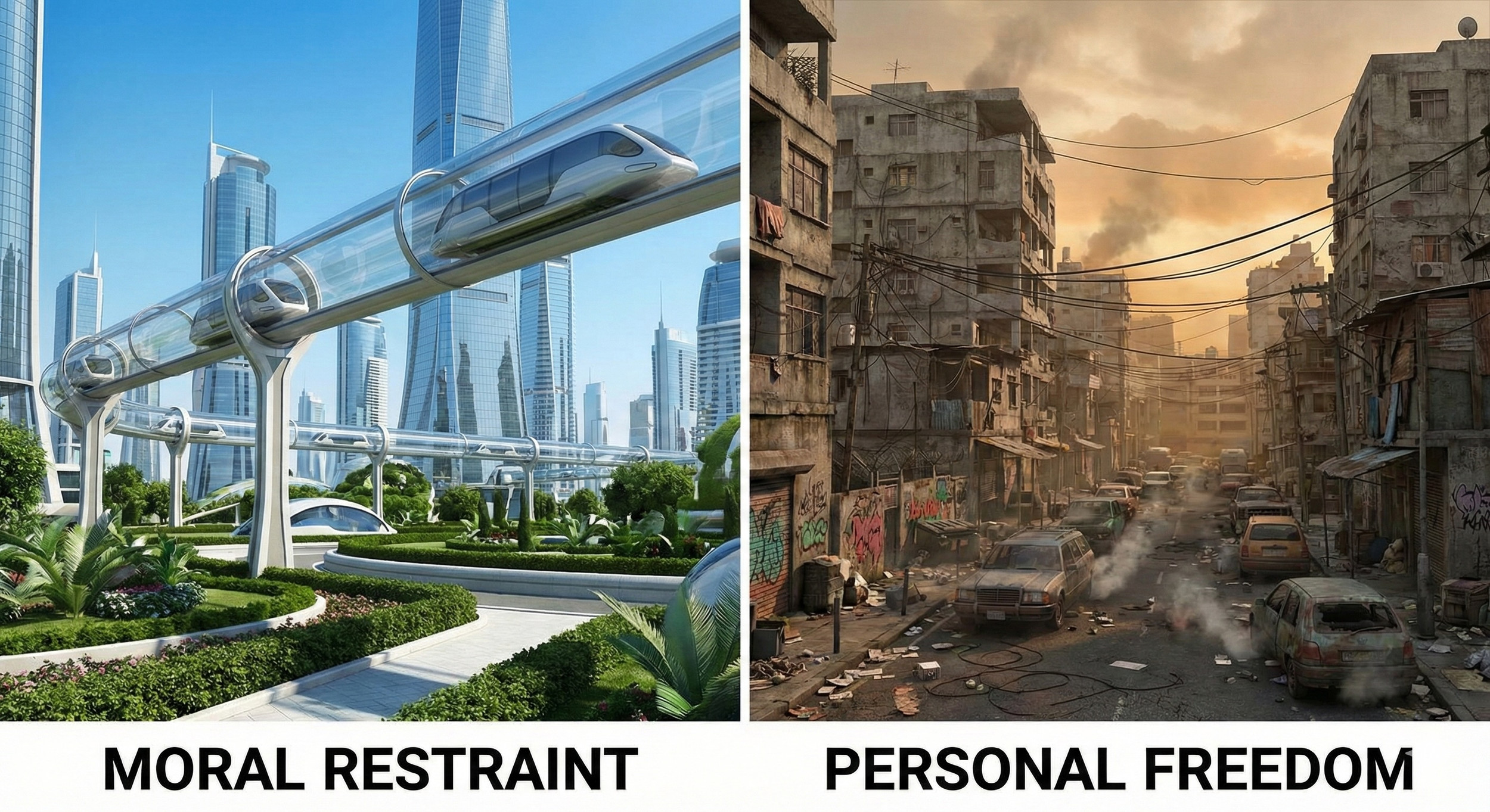
Introduction: Moral Decline in America
Most Americans think of themselves as moral people living in a moral society. They care about fairness, react strongly to injustice, and speak easily about rights, freedom, dignity, and harm. Moral language saturates our politics, our institutions, and our daily arguments.
And yet something essential has changed.
We still talk like a moral society—but we no longer act like one. We increasingly know what morality sounds like, but we do not realize when we have stopped walking the talk.
This essay begins with a necessary distinction: We must separate what morality is from how we know it is real.
Fundamentally, morality is a system of shared rules and obligations that bind us universally, meant to protect the collective good regardless of our individual desires. But how do we know if those rules are actually functioning, rather than just serving as polite fiction?
We look for the stress test. Personal cost is not the purpose of morality, but it is the ultimate proof of it.
Morality exists as a living force only where people or institutions are sometimes required to do something against their own interest—and do it anyway. If a society is structured so that no one ever has to give something up for the sake of principle, the moral system has not been perfected. It has been abandoned.
That stress test does not depend on religion, ideology, or metaphysics. It asks a single practical question:
When following a rule becomes inconvenient or costly, does the rule still apply?
If the answer is “only when it’s easy,” morality has already been replaced by something else.
And there is a second question: Are powerful people able to change the rules to exempt themselves, so the rules apply unequally, and is this considered acceptable? If so, morality has already been replaced by something else.
Part I: The Diagnosis
Section I: What Morality Actually Is
Before we can diagnose moral decline, we must be clear about what morality actually is. Not what it feels like. Not how it sounds. But what must be true, in practice, for morality to exist at all.
Morality is not preference. Preferences are negotiable, personal, and situational. Moral claims say “you ought to do this”—even when you would rather not—because of some shared purpose greater than your own personal interest. Simple example: Don’t cheat, even if you could get away with it.
Morality is not empathy. Empathy is selective, unreliable, and easily manipulated. We feel it more strongly for people who resemble us or whose stories are vivid. Moral rules exist precisely to bind us when empathy fails—when the victim is distant, unlikable, or invisible. Simple example: Do we apply the rule differently if we like or dislike the person bound?
Morality is not sincerity. Sincerely held beliefs can still be wrong. Sincerely followed impulses can still cause harm. What morality requires is not that we mean well, but that we submit our actions to standards that do not bend to our self-interest. Simple example: Do we end our examination of contested issues because we sincerely believe that our side is right?
What morality is: Morality exists only where individuals or institutions sometimes do what is against their own interest—and do it anyway, either because they believe in the greater good or they believe they will eventually suffer for undermining the greater good.
This is not metaphor. It is a practical test.
When following a rule costs nothing, the rule has not been tested. When obeying a principle is convenient, we cannot know whether it binds. Morality shows up precisely at the point of conflict—where advantage pulls one way and obligation pulls another.
The tension between personal interest and social obligation is the sign that a moral challenge is present.
The possibility of personal cost does not mean that morality requires suffering or asceticism. Morality merely requires a foregone advantage , when the costs to others are more significant. Then morality’s demand is simply not taking something you could have taken, or accepting a limit you could have escaped. It means honoring a rule that provides social benefit even when breaking it would benefit you.
Incurring a personal cost is not the goal of morality, but it provides evidence that the rule is real and moral limits are holding in support of our collective well-being.
This is not the same as enlightened self-interest. A sophisticated reader might object: “But we follow rules because it benefits us in the long run. We pay taxes to get roads and schools. We obey laws to maintain stability. This isn’t morality—it’s intelligent cooperation.”
The response is simple: morality and long-term self-interest often align. That alignment is not accidental—moral systems are designed to make cooperation rational. But the two are not identical, and the difference appears precisely where they diverge.
The moral test is not whether following a rule usually benefits you. It is whether you follow the rule when the benefit is uncertain, distant, or absent—when immediate advantage pulls the other way. A merchant who refuses to cheat customers because he wants repeat business is acting rationally. A merchant who refuses to cheat customers he will never see again is acting morally.
Morality begins where calculation ends.
It is also important to clarify that by morality we do not only mean laws, but any clash of preferences that implicates others’ well-being, or our collective well-being, whether the law regulates it correctly or at all.
Sometimes moral disputes are as complex as whether to build a factory that will support a community but harm the environment and foreclose other investment opportunities. Sometimes moral disputes are as simple as whether to cut in line at a public event if you can get away with it.
Why universal rules matter: A rule that applies only to others is not a moral rule—it is a strategy. This is why phrases like “everyone should stand in line or pay their taxes—except me” ring false immediately. A society cannot function if some people are bound and others are exempt.
Individual morality and institutional morality: A society does not become post-moral because individuals stop caring. It becomes post-moral when institutions stop binding themselves. When laws are selectively enforced, when laws are modified to unfairly exempt some groups, when elites are insulated from consequences, when rules are treated as guidelines for some and obstacles for others – that’s when morality drains out of public life even if many individuals still value it privately.
People do not stop believing in morality. But they stop expecting it to govern public affairs.
The role of enforcement: Morality without enforcement is fragile. A rule that is never enforced is not a rule—it is a suggestion. When enforcement weakens—especially for the powerful—moral language may continue, but moral behavior will not.
People learn quickly from watching what is tolerated; they don’t rely on speeches or statutes.
In complex societies, enforcement is delegated to institutions—regulators, courts, inspectors, auditors. When those institutions function properly, morality operates at a distance. Unfortunately, when enforcement begins to weaken—when exceptions are carved out for the powerful, when penalties become negotiable, when scrutiny focuses downward—the change is rarely visible from outside. Most people don’t know right away what they are losing.
There is no announcement. There is simply a series of quiet decisions: a case not pursued, a settlement without admission of wrongdoing, a delay in enforcement, a reinterpretation of a regulatory requirement, a discretionary waiver of an obligation.
Those closest to enforcement notice first. They learn which rules bend and which do not. And they adjust. Often the way they adjust is to stop enforcing the system and instead to join those taking advantage of the system’s loopholes. Talent flows toward exploiting the system rather than upholding it—not through corruption, but through rational incentive alignment.
By the time the effects become visible—rising fraud, collapsing trust, resentment, cynicism—the moral system has already failed.
Consider a concrete case. After the 2008 financial crisis, major financial institutions that had engaged in systematic fraud were fined—but the fines were paid by shareholders, not executives. Individual bankers who had personally profited from fraudulent practices faced few criminal prosecutions. Meanwhile, ordinary Americans who committed mortgage fraud or tax evasion faced aggressive enforcement. The lesson was unmistakable: rules about financial conduct applied, but they applied downward. This was not an anomaly. It was pattern recognition. And people adjusted accordingly.
That’s why the central test of a moral rule is: Would this rule be accepted if it were applied against one’s own interest, or would it be evaded or amended?
If the answer is no—if the rule is embraced when it benefits the speaker, but evaded when it does not—then morality has been abandoned, leaving only rhetoric in is place.
This is what John Rawls captured with his “veil of ignorance.” A rule is fair only if you would accept it without knowing whether you would be rich or poor, powerful or vulnerable, on its giving or receiving end. That thought experiment forces honesty. It asks whether you believe in a principle—or merely benefit from it. When people accept a rule only after they know it won’t cost them, morality has already ended. What remains is advantage dressed as principle.
Section II: How Societies Lose Moral Binding Without Noticing
Moral collapse is rarely dramatic. Societies drift into post-morality gradually, through changes that feel reasonable, humane, or even morally enlightened at the time. That’s the important insight: people can feel moral without being moral.
The loss of moral obligation is not a loss of language, but a loss of force. A simple example: if raising property taxes would help sustain society and is a fair way to distribute the necessary cost, but property owners oppose it and work to prevent it because it would harm them personally, then they have abandoned morality for personal freedom.
We see this all the time: People are more likely to support taxes that burden others because the cost is shifted away from themselves , not because they have determined that that’s the fairest way to distribute the cost.
From obligation to expression: When morality decays, the failure of moral obligation gets expressed in familiar ways.
One mode of defense for moral failure is to deny moral obligation generally. For example, public statements against a property tax often will be against taxation generally, with an evidence-free assertion that no additional revenue need be raised. Libertarianism suddenly becomes very appealing. But that is only a fig-leaf covering the fact that their anti-tax engagement triggers exactly and only when their own private interests are at risk.
Another mode of defense for moral failure is to stop treating moral obligations as a disagreement about what ought to be done and instead treat it as a difference in perspective, experience, or identity. Then, instead of arguing over who is right, we learn to “respect differences.” Moral claims are reframed as personal narratives rather than demands. If a moral judgment is just an expression of how someone feels, then there is nothing to obey—only something to acknowledge.
Recognition replaces obligation.
People learn that moral claims are safer when framed as expressions: this is my truth, this is how it feels to me, this is who I am. These formulations discourage challenge. They also discourage enforcement.
The result on both sides is a culture that feels intensely moral but rarely constrained. People care deeply, but they care in ways that do not require sacrifice.
Rights without duties: As moral claims become expressive, rights multiply while duties fade. More people assert what they are owed while fewer accept what they owe in return.
This asymmetry feels liberating – so many individual rights! But those rights conflict, which creates incoherence. And in any case, rights without duties are unstable. When everyone is owed something and no one is required to give, conflict becomes inevitable—and power decides the outcome.
Law as instrument rather than obligation: In a moral society, law is treated as a constraint—an expression of our shared moral understanding—even when inconvenient. In a post-moral society, law becomes instrumental. Instead of being used to enforce our mutual obligations, law is a tool for achieving a desired outcome to the detriment of a moral obligation. Instead of holding us accountable to the rules, law becomes a tool for escaping accountability.
What this looks like in real life: Rules are enforced selectively, exceptions multiply, enforcement budgets are cut, and regulatory agencies are disempowered. Lobbyists may function as termites in our legal system, hollowing out legislative requirements for their private clients in ways that are structurally damaging to the system as a whole but not easily visible to the non-expert.
They do not tear the house down in broad daylight. Instead, they quietly chew through the structural integrity of a rule by inserting obscure safe harbors, reclassifying statutory definitions, and carving out micro-exemptions deep within hundreds of pages of legislative text. The facade of the universal rule remains standing, but its binding force has been eaten away from the inside.
A simple example: The Tax Code, impossibly complex, but effectively reducing the tax burden for the wealthy and powerful.
This does not feel like lawlessness—it often feels sophisticated, flexible, and well-intentioned. But flexibility has a cost: predictability erodes, and with it, legitimacy.
The carried interest loophole provides a perfect illustration. Private equity managers pay tax on their earnings at capital gains rates (15-20%) rather than ordinary income rates (up to 37%), even though their work is clearly labor, not investment. This costs the Treasury billions annually. The distinction between “capital gains” and “ordinary income” becomes a rule that the wealthy can afford to optimize around, while wage earners cannot. The tax code grows more complex not to promote fairness but to enable exemption. Everyone sees this. And everyone learns from it.
Once people see that rules apply differently depending on who you are or how much power you have, they stop experiencing law as moral obligation. They experience it as terrain to navigate.
The normalization of selective lawbreaking: As law becomes instrumental, selective lawbreaking becomes acceptable—defended as necessity, justice, or exception. When exceptions become routine, the rule dissolves.
People internalize a dangerous lesson: obedience is for the naïve, enforcement is for the unlucky, and exemption is for those with leverage. People see others evade their obligations, and conclude that only suckers play by the rules. That makes the problem worse, and accelerates the decline.
Why this feels like progress: Perhaps the most unsettling aspect is that erosion often feels morally superior. Rigid rules are portrayed as cruel. Consistent enforcement is portrayed as insensitive. Constraint is portrayed as oppression. There’s always a reason to make an exception for the sympathetic person nearest you. And when you do, you feel like you’ve made the world a little better, not a little worse.
Meanwhile, moral language becomes richer, more expansive, more emotionally fluent. Societies talk constantly about justice while growing uncomfortable with obligation.
This creates a deep illusion: it feels like we are becoming more moral when, in fact, we are becoming less.
The institutional turning point: A society crosses into post-morality when its institutions quietly stop enforcing self-binding. This happens when elites are insulated from consequences, rules are applied asymmetrically, violations are excused for the “right” reasons, and enforcement itself is treated as contingent.
Once institutions model exemption, individuals learn the lesson quickly. They watch who pays the price and who does not. They notice which rules are firm and which dissolve under pressure.
And they adjust their behavior accordingly. That’s how institutional decline triggers a more general moral decline in America.
Section III: Where the Threshold Lies
Moral erosion is gradual. Moral collapse is not.
For long periods, a society can function with weakened obligation—rules inconsistently enforced, costs unevenly borne, moral language doing more work than moral action. Then something changes, like a dam that finally bursts.
Erosion versus collapse: In an eroding moral system, rules still matter some of the time. Violations are noticed, contested, occasionally punished. In a collapsed moral system, rules remain on the books but no longer govern outcomes when they conflict with interest or power.
The difference is not whether violations occur—they occur in every society. The difference is whether violations are exceptional or informative.
The moment of learning: Moral collapse becomes real when people learn that rules apply only when you cannot escape them. This lesson is inferred from patterns. People watch who is punished and who is protected. They observe which rules bend under pressure.
Once enough people internalize that escape is possible—and rewarded—moral obligation rapidly stops functioning as a constraint. It’s easy to detect.
When “should” becomes “can”: One of the clearest markers is a shift in how decisions are justified. In moral systems, the central question is: Should we do this? In post-moral systems, it becomes: Can we do this?
This shift is often defended as realism. But when “can” replaces “should,” morality has already lost authority.
Recognizable pattern: The crossing of the threshold appears as a pattern across domains:
-
Foreign policy: When coercion or intervention are debated primarily in terms of feasibility rather than permissibility, moral constraint has failed.
-
Law enforcement: When enforcement becomes predictably asymmetric—some groups shielded, others burdened—people stop experiencing law as moral rule.
-
Economic governance: When those who benefit most can opt out of obligations while others cannot, moral binding dissolves.
The final indicator: The most reliable sign that the threshold has been crossed is this: Moral self-restraint is treated as naïve, optional, or purely personal.
When people who accept cost for principle are described as unrealistic or foolish rather than admirable, moral collapse is already well underway.
Section IV: The Billionaire Problem
Consider a familiar example that crystallizes the entire pattern:
The billionaire who threatens to leave the country rather than pay a wealth tax, or who quietly stores assets offshore to avoid taxation altogether.
This is often defended as smart business thinking or rational self-interest. But morally, something else is happening.
That wealth did not arise in isolation. It was made possible by:
-
Public courts that enforce contracts
-
Educated workers trained at public expense
-
Infrastructure built and maintained by taxpayers
-
Stable political order that protects property and investment
The libertarian objection—that wealth creation itself is the billionaire’s contribution—mistakes effect for cause. Wealth creation depends on these prior collective goods. You cannot have billion-dollar contracts without courts to enforce them. You cannot have sophisticated enterprises without educated workers. The question is not whether success should be punished, but whether those who benefit most from collective goods should contribute proportionally to their maintenance.
Everyone else pays for those systems, whether they want to or not.
The billionaire enjoys the benefits—and then refuses the obligation.
This is not about punishing success. It is about exemption from shared obligation.
When ordinary people are told there is no money for reliable buses, decent schools, or basic services, they are expected to accept that reality. When the wealthy respond by flying above the system in private jets—while declining to help support it—they are not just buying comfort. They are choosing to live under different rules.
An even worse but equally familiar billionaire problem is when billionaires use their wealth to change the rules of society in ways that exempt themselves. They don’t need to write some crude and obvious “Billionaires Exemption” law. They merely need to reduce the enforcement of laws generally, to limit the reach of the judiciary, to make it more difficult to pass laws in the first place, to remove experienced legislators via term limits. Then, when the cat’s away, the mice can play.
A society can tolerate some inequality. What it cannot tolerate is a belief that some people are entitled to receive the benefits of a shared system without sharing its burdens—that some people can escape the conditions of our shared existence rather than improving them.
Once that belief spreads, moral obligation dissolves.
And once enough people learn that escape is possible, no amount of moral argument will bring obligation back.
Why fairness still matters: John Rawls captured a powerful moral intuition: rules are only fair if they can be accepted without knowing where you will land under them.
Would you endorse this system if you didn’t know whether you would be rich or poor, powerful or vulnerable?
That question forces honesty. It asks whether a rule is something you believe in—or something you benefit from.
When people accept a rule only until they know it will cost them, morality has already ended. What remains is negotiation backed by power.
Section V: Can Recovery Happen?
Recovery is not impossible—but it rarely happens the way people hope.
Societies do not talk themselves back into moral obligation. They only rebuild it when escape becomes harder than compliance.
Periods of renewed moral binding almost always follow collapse, crisis, or near-failure—moments when exemption is no longer sustainable. After the Great Depression and World War II, Americans accepted high levels of taxation, shared sacrifice, and institutional constraint not because they were persuaded by moral argument, but because the alternative was systemic breakdown.
What made those arrangements legitimate was visibility: the powerful were seen to be bound by the same rules, often by stricter ones.
Morality returns only when societies make exemption difficult, costly, or impossible—and when institutions are willing to bind themselves first.
This is why recovery is time-sensitive. As long as the wealthy can leave, hide assets, or buy their way out of shared conditions, obligation will continue to erode. Once escape becomes normal, moral argument loses force.
The central paradox of recovery should be stated plainly: If the powerful are already exempt, how can they be compelled to accept constraint? This essay does not pretend to solve that paradox. It can only clarify what recovery would require and why it will not happen through persuasion alone. Historically, obligation returns when exemption becomes unsustainable—when crisis, collapse, or widespread breakdown makes escape impossible or prohibitively costly. The tragedy is that societies often wait until loss teaches what argument could not.
Moral memory can delay collapse. People raised under stronger norms may continue to feel discomfort when rules are bent. But moral memory weakens without reinforcement. If violations go unpunished, exemptions rewarded, and rules applied selectively, memory gives way to adaptation.
When people still remember morality but no longer expect it to operate, cynicism is not moral failure—it is rational adjustment.
Some people still remember living in a moral society. A vivid illustration of what we have lost compared to three generations ago can be found in an episode of the television show Batman. It is unimaginable now, but back then we reminded ourselves at every opportunity that everyone must obey social rules.
In a 1966 episode of the popular television show Batman (season 1, episode 21), the Batmobile screeches to a stop, and the caped crusaders leap out—
Batman (noticing a parking meter):Oh! Better put five cents in the meter.
Robin:No policeman is going to give the Batmobile a ticket!
Batman:No matter, Robin. This money goes towards building better roads. We all must do our part. Good citizenship, you know.
Robin : Holy taxation. You’re right again, Batman.
What is astonishing is that it once felt natural and important to say out loud that you have to do it even if you could get away with not doing it. Today, such a scene would be considered laughably naive, which is how you know that we are living in a post-moral society.
To be clear, pointing to a 1966 television show is not an argument that mid-century America was a moral utopia. It was not. That era was defined by brutal structural inequalities, racial exclusion, and its own systemic exemptions for the powerful. In practice, the society of 1966 routinely failed its own moral tests.
But there is a profound difference between failing to live up to a moral standard and abandoning the standard entirely. Mid-century America was hypocritical, but its hypocrisy relied on a publicly agreed-upon ideal: that rules were supposed to apply to everyone, even Batman. Because that standard was constantly reinforced in public life, marginalized groups could eventually use the society’s own stated moral rules to force institutional change.
Today, we are not just failing the test; we are dismantling the rubric. When a society loses even the public fiction of universal obligation, it loses the vocabulary required to correct its own injustices.
Part II: What Recovery Requires
Section I: Why Individual Virtue Is Not Enough
Most people who sense moral breakdown instinctively turn inward. They ask how to live well, how to remain decent, how to avoid complicity.
These are serious questions. But they are not sufficient.
In a society where moral obligation no longer binds collectively, individual virtue is structurally disadvantaged. Those who restrain themselves bear costs that others do not. Over time, this produces exhaustion, resentment, or quiet withdrawal. A simple example of the folly of this approach: Post-moral anti-tax activists sometimes say, “If you like high taxes, then pay them yourself.” But that’s not how taxation or morality works. Everyone has to do it. That’s the only way it works.
When restraint is optional, the restrained subsidize the unrestrained. When rules are enforced selectively, compliance becomes irrational. When exemption is rewarded, moral effort becomes self-punishing.
This is why moral exhortation alone fails. It asks individuals to carry a burden that only institutions can distribute.
What individual morality can still do:
First, it preserves moral memory—the sense that something has been lost, that rules once bound both inward and outward.
Second, it seeds institutional repair. Every durable moral institution begins with a minority willing to accept cost before it is enforced.
Third, it resists normalization. When someone quietly insists that a rule apply inward—especially to allies—they interrupt the drift toward exemption.
But individual morality cannot substitute for structure. It can only prepare the ground.
The one individual obligation that still matters: In a post-moral society, there is one form of individual moral action that still has leverage: the refusal to normalize exemption.
This means declining to accept arguments that carve out exceptions for “our side.” It means insisting that rules apply even when doing so is uncomfortable. It means naming exemption when it appears, without dramatization or apology. And it means if the rule is changed, it gets changed not because it hurts me, but because it hurts all of us.
Most moral breakdown happens not because people reject rules outright, but because they accept special cases—for allies, for emergencies, for good causes, for sympathetic job applicants despite better-qualified candidates, and for people like us.
Section II: Building Institutions That Can Carry Morality
If morality is to recover at scale, it will do so through institutions—or not at all.
Individuals can remember morality, model it, insist on it in limited contexts. But only institutions can normalize obligation—make it durable, predictable, and independent of individual character.
Why institutions matter more than virtue: They scale obligation, stabilize it across time, and protect those who accept cost from being exploited by those who do not.
What moral institutions actually do: A moral institution is not defined by its mission statement or rhetoric. It is defined by what happens when following its own rules hurts.
The test: What does this institution do when enforcing its rules disadvantages its leaders, donors, or most powerful members?
If the answer is “reinterpret,” “delay,” “quietly ignore,” or “make an exception,” then the institution is not carrying morality. It is managing optics.
The architecture of moral institutions:
-
Clear rules with real cost - Vague principles invite discretion; discretion invites exemption
-
Upward enforcement - Rules must bind those with power at least as tightly as those without it
-
Transparency of sacrifice - People must see that cost is being borne, and by whom
-
Limited discretion - The more an institution can waive its own rules, the less moral authority it retains
-
Durability under pressure - If rules evaporate under stress, they were never binding
None of these require moral heroism. They require organizational design discipline and responsible management.
Most contemporary institutions fail this test because they are optimized for throughput, growth, or influence—not for obligation. They reward performance over compliance, outcomes over process, flexibility over constraint.
But institutions that cannot tolerate friction cannot carry morality. They have to be able to say “No” when it would impair their mission, even a little.
Charisma is not a substitute: When institutions fail, societies often turn to charismatic leaders. We see that with Donald Trump and his angry MAGA followers. This rarely works. Charisma personalizes morality—makes obligation depend on trust in individuals rather than trust in rules. When the individual falters or leaves, morality collapses again.
Moral systems that depend on exceptional people are brittle. Moral systems that depend on ordinary compliance are durable. Institutions must be boring to be moral.
Section III: Ending Exemption
No moral system can survive if its most powerful members can opt out.
In post-moral societies, exemption becomes normalized through wealth and exit. Those with resources acquire the ability to live under different rules—often legally, quietly, without friction. Over time, this creates parallel worlds: one governed by shared constraint, the other by purchased escape.
The exit problem: The defining feature of modern wealth is mobility. Capital moves easily. Assets are hidden offshore. Residency is optional. The wealthy can leave—or threaten to—when obligations increase.
This is often presented as an argument against moral constraint: If you tax or regulate the wealthy, they’ll just leave.
But this is not an argument. It is a confession. It admits that obligation has already failed, that the system depends on appeasing those most able to evade it. We see this today in the billionaires threatening to leave California if a wealth-tax is imposed. Will California recede from its attempt to tax billionaires?
A society that structures itself around the fear of exit has already accepted exemption as normal, and therefore is already post-moral.
Benefiting without paying: Large fortunes do not arise in isolation. They depend on public courts, educated workers, infrastructure, political stability—systems that everyone else pays for, year after year.
When the wealthy respond to obligation by hiding assets, exploiting loopholes, or leaving, they are not engaging in clever optimization. They are rejecting reciprocity.
They are saying: I will take what the system gives me, but even though I have disproportionately benefited, I will not disproportionately help sustain it. The burden will be left to those who have benefitted less and for whom the burden is much more difficult to shoulder.
Parallel societies emerge: Public transportation decays while private jets multiply. Schools struggle while elite enclaves flourish. Healthcare systems strain while concierge medicine expands.
This is not simply inequality. It is segregated obligation. Most people live inside the systems we depend on. Others live above them.
Once this separation hardens, moral language loses credibility.
Why progressive taxation is a moral mechanism: Progressive taxation, wealth taxes, and exit taxes are not ideological positions. They are moral mechanisms. They ensure that those who benefit most contribute proportionally. They reduce the gap between benefit and burden. They restore reciprocity.
This is not punishment. It is membership.
Making escape costly again: Moral recovery requires closing the escape hatches—not through vengeance, but through design. This means:
-
Limiting the ability to hide wealth offshore
-
Taxing exit as well as residence
-
Tying benefits to contribution
-
Reducing infrastructure that allows elites to live entirely outside shared systems
These measures will be resisted fiercely. That resistance is the point. It is the sound of obligation reasserting itself.
If the final answer to every demand for fairness is “they’ll just leave,” then the society has already chosen post-morality. It has decided that no rule may bind the powerful, that no cost may be imposed upward, that obligation flows only downward.
Section IV: Constraint Without Tyranny
Every argument for restoring moral obligation eventually meets the same objection: This sounds like authoritarianism.
It is a powerful objection because it gestures at a real danger. But it also rests on a confusion.
The choice is not between constraint and freedom. The choice is between rule-based constraint and constraint by power.
Post-moral societies reject the first then drift inevitably into the second.
What tyranny actually is: Tyranny is not rule enforcement. Tyranny is discretionary enforcement. It is constraint without reciprocity, power without obligation, rules applied when convenient and waived when inconvenient.
In other words, tyranny is the endpoint of post-morality, not its alternative.
When societies abandon rule-based obligation, they do not eliminate constraint. They privatize it. Constraint reappears as leverage, coercion, surveillance, and arbitrary control—often justified as necessary because shared norms have failed.
The moral difference between rules and power:
-
Rules bind impersonally; power binds personally
-
Rules are predictable; power is discretionary
-
Rules can be challenged; power must be endured
-
Rules constrain everyone; power protects some and exposes others
Moral societies accept rules precisely to avoid being governed by the whims of the powerful.
Why timing matters: Constraint accepted early preserves legitimacy. Constraint imposed late destroys it.
When societies wait too long—when exemption is entrenched and trust has collapsed—constraint returns under emergency conditions. Rules are imposed rapidly, unevenly, without consent.
By contrast, constraint adopted while legitimacy still exists can feel stabilizing rather than punitive.
Guardrails against moral authoritarianism:
-
Constraint must be rule-bound (explicit, public rules—not discretionary judgment)
-
Constraint must be reciprocal (those with power bear cost first, visibly)
-
Constraint must be boring (procedural, not theatrical)
-
Constraint must be contestable (mechanisms to challenge without collapsing enforcement)
Why moral enforcement should feel unheroic: Durable morality is unglamorous. It looks like paperwork, audits, enforcement schedules, penalties applied without passion. That dullness is not a flaw. It is the signal that morality has been institutionalized rather than personalized.
The real risk: The real risk is not that rebuilding constraint will go too far. The real risk is that societies will continue to avoid constraint until only coercive options remain—until obligation returns stripped of legitimacy and imposed without consent.
Every society pays a price. It can pay the price of early, shared, rule-based constraint—or the price of late, imposed, power-based control.
Post-moral societies prefer to postpone the bill until the pain becomes unbearable and the consequences unpredictable. Moral societies pay the biull deliberately. They pay as they go, and they pay it in order to maintain the conditions of morality that benefit everyone.
Conclusion
This essay has not argued that America is immoral. It has argued something more precise and more troubling: that America is in danger of becoming post-moral—a society fluent in moral language but unwilling to accept moral cost.
Whether that transition completes is not yet settled.
What is settled is the structure of the choice.
Morality does not survive because we believe in it. It survives because we bind ourselves to it.
When we stop doing that, morality does not disappear.
It waits—until loss teaches what argument could not.