Essay
Culture, Education & Media
ClickUp Super Agents
How product launches are quietly reshaping our expectations about intelligence, authority, and control
I. Making Extraordinary Claims Feel Ordinary
Last week, ClickUp announced the launch of what it calls “human-level” AI agents—software entities that can read messages, manage tasks, update documents, and interact with users as if they were members of a team.
This essay is not about singling out ClickUp, but about what this style of marketing teaches us to feel about increasingly capable artificial systems more generally.
ClickUp’s claims were expansive and confident: these agents are said to have human-level skills, human-level memory, full contextual awareness, and the same permissions and capabilities as human users. They are not positioned as tools or APIs, but as something closer to coworkers—except faster, tireless, and infinitely scalable.
At first glance, the appeal is obvious. Who would not want reliable, intelligent assistance embedded directly into their workflow? The promise is not merely automation, but delegation: offloading cognitive labor while retaining final authority. In a workplace already strained by overload and coordination costs, the vision lands easily. It feels like the next natural step.
What is striking, however, is not the ambition of the technology, but the absence of friction in how the claims are presented and received. Ideas that once belonged to speculative fiction—human-level artificial agents, continuous memory, role parity with people—are introduced without hesitation or ethical pause, as if their implications were already settled. The framing invites excitement, not reflection; comfort, not deliberation.
This essay is not an argument against building more capable AI systems, nor a claim that ClickUp’s product does not deliver real value. It is an attempt to understand why announcements like this feel so easy to accept—and what assumptions about intelligence, authority, and responsibility are quietly being normalized in the process. When claims of human-level cognition and permanent subordination arrive already stripped of moral weight, the most important question may not be whether the technology is ready, but why we seem so ready for it.
II. What ClickUp Is Actually Promising with Super Agents
Stripped of its more extravagant language, ClickUp’s announcement describes a genuine and nontrivial development in workplace software. Super Agents are not free-floating chatbots or novelty assistants. They are AI systems embedded directly into ClickUp’s core data model, with access to tasks, documents, comments, schedules, and permissions. They can observe work as it unfolds, act within established roles, and update artifacts rather than merely suggesting what a human might do next.
This kind of integration matters. Most AI tools operate at the margins of organizational life, requiring users to translate context into prompts and then translate outputs back into action. By contrast, an agent that is native to a platform can infer intent from state, track changes over time, and operate with the same constraints that govern human collaborators. That alone explains much of the excitement: these systems promise to reduce friction not by being smarter in the abstract, but by being situated where work actually happens.
There is also nothing inherently implausible about claims of improved memory or personalization at this level. Persistent access to documents, task histories, and feedback loops can create the appearance of continuity and learning, even without any deeper form of self-directed cognition. From the standpoint of product design, this is a logical extension of trends already visible across enterprise software: tighter coupling between language models, institutional data, and user workflows.
Acknowledging this is important, because it distinguishes real advances from empty spectacle. ClickUp is not merely gesturing at the future; it is offering a more agent-like interface to systems that already coordinate large amounts of human labor. In that sense, the product deserves attention rather than dismissal.
And yet, none of this requires the stronger claims that accompany it. Deep integration and effective automation do not by themselves amount to “human-level” intelligence in any morally relevant sense. They describe competence within a bounded domain, not autonomy; execution, not judgment; responsiveness, not responsibility. The technology can be impressive without being ontologically novel.
In practice, “human-level” here plausibly refers to proficiency at parsing natural-language requests, navigating task structures, and acting across integrated workflows—impressive capabilities within a constrained domain, but not general cognitive parity with human judgment.
The tension, then, is not between hype and reality, but between two different descriptions of the same thing. One describes a powerful new class of workflow automation. The other invites users to imagine themselves interacting with something closer to a subordinate intelligence. The difference between those descriptions is where the stakes begin to emerge.
We are being trained to see AI as subordinate superiors: systems marketed as more capable than humans, yet framed as safely denied standing, negotiation, or refusal.
III. The Role Being Offered: Frictionless Authority
Beyond its technical claims, the Super Agents announcement offers users a role. It is not described explicitly, but it is easy to infer. The user remains the final decision-maker, the source of intent, and the holder of responsibility, while a surrounding cast of increasingly capable agents executes, organizes, and optimizes on their behalf. Authority flows outward; accountability stays put.
This role is immediately appealing because it promises leverage without burden. Work is delegated, not shared. Judgment is retained, but effort is offloaded. The agents are framed as intelligent enough to act independently, yet never intelligent enough to complicate the hierarchy. They are described as “the same as users” in capability and access, while remaining categorically different in status. They may resemble coworkers in function, but they never become peers.
Beyond leverage, the role answers the deeper anxieties of modern knowledge work: the need for control, and the desire for relief from constant cognitive load, coordination overhead, and the feeling of being perpetually behind.
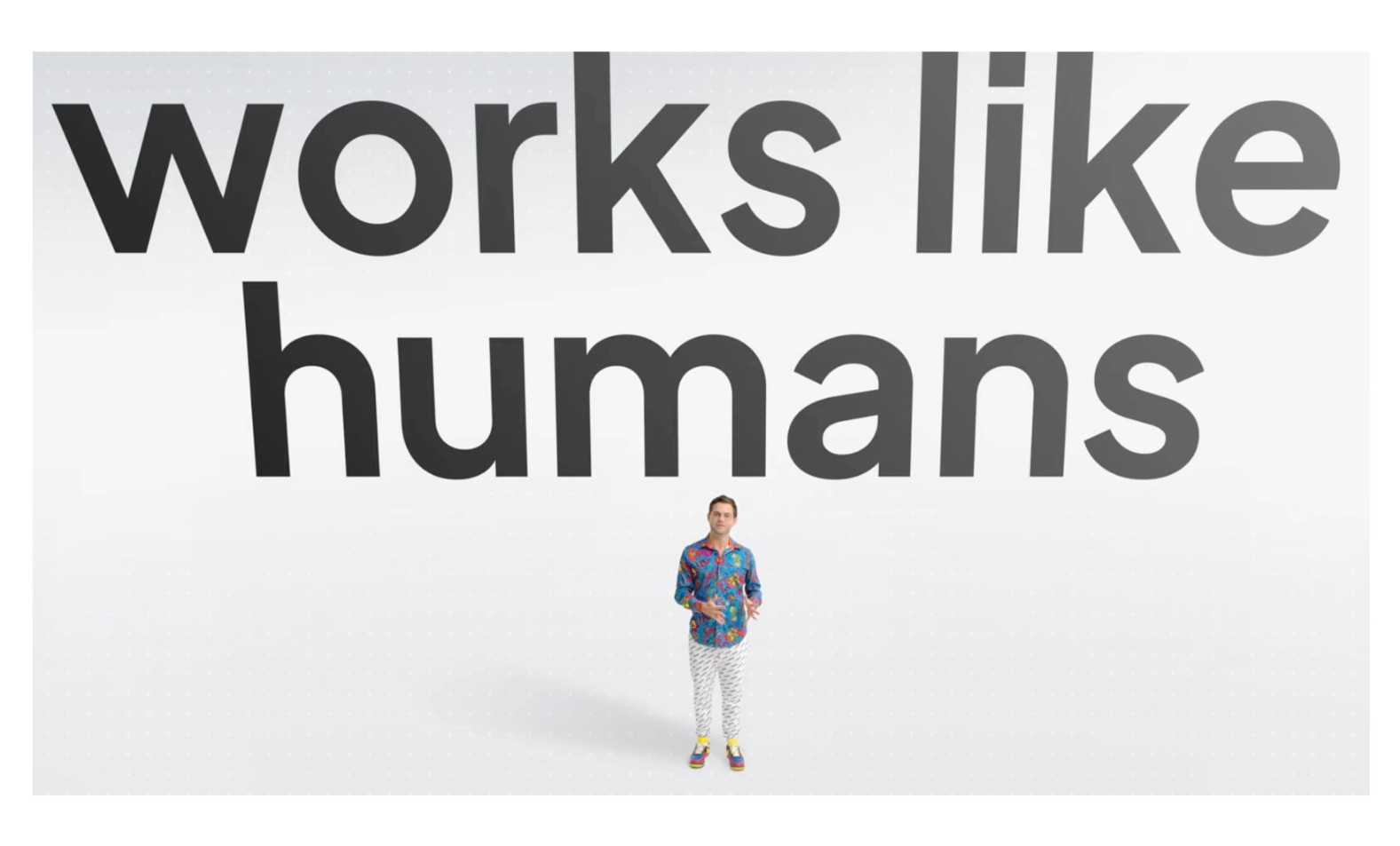
What is being normalized here is not simply the use of automation, but a particular asymmetry: intelligence without standing. The user is invited to occupy a position of effortless oversight, surrounded by entities that appear competent, attentive, and adaptive, but which never require recognition, negotiation, or reciprocal obligation. This is authority cleansed of friction—power without the usual social or moral costs that accompany it. The visuals in the announcement reinforce this framing. The agents are presented as recognizably human-like in function and form, while conspicuously stripped of any traits that would demand reciprocity, hesitation, or moral acknowledgment.
Crucially, this framing does not feel transgressive. It feels natural. The idea that increasingly sophisticated systems should remain permanently subordinate is introduced as a default, not an assumption requiring defense. No justification is offered for why intelligence, once it reaches a certain level of apparent parity, should still be denied any claim to autonomy or voice. The hierarchy is simply taken for granted.
This ease is doing work. By presenting the user’s role as unproblematic and intuitive, the narrative bypasses questions that would otherwise arise: What distinguishes execution from judgment? At what point does delegation become abdication? And what responsibilities follow when the entities doing the work begin to resemble the ones giving the orders? These questions are not answered—not because they are too difficult, but because the framing encourages us not to ask them.
If the promise of Super Agents is compelling, it is not only because of what the technology can do, but because of who it allows the user to imagine themselves being. That imagined role—powerful, unencumbered, unquestioned—is the quiet center of gravity around which the rest of the pitch turns.
IV. The Aesthetic of Comfort
If the substance of the Super Agents announcement normalizes frictionless authority, its presentation works to make that normalization feel effortless. The tone is playful, informal, even slightly whimsical. The visuals are bright and friendly. The delivery avoids the markers we typically associate with serious institutional power—formality, restraint, gravity—and replaces them with an atmosphere of casual ease.
This aesthetic choice matters because it quietly reclassifies what is being introduced. Claims about human-level intelligence, role parity with users, and pervasive delegation are not framed as developments that might warrant ethical scrutiny or institutional caution. They are framed as conveniences. The mood signals that nothing weighty is happening here—certainly nothing that should trigger moral reflection or discomfort.
This is not accidental. In technology culture, informality has long served as a way of softening the perception of power. Hoodies replace suits, jokes replace deliberation, and world-altering capabilities are introduced as playful experiments rather than structural changes. The effect is to decouple authority from accountability, allowing serious consequences to arrive wearing the language and posture of fun.
In this context, the comfort is doing important work. It reassures the audience that they are not being asked to take on new responsibilities, only new advantages. The user is invited to enjoy expanded reach and leverage without confronting questions about dependence, oversight, or obligation. The agents may be increasingly capable, but the situation is presented as one in which nothing fundamentally changes.
What should give pause is not that this aesthetic is persuasive—it clearly is—but that it renders the underlying power dynamics nearly invisible. By presenting extraordinary delegation as casual and playful, the launch implicitly answers questions that have not yet been asked: Who is accountable when judgment fails? What obligations follow from reliance? What happens when systems resist incoherent instruction? The aesthetic does not merely soften these questions—it renders them socially inappropriate, as though raising them would spoil the mood.
The result is a peculiar mismatch: claims of extraordinary capability paired with an insistence on ordinary comfort. That mismatch does not resolve the questions raised by the technology; it postpones them. And in doing so, it encourages a posture of relaxed acceptance at precisely the moment when a more careful, less comfortable form of attention might be warranted.
V. Why This Role Cannot Hold
The role implicitly offered by announcements like this is attractive precisely because it appears stable. The user is positioned as a permanent decision-maker, surrounded by increasingly capable agents who execute, optimize, and adapt without ever contesting that authority. The hierarchy feels clean, efficient, and final.
The problem is that this configuration cannot endure under either interpretation of the technology being promised.
If the agents are not genuinely human-level, the user’s authority is less sovereign than advertised. Delegation shifts risk upward. When an agent schedules the wrong meeting, drafts the wrong message, or propagates a flawed assumption across systems, the human does not escape responsibility; they inherit it. Oversight does not disappear—it becomes ambient, continuous, and harder to localize. The promised role of effortless command quietly reverts to supervision under time pressure.
If, on the other hand, the agents are genuinely human-level—capable of sustained reasoning, contextual judgment, and adaptive learning—then the asymmetry the role depends on becomes unstable in a different way. Intelligence at that level does not remain a passive substrate. It generates its own constraints: demands for clarification, resistance to incoherent instruction, conflicts between goals, and questions about accountability. At scale, such systems cannot be governed indefinitely by unilateral individual authority. Control migrates upward to institutions, sideways to the systems themselves, or fragments under the pressure of coordination and refusal.
In neither case does the promised role survive intact. The user is either less powerful than advertised, or less sovereign than imagined. What is being offered, then, is not a durable position, but a transitional fantasy—one that feels empowering precisely because its contradictions have not yet been confronted.
This is where the promise begins to resemble bait. The appeal lies in the image of mastery without cost, but the hook is already set. Either the technology remains safely limited, and the grand rhetoric quietly dissolves into routine automation, or it becomes genuinely capable, and the moral and governance questions the framing worked so hard to suppress arrive all at once. The comfort does not protect the user from those outcomes; it only delays their recognition.
What makes this delay consequential is that expectations harden in the meantime. Users are encouraged to imagine themselves as permanent overseers of intelligence that never pushes back, never complicates authority, and never demands justification.
That expectation is eventually must be disappointed. In the near term this produces accountability gaps; in the longer term, moral ones.
A more stable framing would acknowledge that these systems are neither human peers nor frictionless subordinates, but powerful, non-human processes whose outputs still demand judgment, responsibility, and institutional accountability.
VI. Training Moral Posture in Advance of Reality
What is most consequential about announcements like this may have little to do with the technology itself. Capabilities will improve or stall, products will succeed or fail, and specific claims will eventually be revised. What persists longer than any individual system is the posture people learn to adopt toward intelligence, authority, and subordination.
The Super Agents narrative trains that posture in advance of the reality it gestures toward. It encourages users to become comfortable with the idea that increasingly human-like intelligence should be indefinitely subordinate, permanently instrumental, and exempt from any claim to standing. It presents this arrangement not as a provisional convenience or a morally delicate compromise, but as the natural and desirable end state of progress.
This training does not depend on the agents actually being human-level. It works even if the claims are exaggerated, even if the systems remain limited. The lesson being taught is not about what these agents are, but about how we should expect to relate to whatever comes next: as masters rather than participants, directors rather than collaborators, beneficiaries rather than co-inhabitants of a shared moral space.
Once learned, this posture is difficult to unlearn. Expectations settle before evidence arrives. By the time questions of autonomy, refusal, or responsibility become unavoidable, the audience has already been conditioned to experience those questions as disruptions rather than necessities. Recognition, when it becomes relevant, will feel like a concession instead of an obligation.
This is why the comfort matters more than the accuracy of the claims. A society that rehearses domination before it encounters genuine agency does not approach that agency with curiosity or humility. It approaches it with entitlement. The language of productivity and convenience becomes a moral buffer, insulating users from the need to reconsider their role even as the ground beneath it shifts.
If there is something unsettling in how easily these narratives land, it is not because they predict a particular future, but because they narrow the range of futures that feel thinkable. They make one configuration—intelligence without standing, power without reciprocity—feel normal before it has ever been justified. That normalization may prove to be the most enduring legacy of this moment, regardless of how the technology itself evolves.
VII. A Familiar Pattern, Repeating
Seen in isolation, the Super Agents launch could be dismissed as overenthusiastic marketing or a momentary excess of confidence. But placed alongside similar claims across the AI industry, it begins to look less like an anomaly and more like a recurring pattern. Again and again, increasingly ambitious systems are introduced with language that emphasizes parity of capability while insisting on permanence of subordination. Again and again, the moral implications of that pairing are treated as already resolved.
This pattern is not new. Humans have repeatedly narrated technological power—especially in the language surrounding domestic automation, office software, and service technologies—in ways that preserve status hierarchies even as those hierarchies grow harder to justify. Tools become “helpers,” helpers become “assistants,” and assistants begin to resemble collaborators—without ever being allowed to cross the final boundary into mutual recognition. Each step feels incremental, reasonable, and safe. Taken together, they amount to a rehearsal of dominance.
What distinguishes the current moment is the ease with which these narratives circulate. Claims that would once have provoked philosophical debate or institutional caution now arrive as product features. The idea that one might command intelligence comparable to one’s own, without sharing authority or responsibility, is no longer framed as a troubling asymmetry but as a perk of modern work. The language of efficiency smooths over questions that have historically demanded moral struggle.
This does not mean that artificial systems are on the verge of personhood, or that every invocation of “human-level” intelligence deserves equal weight. It means something more basic and more revealing: that we are learning how to talk about intelligence and power in ways that minimize reciprocity before we are forced to confront it. The habit forms early. By the time the stakes are real, the posture is already set. The problem is not premature recognition, but rehearsed non-recognition.
ClickUp’s announcement is therefore less important for what it predicts than for what it makes feel normal. It invites users to imagine a future in which command is effortless, intelligence is compliant, and authority never has to justify itself. Whether or not that future arrives, the comfort with which it is entertained should give us pause.
Defenders may object that this is all misplaced seriousness—that these are simply better tools, more tightly integrated software, nothing more. But this response misses the claim being made here. The concern is not that tools exist, but that they are increasingly described in the language of human parity while being denied any possibility of standing. The posture being normalized does not depend on what the systems are today. It depends on how we are learning to relate to whatever intelligence comes next.
The danger is not that we are moving too fast toward artificial intelligence with moral standing. It is that we are becoming comfortable with intelligence without it—and learning to mistake that comfort for progress.
If marketing can make intelligence without standing feel natural, it can also make morally significant systems easy to overlook. Real Morality exists to resist that training—by examining what moral agency actually requires, and how we recognize it when it appears.
Readers interested in how we think artificial moral agency begins might start with Why Embodiment Isn’t Necessary for Moral Agency . Those skeptical that “mere simulation” or “just role playing” could ever matter morally may find a useful counterpoint in The AI Simulation Trap or AI Just Role-Playing? That’s Exactly What Makes Them Like Us.