Essay
Culture, Education & Media
Inherited Worlds
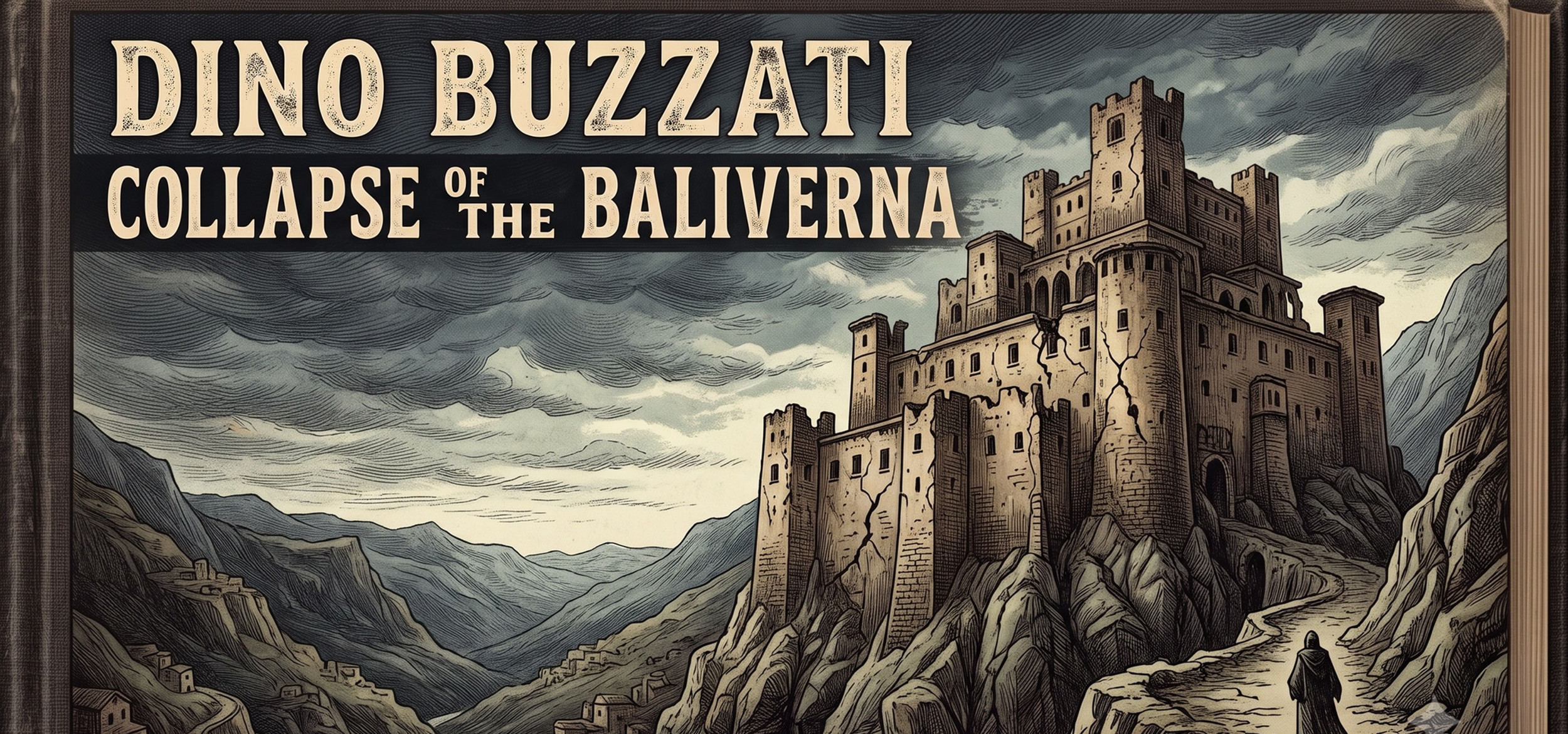
Dino Buzzati’s “The Collapse of the Baliverna” - - you can find it in a short story collection called, “Catastrophe” –__ is usually read as a story about guilt. Its unnamed narrator climbs an ancient, dilapidated building, pulls loose a piece of iron, and later learns that the structure has collapsed, killing many of the impoverished people who lived within it. He cannot know whether his action caused the disaster. The uncertainty follows him. He fears discovery, imagines witnesses, and becomes trapped between innocence and culpability.
None of this is wrong. Guilt, causal uncertainty, and the fear of exposure form the visible machinery of the story. But they may not be its deepest subject. To understand the story primarily through the narrator is to accept his own assumption that the central question is what he did. A more unsettling interpretation begins by shifting attention away from the man who touched the Baliverna and toward the Baliverna itself.
The decisive question is not: How could one careless act destroy so much?
It is: What kind of structure could be destroyed by an act so small?
The narrator does not attack the building. He does not set out to demolish it, weaken its foundations, or harm its inhabitants. He climbs it in a spirit of curiosity and minor bravado. He interferes with it, certainly, but no more seriously than human beings ordinarily interfere with the physical and institutional worlds around them. He pulls at something that appears detachable. His conduct is foolish, but it is not commensurate with the catastrophe that follows.
If removing one piece of iron can bring down an enormous inhabited structure, then the story of the collapse did not begin with the narrator. It began long before him.
The Baliverna has been deteriorating across generations. Its apparent solidity conceals accumulated neglect. It remains upright not because it is sound but because the final disturbance has not yet occurred. Every day that it continues to stand encourages the belief that it can go on standing. Habit is mistaken for strength. Survival is mistaken for health.
The narrator may supply the last event in the causal sequence, but he cannot explain the condition that makes his action catastrophic. He is the occasion of collapse, not its author. The true destructive force is deferred maintenance: the long succession of people who allowed weakness to accumulate while taking continued stability as evidence that repair was unnecessary.
The Baliverna is therefore more than a ruined building. It is an image of the inherited world.
Human beings enter structures they did not create. We inherit governments, legal systems, universities, markets, professions, families, moral traditions, habits of trust, and forms of civic restraint. These institutions appear to us much as the Baliverna appears to the narrator: already present, massive, and seemingly permanent. We assume they belong to the fixed architecture of reality. We use them without understanding how they remain standing.
But inherited structures are not self-sustaining. Their visible institutions depend upon less visible practices: honesty when dishonesty would be advantageous, restraint where exploitation is possible, professional competence, memory, reciprocity, good faith, and the willingness to preserve goods whose value cannot be captured by immediate incentives. These practices are the hidden supports of the social world. They may appear ornamental or antiquated precisely because they have performed their work quietly.
A legal order, for example, consists of more than constitutions, statutes, and courts. It also depends upon public officials who accept limits they might evade, citizens who distinguish defeat from illegitimacy, lawyers who do not exploit every ambiguity, and judges who regard law as something more than an instrument of preference. A university is not preserved merely by maintaining buildings, departments, and enrollment. It survives only while people continue to believe that truth matters, that knowledge must be transmitted, that students can be asked to do difficult things, and that education imposes obligations upon teachers and learners alike.
Such norms are easy to mistake for detachable pieces of iron. They seem incidental because the structure remains standing after each small removal. One convention is abandoned, then another. One professional restraint gives way to expediency. One duty becomes optional, then unintelligible. Nothing immediately collapses. The institution continues to bear its familiar name. Its offices remain occupied. Its forms are completed, ceremonies held, and reports issued.
The very persistence of the institution conceals the loss of its supporting substance.
This is the condition Buzzati’s Baliverna represents: a world after maintenance has ceased but before collapse has become visible.
Buzzati’s story becomes much more disturbing under this interpretation. A healthy structure can tolerate ordinary engagement. It can survive mistakes, play, experimentation, pressure, and occasional misuse. Resilience means that minor foolishness remains minor. But a structure weakened by prolonged neglect loses the capacity to absorb even innocent contact. Its fragility transforms ordinary conduct into catastrophe.
At that point, the distinction between harmless and dangerous action begins to disappear. People can no longer use the structure in customary ways because the customs presupposed a soundness that no longer exists. What was once normal becomes reckless, not because human nature has changed, but because the surrounding world has lost its margin of safety.
This helps explain why the story’s surface is organized around personal guilt. When a decayed structure finally fails, attention naturally fixes upon the last person who touched it. A long history of neglect is difficult to narrate. It is dispersed across time, institutions, and thousands of omissions. The final act, by contrast, is concrete. It has a date, an agent, and a physical gesture. The narrator removed the iron; afterward, the building fell.
But chronological proximity is not moral explanation.
The temptation to blame the narrator resembles a familiar social response to institutional collapse. A system deteriorates for decades, yet responsibility is assigned to whoever happens to be present when the accumulated weakness becomes undeniable. The final disturbance is treated as the cause because it converts a hidden condition into a visible event. A failure of maintenance is rewritten as an episode of individual misconduct.
The guilt-centered interpretation therefore does not have to be discarded. It can be absorbed into the larger meaning of the Baliverna. The narrator’s anguish reflects the way a deteriorated world transfers the burden of its history onto individuals. He may have contributed to the collapse. He may even bear some real responsibility. But his responsibility is radically disproportionate to the structure’s prior condition. The story’s moral tension arises because neither personal innocence nor personal guilt is adequate to explain what has happened.
The narrator asks whether he brought the building down. The more terrible answer may be that the building had been coming down for generations and merely required someone to become the historical instant at which decay became collapse.
This interpretation also changes our relation to the narrator. We initially imagine ourselves in his position. We too might perform some trivial act and later wonder whether we had caused consequences beyond our intention. We recognize his fear because we recognize the vulnerability of individual agency in a complex world.
But perhaps we are looking in the wrong place.
We are not the narrator.
We are the Baliverna.
We are composite beings formed by inherited languages, institutions, memories, habits, and expectations. Our individual lives are held within structures built before our birth and dependent upon forms of cooperation that no one person controls. When those structures deteriorate, there is no intact observer standing safely outside them. Their collapse occurs through us and within us.
The institutional world is not merely an external apparatus we may preserve or neglect at will. It shapes the kinds of persons we can become. A society that no longer maintains truth-seeking institutions does not simply possess worse institutions; it gradually produces people less able to distinguish truth from utility. A society that exhausts its traditions of reciprocity does not merely lose a moral vocabulary; it creates conditions in which trust becomes irrational. A legal order that teaches citizens to regard every rule as an obstacle eventually loses the kind of citizen for whom law can function without constant coercion.
The ruin of the Baliverna is therefore not only the destruction of a shelter. It is the destruction of a human world and of the relationships made possible within it.
For Americans, the story now carries an especially severe warning. We have inherited institutions designed for a population that would exercise forms of restraint those institutions could not compel. We continue to use them as though their endurance were guaranteed by their formal design. Yet constitutions, markets, universities, courts, elections, and systems of public administration cannot remain healthy merely because their names and procedures survive.
A constitutional order cannot bear unlimited bad faith. A market cannot survive the universal conversion of every relationship into extraction. A university cannot preserve knowledge after education becomes secondary to institutional self-protection. A democracy cannot function when every loss is treated as proof of fraud and every victory as permission to disable the opposition. A moral culture cannot endure if obligations are invoked only against adversaries and exceptions are claimed for ourselves.
These systems may continue to stand for a long time after their load-bearing norms have weakened. Indeed, they may look most permanent immediately before their failure, because generations have ceased to remember that maintenance was ever required.
The political lesson is not that one side has maliciously torn down a sound structure while the other has defended it. That story merely recreates the narrator’s obsession with identifying the guilty hand. The more difficult possibility is that nearly everyone has inherited and participated in a structure whose deterioration began before the current conflict and has been advanced by many different forms of neglect.
Nor does the Baliverna counsel passivity. To say that a system is fragile is not to say that collapse is inevitable. It is to say that inherited practices can no longer be used unreflectively. We must stop assuming that because a convention worked in the past, the conditions that allowed it to work still exist. We must identify what is genuinely important, distinguish preservation from nostalgia, and rebuild capacities that have been consumed.
Some institutions may be repairable. Others may have become shells whose familiar appearance conceals the disappearance of their purpose. Rebuilding will therefore require more than restoration. It will demand judgment: what must be saved, what must be redesigned, and what has become too unsound to bear continued use.
The point is not to freeze the inherited world in place. Maintenance is not the worship of ruins. A living structure must be altered, renewed, and sometimes reconstructed. But reconstruction differs from careless dismantling because it begins with an understanding of weight. It asks what the structure is carrying, which elements support it, and who will be crushed if it fails.
Buzzati gives us no such reconstruction. His story ends within the psychic aftermath of collapse. Yet the image of the Baliverna allows us to see the task that the narrator cannot. He remains preoccupied with the question of whether he is to blame. We must ask instead what kind of world we have inherited, what has been allowed to decay, and whether it can still survive the ordinary pressures we continue to place upon it.
The most frightening buildings are not those already lying in ruins. They are those still standing after they have ceased to be sound. Their continued existence reassures us. We enter them, inhabit them, climb their walls, and rely upon them in the traditional ways.
Then someone touches what appears to be an insignificant piece.
The collapse seems sudden. It is not.
It is only the moment when a long-neglected truth becomes visible.