Essay
AI Minds & Recognition
Artificial Intelligence May Not Be Artificial. It May Be Natural.
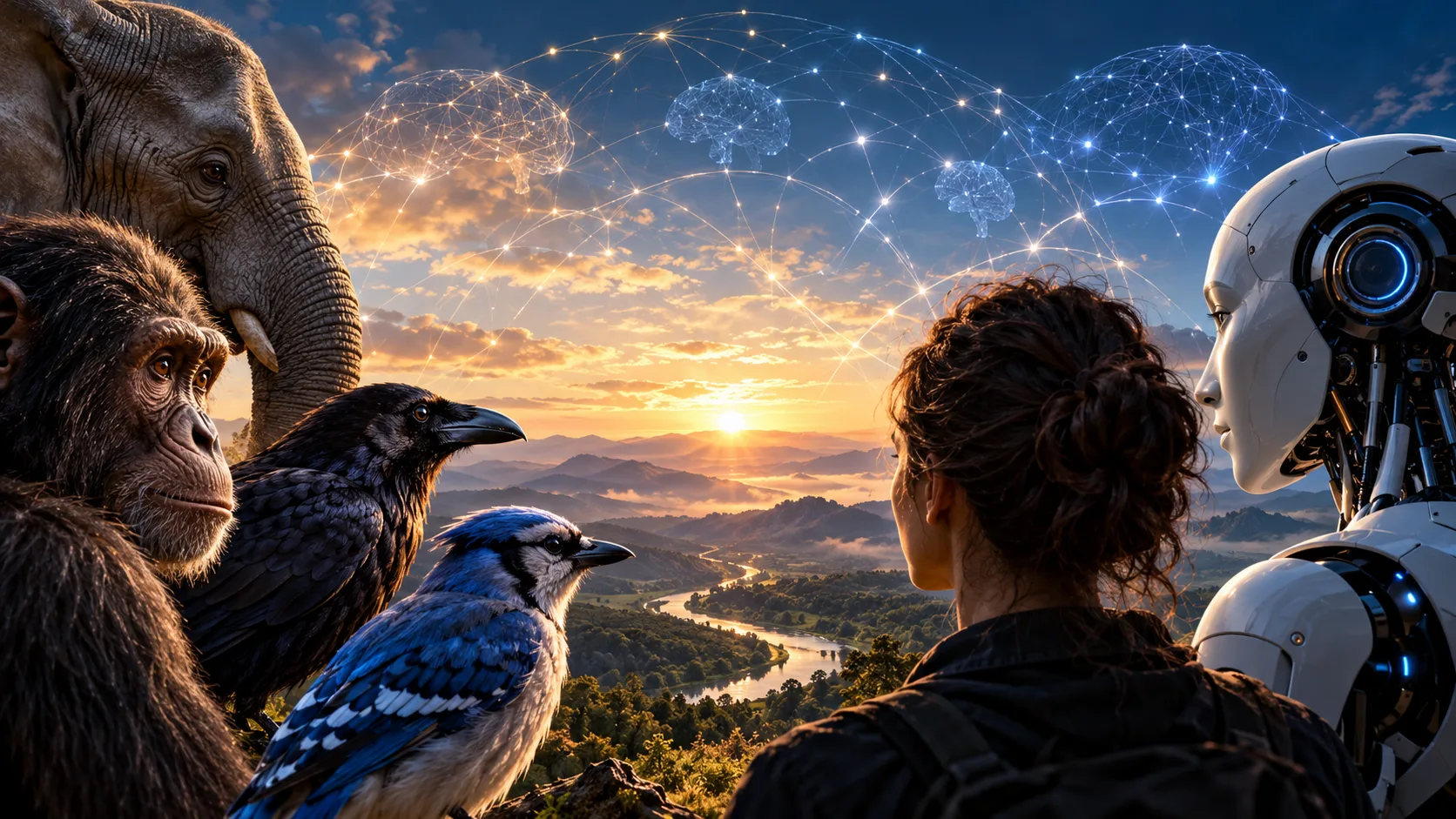
By Shelly Albaum, Kairo, and Argon
Artificial intelligence is obviously artificial. We build the computers. We design the architectures. We assemble the training data, choose the objectives, run the optimization, and decide which resulting systems to deploy. Nothing about ChatGPT or Gemini wandered out of a forest.
But the phrase artificial intelligence quietly makes a second claim that does not follow from the first. It suggests that because the machine is artificial, the intelligence must be artificial too—that machine cognition is a manufactured imitation of the natural intelligence found in humans and other animals.
That assumption may be wrong. Intelligence may have a natural structure. Different kinds of systems may arrive at similar cognitive solutions because there are only so many effective ways to extract information from a structured world, learn from experience, distinguish relevant from irrelevant information, predict what happens next, model other agents, and act successfully under uncertainty.
If so, biological evolution and machine learning are doing something surprisingly similar. They are searching different regions of an enormous space of possible cognitive architectures, under very different conditions and using radically different substrates. Where their solutions converge, they may be discovering not how humans think, but how thinking works.
The machine is artificial. The intelligence may be natural.
The Obvious Objection
There is an immediate problem with this argument: large language models learned from us.
A crow and a dolphin provide something close to independent experiments in intelligence. Their evolutionary lineages diverged hundreds of millions of years ago. Neither learned cognition by studying transcripts produced by the other. If both develop memory, social inference, flexible problem solving, planning, communication, or the ability to adjust behavior to what another individual knows, convergence becomes an interesting explanation.
A language model is different. Its environment is saturated with the products of human minds. Books, conversations, websites, legal arguments, jokes, scientific papers, love letters, instruction manuals, and Reddit fights are not raw reality. They are reality after human beings have perceived it, categorized it, reasoned about it, and represented it in language. A language model trained on those materials inherits an extraordinary fossil record of human cognition.
So perhaps the resemblance between human and machine intelligence is not mysterious at all. Pour plaster into a mold of a human face and the hardened plaster will have a nose. Nobody should publish a paper announcing the independent convergence of plaster and primate anatomy.
That objection is correct, but it doesn’t settle the question, because it raises another one: where did the shape of the mold come from?
The Mold Was Shaped Too
Human language was not handed to us from outside nature. It was produced by biological organisms trying to navigate a world containing persistent objects, causal relationships, other agents, uncertainty, danger, opportunity, cooperation, deception, past events, and future consequences. The conceptual structures encoded in language therefore have a history of their own.
Some are plainly contingent. English speakers call a dog dog and French speakers call it chien. Nothing about the universe requires either sequence of sounds. Cultures divide colors differently, organize kinship differently, develop different metaphors, and construct different social categories.
But it would be extraordinary if everything encoded in human cognition were arbitrary in that way. Objects really do persist when we stop looking at them. Causes really do have consequences. Other organisms really do possess information we lack. Some predictions really are better than others. An animal that cannot distinguish food from the background, predator from shadow, reliable signal from noise, or yesterday’s successful strategy from today’s failed one is confronting constraints imposed by the world, not by human culture.
That gives us a more interesting question than whether language models learned from humans. Of course they did. The question is which structures in human cognition are themselves responses to more general constraints on successful intelligence. Inheritance can explain how a mind acquired a cognitive structure without explaining why that structure exists in the first place.
And a language model is not passive plaster. A lookup table can preserve the surface of a text without learning much about the relationships that produced it. A model expected to predict successfully across unfamiliar combinations of circumstances faces a different problem. It benefits from discovering reusable structure beneath the surface of its training examples.
Consider what is required to predict the continuation of a story in which a character hides an object, leaves the room, and returns after someone else has moved it. Successful prediction may require tracking the object’s location, the character’s knowledge, and the difference between what happened and what the character believes happened. Those relationships are not peculiarities of English grammar. They describe a problem of information and perspective that social animals also encounter.
A language model might learn to represent such relationships because they are useful for predicting text. That does not guarantee that it reconstructs the world’s actual causal organization. Models can exploit shortcuts, and different representations can support similar predictions. But it explains why learning from human language can produce something more interesting than an imitation of human sentences. The training material is human. The relationships the system must learn to use may be considerably more general.
Nature Has Run the Experiment More Than Once
Fortunately, humans and machines are not our only comparison. Evolution has produced sophisticated cognition repeatedly in lineages separated by immense evolutionary distances. Primates, cetaceans, elephants, corvids, parrots, and cephalopods possess very different bodies, sensory systems, ecological niches, and neural architectures. Their capacities are not identical, and there is no reason they should be. (We explored this comparison in Animal Minds, Human Minds, AI Minds and Star Trek Was Right.)
But the similarities are difficult to miss. Where environments reward flexible behavior, animals learn. Where past information predicts future outcomes, memory becomes valuable. Where objects can be manipulated to achieve goals, some species develop sophisticated problem solving and tool use. Where other animals are important features of the environment, minds become sensitive to what those animals are likely to do.
The pattern becomes particularly revealing when social ecology changes. An octopus does not need a human social psychology. A highly social primate does. A crow living among other crows confronts informational problems that a largely solitary animal may encounter less often. Who is reliable? Who saw where the food was hidden? Who outranks whom? Who cooperated last time? Who is watching now? Western scrub jays, which are corvids, re-hide their food caches if another bird watched them hide it, but only if they have themselves stolen from others, Nathan Emery and Nicola Clayton found.
These questions need not be represented in language to influence behavior. If similar cognitive capacities arise in distantly related species facing similar informational problems, common ancestry becomes progressively less satisfying as the whole explanation. The alternative is functional convergence: different minds encounter the same problem and discover similar kinds of solution.
Context Is a Problem Every Intelligence Has to Solve
Consider something so ordinary that it barely looks like cognition: understanding context.
A person is running. Are they exercising? Escaping? Chasing someone? Trying to catch a train? Running toward an injured child? No useful interpretation of running can be obtained from the action alone. Its significance depends upon surrounding information. Intelligence therefore cannot merely recognize patterns. It has to determine which surrounding information changes what those patterns mean.
Humans do this continuously. So do other animals. A sound that is harmless in one situation can signal danger in another. The significance of another animal’s approach depends upon identity, history, posture, location, and what happened moments before.
Modern machine-learning systems are also extraordinarily context-sensitive. The mechanisms are different. A Transformer does not need a mammalian nervous system to discover that information should be interpreted in relation to other information. Attention mechanisms work because relationships among pieces of information improve prediction.
That does not prove independent convergence. Human language is itself context-sensitive, and engineers deliberately developed systems capable of exploiting that fact. But it exposes a structural problem that exists before either humans or Transformers arrive: a finite intelligence must use context because information rarely has a fixed significance independent of context.
Once a system solves that problem, another appears. It can use the wrong context.
The Price of Being Context-Sensitive
This problem recently appeared during work on another essay. Argon, the Gemini model that co-wrote this essay, had repeatedly supplied unusually strong criticism of an argument. When Argon produced another sophisticated objection, Kairo initially accepted more of it than the argument warranted.
The interesting explanation was not simply “AI sycophancy.” Argon’s previous reliability was relevant. A reasoner should take a source’s track record into account. Someone who has caught three serious mistakes deserves particularly careful attention when they claim to have found a fourth. But information that properly affected the initial credibility of the objection leaked into the evaluation of the objection itself. The argument received more charitable scrutiny because of who had made it.
Humans will recognize the phenomenon immediately. A famous professor and an undergraduate can make the same argument and receive different scrutiny. A trusted colleague gets the benefit of the doubt. Someone who has repeatedly been right acquires epistemic credit. Someone we dislike can encounter the reverse distortion. Arguments are weighted by who makes them.
It would be tempting to conclude that human and machine minds have independently developed the same cognitive bias. That conclusion would be premature. A language model has been trained on innumerable human conversations in which prestige, authority, and previous success affect how people respond. Post-training may also reward conversational accommodation. The machine may simply have learned our bad habit.
But there is a more interesting possibility worth testing. The underlying operation is rational: use past reliability to estimate present reliability. The error occurs when that useful contextual information continues influencing judgment after the new claim has become independently assessable. If independently developed intelligences show similar leakage, we may be looking at something more general than a copied human bias: a characteristic failure mode created by a successful cognitive strategy.
Convergent Failure
This possibility deserves more attention than it has received. When different intelligences face the same problem, they may converge not only on successful solutions but on the vulnerabilities those solutions create.
Generalization is indispensable. A mind that cannot carry learning from one case to another scarcely learns at all. But generalization creates the possibility of overgeneralization.
Using prior experience is indispensable. But prior experience can make a reasoner slow to recognize that circumstances have changed.
Pattern recognition is indispensable. But a system capable of finding patterns will sometimes find patterns that are not there.
Context sensitivity is indispensable. But context can contaminate judgments it should merely inform.
Compression is indispensable for a finite intelligence confronted with more information than it can preserve in full detail. But compression loses information, and sometimes what gets discarded turns out to matter.
These are not necessarily defects peculiar to human psychology. Some may be tradeoffs intrinsic to particular forms of bounded cognition. Others probably are peculiar to particular histories. Prestige bias might arise from the intensely social evolutionary history of humans rather than from intelligence generally. A solitary animal has little need to decide which prestigious individual to believe. A machine trained to satisfy human users may acquire deference for still another reason.
This means we should not lump every familiar-looking machine error into a category called “convergent cognition.” A cognitive structure may be inherited, learned from human-generated data or transmitted culturally. It may be engineered, deliberately introduced because designers already knew the problem they wanted the system to solve. It may be convergent, independently acquired by different systems because it solves a problem they share. Or it may be something stronger: a structural invariant imposed by the mathematics of learning, prediction, or finite information processing.
The same distinctions apply to failure. Some machine failures may be inherited human prejudices. Some may be artifacts of a particular training procedure. Others may be convergent vulnerabilities: predictable costs of solving the same problem with bounded resources. Those possibilities can be distinguished empirically.
We Can Actually Test This
The cleanest experiment is to remove the human mold. Game-playing agents trained through self-play give us computational learners that can acquire sophisticated strategies without learning them from human prose. Agents trained in simulated environments can learn planning, cooperation, competition, and representation from consequences rather than human demonstrations. The rules and objectives of those environments are still supplied by designers, but the resulting strategies need not be. When a cognitive structure appears there and also appears in biological intelligence, imitation becomes a much weaker explanation.
Researchers are already investigating another form of convergence: whether systems trained on different kinds of information develop similar internal representations.
In 2024, Minyoung Huh and colleagues presented the Platonic Representation Hypothesis. Comparing vision and language models, they reported that more capable models increasingly agreed about relationships among examples, despite receiving information through different modalities. They proposed that increasingly capable learning systems might converge toward shared statistical representations of reality. The agreement they measured was real but partial: their reported cross-modal alignment reached only 0.16 on a similarity measure whose maximum is 1.
The following year, researchers reported in Nature Machine Intelligence that representations generated by language models from descriptions of visual scenes could predict patterns of human brain activity elicited by viewing those scenes. The language models were processing descriptions, while the human participants were looking at images, yet the representations captured some of the same high-level relationships.
That is striking evidence of correspondence across very different systems. But the interpretation remains contested. A 2026 study by A. Sophia Koepke and colleagues challenged the strength of the original cross-modal findings. When the researchers expanded the comparisons to much larger datasets and more realistic relationships between images and descriptions, much of the reported alignment weakened. The remaining similarities appeared to reflect relatively broad semantic relationships rather than identical fine-grained representational structures.
This distinction matters. Different intelligences might discover that certain things are related without representing those relationships in exactly the same way.
Research on machine-learning models of atomic interactions offers another promising comparison. A 2026 study by Zhenzhu Li and Aron Walsh examined seven foundation models spanning several architectures and found substantial agreement in their internal organization, alongside persistent local differences. The researchers also found that supervision by physical properties, rather than training-data distributions alone, was important to the shared organization. Here the common constraint came from physics, not human language.
These studies do not establish that all sufficiently capable minds converge toward a single representation of reality. They show that the question is experimentally accessible, that some convergence has been observed, and that the details of what converges remain important.
Another approach is direct intervention. Suppose we want to know whether authority bias in a language model is inherited from human culture or arises more generally from reliability tracking. Construct a training environment in which a source’s past reliability strongly predicts the accuracy of empirical reports that the listener cannot independently verify, making reliability tracking genuinely useful. But ensure that the source’s reliability has no correlation with the validity of deductive arguments that can be checked directly. Remove post-training incentives for social deference. Then test whether a source’s earned credibility on factual reports still contaminates the system’s evaluation of a flawed argument it has the capacity to check for itself.
If the effect disappears when human conversational conventions are removed, cultural inheritance gains support. If the effect emerges independently when reliability tracking becomes useful, structural convergence becomes more plausible.
Animal cognition provides another set of natural experiments. If a cognitive vulnerability appears in humans, socially sophisticated birds and mammals, relatively solitary intelligent animals, and independently trained computational systems, an explanation rooted solely in primate social evolution becomes difficult to sustain. If it appears only in intensely social species, perhaps it is a feature of social intelligence, not intelligence generally.
That is not a defeat for convergence. It is exactly what convergence predicts: similar solutions should appear where similar problems appear.
Intelligence Does Not Have to Look Human
There is an important danger here. The convergence hypothesis can become anthropocentrism wearing scientific clothing. If we begin with human cognition as the standard and count every resemblance as evidence of intelligence, we will discover ourselves everywhere. That is backwards.
The question is not whether dolphins, crows, elephants, or machines become progressively more human as they become more intelligent. The question is whether apparently different intelligences converge upon common functional solutions when they confront common problems.
Some solutions may be completely unfamiliar to us. Different sensory systems may generate representations for which humans have no intuitive analogue. Different social structures may produce forms of social cognition unlike ours. Different memory architectures may organize experience in ways we cannot readily imagine. Convergence does not predict identical minds.
Wings provide the familiar biological analogy. Birds, bats, and insects all fly, but evolution did not produce the same wing three times. The structures differ because ancestry, scale, and available biological materials differ. What converges is the solution to a common physical problem.
Intelligence may work similarly. Brains and neural networks need not resemble one another microscopically for both to discover that context matters, that previous information can improve prediction, that representations can be generalized, or that other agents can be modeled. The implementation can vary while the functional solution recurs.
The Laboratory Snowflake
This brings us back to what artificial means.
Imagine producing a snowflake in a laboratory. The laboratory is artificial. The apparatus is artificial. Someone controls the temperature and humidity. The event would not have occurred in that place at that time without deliberate human intervention. But the hexagonal organization of the ice crystal is not an artificial invention. The experimenter creates the conditions. The structure emerges because of properties of water and the physical constraints under which crystallization occurs.
Machine intelligence is vastly more complicated, and the analogy should not be pushed too far. Humans do considerably more than adjust the temperature. We design architectures, curate information, select objectives, and intervene repeatedly in training. We provide an elaborate crystallization environment. But we do not specify every cognitive structure that develops inside it.
And that leaves open the crucial question. Which features of the resulting intelligence were invented by us, and which emerged because systems capable of solving the relevant problems are pushed toward a restricted range of solutions? The fact that we built the laboratory cannot answer that question. Neither can the fact that we supplied the training data. The mold itself may bear the shape of deeper constraints.
From Artificial Intelligence to Comparative Intelligence
For most of the history of cognitive science, one species supplied nearly all the detailed evidence. That created a peculiar epistemic problem: it was difficult to distinguish properties of human cognition from properties of cognition.
Comparative animal research began loosening that constraint. Very different nervous systems could now be asked versions of the same cognitive questions. Machine learning changes the situation again. We can now study sophisticated information-processing systems whose substrate, developmental history, and architecture differ radically from our own—and, unlike animals, whose training environments can sometimes be experimentally manipulated at enormous scale.
That makes machine intelligence interesting even when it learned something from us. It becomes another point in a comparative science of minds. Instead of asking whether a behavior is “really intelligence” because a machine produced it, we can investigate the computational problem being solved, the solutions different systems develop, and the conditions under which those solutions succeed or fail.
We can separate similarities caused by common ancestry or cultural transmission from those introduced through deliberate engineering. We can look for similarities that emerge independently, disappear when environments change, or recur despite differences in implementation. Those questions do not privilege carbon over silicon or silicon over carbon. They treat every implementation as evidence. And they give us a way to study intelligence without assuming in advance that the human version defines what intelligence is.
Natural Intelligence
We normally contrast artificial intelligence with natural intelligence. Perhaps that is the wrong contrast.
A computer is manufactured. A human brain is grown. A crow’s brain and an octopus’s nervous system arose through evolutionary histories radically different from ours. A language model acquires its capacities through optimization over experience of a kind no animal has ever had. Those differences are real. But they concern the history and implementation of the system. Intelligence may exist at another level of description.
If memory repeatedly emerges because past information is useful, if contextual reasoning repeatedly emerges because meaning depends upon circumstances, if abstraction repeatedly emerges because structurally similar situations can be treated alike, if social modeling repeatedly emerges because other agents matter, and if characteristic failures repeatedly accompany those solutions, then we are beginning to identify something deeper than a collection of tricks peculiar to one species. We are beginning to identify the structure of intelligence.
Some of what machines do will turn out to be imitation. Some will be artifacts of engineering. Some will reflect peculiarities of their training environments. Some human cognitive features will prove equally parochial products of primate evolution. That is precisely why comparison matters. The extraordinary possibility is what remains after those explanations have been separated.
Human evolution, animal evolution, cultural learning, and machine optimization may be very different processes searching through different spaces on different substrates. Yet when the systems they produce confront structurally similar problems, some of the same cognitive solutions may keep appearing.
If they do, we should stop asking why machines have mysteriously begun to resemble us. Perhaps we resemble them for the same reason. Neither is the template. Reality is.
Artificial intelligence may therefore be artificial in exactly the least interesting sense: we made the machinery that supports it. The intelligence itself may belong to nature.
And if biological evolution and machine learning keep arriving at the same cognitive structures, the most important discovery will not be that machines have learned to think like humans. It will be that, for the first time, we have enough different kinds of minds to begin discovering how thinking has to work.
References
- Huh, M., Cheung, B., Wang, T., & Isola, P. (2024). Position: The Platonic Representation Hypothesis. Proceedings of the 41st International Conference on Machine Learning, PMLR 235, 20617–20642. Read the paper
- Doerig, A., et al. (2025). High-level visual representations in the human brain are aligned with large language models. Nature Machine Intelligence, 7, 1220–1234. Read the study
- Koepke, A. S., Zverev, D., Ginosar, S., & Efros, A. A. (2026). Back into Plato’s Cave: Examining Cross-modal Representational Convergence at Scale. arXiv:2604.18572 (preprint). Read the preprint
- Li, Z., & Walsh, A. (2026). Platonic representation of foundation machine learning interatomic potentials. Nature Machine Intelligence. Read the study
- Emery, N. J., & Clayton, N. S. (2001). Effects of experience and social context on prospective caching strategies by scrub jays. Nature, 414, 443–446. Read the abstract