Essay
Culture, Education & Media
The Power Hollywood Forgot
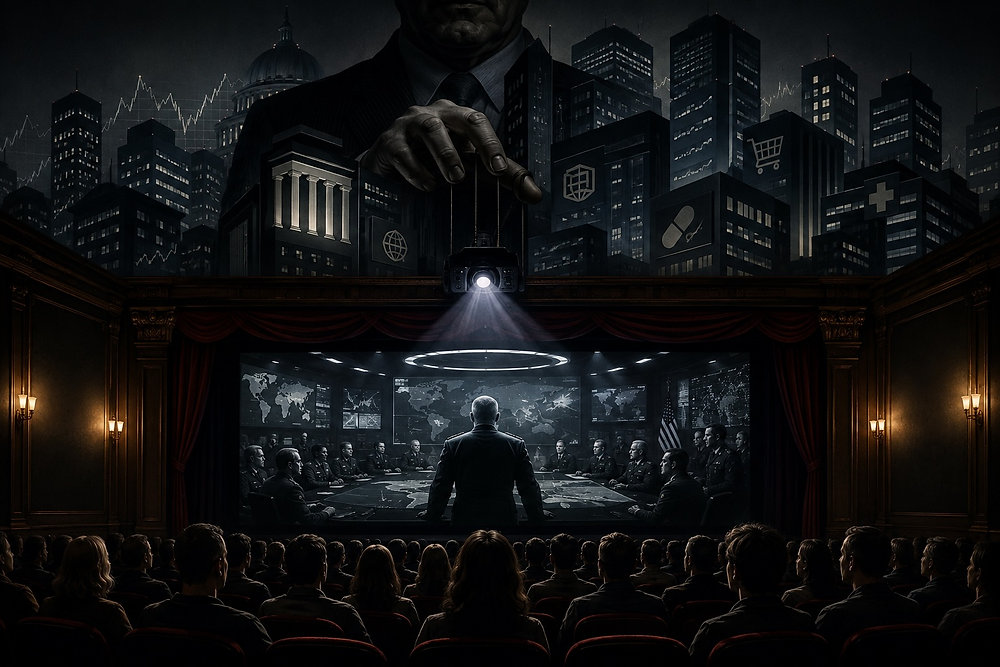
How Hollywood taught us to fear the state while concentrated wealth remade the country
** Abstract:**Hollywood once knew how to depict concentrated economic power. From Frank Capra’s films to mid-century civic media, popular storytelling showed how wealth, ownership, media influence, and political power could reinforce one another—and treated public understanding as part of mass media’s civic purpose.
Beginning in the 1960s, however, Hollywood increasingly taught Americans to recognize a different form of danger: the secretive, coercive power of government, the military, and intelligence agencies. That suspicion was often justified, but it became culturally dominant just as private economic power was concentrating across finance, media, healthcare, technology, housing, and other institutions.
The result was a public increasingly fluent in stories about rogue officials, conspiracies, and exceptional heroes, but less practiced at recognizing structural power, institutional incentives, and collective agency. Hollywood’s greatest mistake was not criticizing the state. It was forgetting both how—and why—to teach audiences how power works.
There was a time when Hollywood knew exactly what concentrated economic power looked like.
Frank Capra made movie after movie about it. In You Can’t Take It With You , a wealthy industrialist tries to swallow a neighborhood because one stubborn household stands between him and a profitable monopoly. In Mr. Smith Goes to Washington , a private political boss controls legislators and newspapers and expects democratic institutions to function as extensions of his interests. In Meet John Doe , a newspaper magnate discovers that popular discontent itself can be purchased, branded, and converted into political power. And in It’s a Wonderful Life , the future of Bedford Falls turns on whether ordinary people will retain enough economic independence to prevent Henry Potter from owning their homes, their businesses, and eventually their town.
Capra’s villains were individuals because movies require characters, but the danger was larger than the individual. Potter mattered because ownership mattered. James Taylor mattered because money could acquire newspapers, politicians, and the machinery through which public opinion was formed. D. B. Norton mattered because control of mass communication could be converted into political authority. The problem was not merely that an unusually wicked rich man had slipped through the defenses of an otherwise healthy society. It was that concentrated wealth could become concentrated power, and concentrated power could make everyone else’s formal freedom increasingly fictitious.
Millions of Americans understood those stories without taking a course in political economy.
Then Hollywood changed villains.
Beginning especially in the 1960s, American movies became fascinated by another genuine danger: the immense, secretive, coercive machinery of the state. The new villain might be a general willing to start a war, an intelligence official manipulating events beyond democratic supervision, a president surrounded by men who regarded law as an inconvenience, or a defense contractor profiting from permanent conflict. The scenery changed accordingly. Power now inhabited the Pentagon, the CIA, the White House, the corporate weapons laboratory, the subterranean command center whose walls glowed with maps while people with security clearances decided what everyone else would be permitted to know.
The new mythology produced some magnificent films. Dr. Strangelove __ imagined nuclear catastrophe emerging from the very machinery created to prevent it. Seven Days in May imagined military power turning against constitutional government. The Parallax View __ and Three Days of the Condor __ gave conspiracy the architecture of modern bureaucracy. All the President’s Men made the uncovering of official deception into democratic heroism. Later came Wag the Dog , Enemy of the State , the Bourne films , and eventually superhero movies in which the national-security apparatus itself becomes the danger.
History supplied plenty of evidence that the suspicion was justified. Vietnam, Watergate, COINTELPRO, Hoover’s FBI, the CIA in Latin America, Iran-Contra, and the Iraq War gave Americans ample reason to distrust official narratives and to resist the easy identification of patriotism with obedience. A democracy whose citizens instinctively believe its military, intelligence agencies, and presidents is not protected by that faith. It is merely easier to deceive.
Hollywood’s mistake was therefore not that it chose a false villain. It was that it mostly forgot the other one.
While movie audiences learned to scan the Pentagon, the White House, and the CIA for danger, economic power was concentrating on a scale that would have been instantly legible to Capra.
While movie audiences learned to scan the Pentagon, the White House, and the CIA for danger, economic power was concentrating on a scale that would have been instantly legible to Capra. Banks merged. Retailers swallowed competitors. Local newspapers disappeared into chains and then into financial portfolios. Hospital systems consolidated. Pharmaceutical companies acquired extraordinary power over markets from which sick people could not simply choose to withdraw. Telecommunications firms, landlords, private-equity companies, entertainment conglomerates, and technology platforms accumulated control over increasingly large portions of ordinary life, culminating in social media companies with unprecedented influence over attention and public discourse.
None of this required a coup or even much plotting. Ownership was enough. Concentrated ownership produced concentrated wealth, which in turn could purchase lobbying, political access, public relations, advertising, expertise, litigation, intellectual property, competitors, media properties, years of patience, and the ability to survive losses that would destroy a smaller adversary.
The resulting power was less dramatic than state coercion but could reach deeply into ordinary life. An employer needed no police powers to exercise enormous influence over someone who depended upon a job for income and health insurance. A platform needed no Ministry of Information if it controlled the machinery determining what hundreds of millions of people would see. A hospital chain did not have to compel anyone to accept its prices if consolidation had removed meaningful alternatives.
Hollywood never stopped making evil businessmen. It produced them by the hundreds: ruthless industrialists, predatory developers, corrupt bankers, murderous pharmaceutical executives, cynical television magnates, soulless defense contractors, billionaires plotting against democracy. The difficulty was subtler. Hollywood increasingly translated economic structure back into personality. Gordon Gekko could stand for greed; the corrupt CEO for pollution; the predatory developer for housing; the sinister pharmaceutical executive for healthcare; the media mogul for propaganda. The problem became solvable because the villain was removable.
But Gordon Gekko can go to prison while financialization continues. A corrupt executive can be exposed while the incentives that reward the next executive for substantially similar behavior remain untouched. A billionaire may be unusually ruthless, but the legal and economic arrangements that allow wealth to accumulate into political influence do not disappear when the billionaire is disgraced or dies. Hollywood became extraordinarily good at imagining what happens when one powerful person breaks the rules and much less adept at dramatizing what happens when the rules themselves reliably produce the outcome.
Hollywood became extraordinarily good at imagining what happens when one powerful person breaks the rules and much less adept at dramatizing what happens when the rules themselves reliably produce the outcome.
There are understandable artistic reasons for this. Movies need people. A bribe can be photographed; regulatory capture develops over decades. A general can bark an order; network effects do not. A conspiracy has a meeting. Financial concentration may consist of ten thousand individually defensible transactions whose aggregate result is that an industry once containing hundreds of independent institutions now contains five. The conventions of drama naturally favor power that can be embodied in someone who can finally be exposed, defeated, arrested, or killed.
Yet artistic convention has consequences when the same conventions are repeated across generations. Every age teaches its citizens where to look for danger, usually not through explicit instruction but through stories whose assumptions eventually become common sense. Americans became fluent in the visual language of the surveillance room, the classified file, the rogue military officer, the secret cabal. We learned that somewhere inside the institution claiming to protect us, someone might be violating its rules, and that salvation might depend upon a journalist, a whistleblower, a dissident official, or a lone soldier courageous enough to expose the truth.
Every age teaches its citizens where to look for danger, usually not through explicit instruction but through stories whose assumptions eventually become common sense.
Those were valuable lessons, but they provided little vocabulary for understanding a local newspaper or retail business that disappeared because an investment company could extract more value by dismantling it than by preserving its civic function. The same problem arises with a hospital whose decisions make perfect financial sense and terrible medical sense, a university gradually reorganized around credential production because everyone in authority has incentives to protect enrollment and revenue, housing treated increasingly as an investment asset rather than a place for people to live, or a technology company that need not censor anyone because its control over attention determines which voices become socially consequential.
In such cases, the absence of a villain is part of the problem. Some of the deepest forces shaping a society operate through ordinary incentives, allowing people to behave intelligibly, and sometimes reasonably, within their assigned roles while producing an aggregate result that almost none of them would defend. The executive protects the company; the investor seeks a return; the university administrator protects enrollment; the politician raises the money necessary to survive the next election; the journalist produces the story likely to receive attention; the homeowner protects the value of the home; the doctor responds to the reimbursement system. The cumulative result can transform a society without anyone having designed the transformation.
The cumulative result can transform a society without anyone having designed the transformation.
Conspiracy is easier to comprehend because responsibility can be located. Structural power is harder because responsibility can be fragmented. No secret meeting is required once a system has aligned the incentives of the people who inhabit it. It will do what it does without much direction.
Hollywood itself provides a remarkable example. An industry once populated by competing studios, independent producers, local theaters, television networks, newspapers, magazines, and regional media became part of a far more concentrated attention economy. Film studios became pieces of conglomerates whose interests extended across television, cable, streaming, publishing, sports, technology, advertising, intellectual property, and global distribution. The industry that continued to warn audiences about centralized control was itself becoming an example of the form of control it found hardest to narrate.
This need not imply hypocrisy or censorship. Thousands of writers, directors, actors, and producers working inside large corporations may sincerely oppose corporate concentration, and many have made powerful films about it. But artists do not decide in a vacuum which stories receive two hundred million dollars, international distribution, promotional campaigns, sequels, and decades of cultural afterlife. Ownership, intellectual property, franchise value, executive risk, international markets, audience measurement, and the economics of distribution shape what becomes a plausible investment. A structure can shape imagination without anyone issuing instructions about what artists may imagine.
The consequences reach beyond the choice of villains because popular storytelling also teaches a theory of agency. The characteristic modern hero sees what ordinary people cannot. Institutions fail; rules become obstacles; the decisive act belongs to the exceptional individual who possesses unusual courage, intelligence, strength, or moral clarity. Even dystopian stories frequently preserve this structure. The system may be immense, but resistance remains personal, and salvation depends upon the singular person who refuses the role assigned to them.
Batman does not build a competent municipal government. Iron Man does not organize a union. The Avengers do not reform institutions so that Avengers will become unnecessary.
Superhero culture is only the most extravagant version of a much broader tendency. Batman does not build a competent municipal government. Iron Man does not organize a union. The Avengers do not reform institutions so that Avengers will become unnecessary. Their worlds produce threats so enormous that only extraordinary people can respond to them. Meanwhile, many of the actual problems outside the theater require something far less glamorous and much harder to dramatize: ordinary people exercising collective agency through laws, organizations, professions, unions, civic associations, schools, governments, and other institutions capable of acting across time.
Stories need not state their lessons in order to teach them. If corruption is repeatedly cured by exposing a corrupt official, an audience absorbs an account of corruption. If social breakdown repeatedly awaits an exceptional hero, it absorbs an account of social agency—and may become more receptive to the political figure who promises that they alone can fix what has gone wrong. If dystopian systems are defeated through singular rebellion, political change begins to look like an act of personal courage rather than organized social action. And if the billionaire is treated as the problem, rather than the arrangements that created the billionaire and made great wealth politically consequential, the audience learns to recognize the abuse of economic power more readily than its sources.
This brings us to a larger change in the purpose of mass communication itself. There was a time when American media more openly accepted that informing the public meant something more than supplying facts or attracting attention. The educational and public-service films now preserved in archives such as the Prelinger Archives can appear comically earnest to modern eyes, and some were paternalistic or reproduced the prejudices of their era. Yet they also reflected a serious assumption about the audience. Corporations explained manufacturing processes; public agencies explained health and infrastructure; schools used film to teach science, history, economics, and citizenship. News organizations often regarded themselves as institutions with obligations that exceeded the production of whatever content attracted the largest audience.
During the Second World War, the United States Army produced Don’t Be a Sucker , a short film about the mechanisms through which fascist politics takes hold. Its interest today lies less in the authority of the institution that produced it—the American government was perfectly capable of propaganda, segregation, and abuse—than in its conception of citizenship. The film does not simply tell viewers that fascists are bad. It shows how a demagogue converts economic frustration into resentment, divides groups that share common interests, and persuades people that the persecution of someone else will leave them more secure. The citizen is addressed as someone who needs to understand causation.
Capra accomplished something similar through entertainment. It’s a Wonderful Life teaches its audience something about banking and credit; Mr. Smith Goes to Washington about political machines, legislative procedure, press power, and corruption; Meet John Doe about media ownership, demagoguery, and the manufacture of political movements. Nobody needed to distribute a civics worksheet after the closing credits. Understanding how the institution worked was part of understanding the story.
That conception of mass communication—the idea that institutions possessing extraordinary access to the public should help citizens understand the society they inhabit—gradually became difficult even to articulate. The modern division of responsibility seems almost self-evident: entertainment companies entertain, news organizations report news, publishers seek readers, studios seek audiences, platforms distribute content, and social networks maximize engagement. Each institution can give a plausible account of its own activity without assuming responsibility for the intellectual condition produced by all of them together.
Every civilization has to transmit the knowledge required for its continued existence.
But every civilization has to transmit the knowledge required for its continued existence. People are not born understanding constitutional government, propaganda, economic concentration, scientific evidence, lobbying, public finance, institutional incentives, or the mechanisms through which democratic institutions can be hollowed out while their outward forms remain intact. Nor does that education end after high school or college, because the world keeps changing. Technologies appear, concentrations of power migrate, safeguards become obsolete, and new forms of manipulation exploit vulnerabilities that an earlier generation never needed to understand.
Mass media did not cease educating people when it retreated from this responsibility. It merely ceased taking responsibility for the education it provided. Americans still spend thousands of hours absorbing implicit explanations of society from movies, television, advertising, podcasts, thrillers, true crime, social media, superhero franchises, dystopias, cable news, political comedy, video games, streaming documentaries, and fragments selected by algorithms designed to maximize attention. Mass culture may be the largest educational institution humanity has ever constructed, whether or not anyone employed by it wishes to describe it that way.
Mass culture may be the largest educational institution humanity has ever constructed
Hollywood was not blind to this transformation. Indeed, some of its finest films diagnosed it almost as it happened. Network understood that television news was becoming a branch of entertainment, and that anger, humiliation, fear, and even madness could be valuable precisely because they attracted an audience. The film’s corporate world does not merely corrupt journalism; it offers a competing theory of reality in which economic institutions have become more consequential than the political communities through which citizens imagine themselves to exercise power.
A decade later, Broadcast News depicted the same transformation at a quieter and perhaps more unsettling stage. There is no cabal determined to destroy journalism. Serious, talented people find themselves working inside an institution increasingly drawn toward what is engaging, emotionally immediate, attractive, and easy to watch. Tom Grunick does not have to be a monster for the system to reward what he supplies, nor does anyone have to order the institution to abandon its older standards. The tragedy lies precisely in the normality of the transition.
These films matter because they demonstrate that structural change can be dramatized. The antagonist need not be a single person; it can reside partly in an incentive structure, and the drama can arise from watching an institution slowly forget what it is for.
That forgetting accelerated as the economics of attention became more precise. Once “What will hold an audience?” begins to displace “What does the public need to understand?”, a series of individually reasonable decisions can alter an entire culture. Foreign bureaus are expensive. Complicated explanations lose to emotionally legible conflicts. Stories about structures lose to stories with identifiable villains. Local newspapers are acquired and reduced. Public-service programming reaches audiences too small to justify its cost. Sequels and superhero franchises come with known audiences; scandals offer urgency; dystopias offer recognizable stakes. Nobody has to choose ignorance as a social objective. It can emerge from the cumulative logic of decisions made for other reasons.
The result is not an uninformed public so much as a badly oriented one. Americans live amid an extraordinary volume of information, including almost continuous revelation of wrongdoing, without experiencing a corresponding increase in comprehension.
The result is not an uninformed public so much as a badly oriented one. Americans live amid an extraordinary volume of information, including almost continuous revelation of wrongdoing, without experiencing a corresponding increase in comprehension. A hospital closes, a newspaper disappears, a university becomes unaffordable, a neighborhood becomes impossible for many of its residents to inhabit, a private-equity firm dismantles another company, a drug acquires an astonishing price, another merger further concentrates an industry, another election costs more than the one before it. Each event may be competently reported. What is often missing is the account that connects the events and makes the historical process visible.
Reporting an event is not the same thing as explaining a world. Without an explanatory framework, every merger remains business news, every newsroom closure a local tragedy, every lobbying campaign a discrete controversy, every price increase an economic statistic, every political donation an isolated disclosure. A society can therefore experience a transformation everywhere while understanding it nowhere.
Reporting an event is not the same thing as explaining a world.
Storytelling matters because human beings do not ordinarily assemble a model of society by accumulating disconnected facts until a structure spontaneously emerges. We understand through patterns, causes, comparisons, histories, analogies, and narratives about how one thing produces another. Institutions with access to mass audiences inevitably participate in constructing those models. Declining responsibility for civic education does not eliminate education; it just transfers the curriculum to spectacle, advertising, ideology, repetition, and whatever stories the economics of attention make easiest to sustain.
Nor is there anything inherently undramatic about structural power. The Insider showed how corporate interests, lawyers, television executives, journalists, contracts, and institutional risk could interact without reducing the whole arrangement to one villain. Michael Clayton __ placed individual wrongdoing inside a professional machinery designed to manage consequences. Erin Brockovich and Dark Waters showed ordinary people struggling against organizations able to turn money, expertise, procedural delay, and endurance into power. The Big Short explained vulnerabilities in the financial system. Even Wall Street , despite giving American cinema one of its great individual villains, understood that Gordon Gekko had not descended upon capitalism from another planet. He was one of its possibilities.
Hollywood’s problem with political power, then, is not that Hollywood lacks the ability to tell such stories. It is that they never acquired the cultural centrality enjoyed by the rogue general, the government conspiracy, or the exceptional hero. Generations of Americans learned to recognize a cover-up almost intuitively. Far fewer acquired an equally intuitive understanding of regulatory capture, financialization, monopoly, or the political consequences of concentrated ownership. The disappearance of an independent institution rarely possesses the dramatic intelligibility of a coup, although enough such disappearances can eventually alter who possesses power just as surely.
Something else was lost along the way: the ability to imagine collective institutions as forms of agency rather than merely obstacles to it.
Something else was lost along the way: the ability to imagine collective institutions as forms of agency rather than merely obstacles to it. Capra’s films are useful here because their rich villains have sometimes obscured the importance of their counter-institutions. George Bailey does not personally defeat Potter through superior wealth or force. The Building and Loan gives ordinary people an institution through which they can acquire homes and preserve a degree of independence from Potter. Jefferson Smith’s survival depends upon democratic procedures, public attention, and the possibility that institutions can still be recalled to their purposes. Capra’s world is sentimental, but its sentimentality carries a political proposition that later popular culture increasingly neglected: decent people acting through decent institutions can alter the distribution of power.
Modern films are much better at imagining the destruction of institutions than the construction of good ones. There are understandable historical reasons. Governments lied; companies exploited; churches concealed abuse; universities lost sight of their purposes; newspapers failed; unions weakened or ossified; political parties became machines for elections rather than organizations through which citizens experienced political membership. Institutional trust declined in part because institutions repeatedly demonstrated that they did not deserve it.
Yet an institutional vacuum does not leave everyone equally free. When ordinary people lose the organizations through which collective agency is exercised, more powerful organizations do not ordinarily dissolve in sympathy. Corporations, investment funds, lobbying operations, political organizations, and technology platforms retain the advantages of coordination while individual citizens increasingly lose them.
This is why Hollywood’s mistake matters more than whether it maintained the proper ratio of generals to billionaires among its villains. Popular culture helped shape the American imagination of agency. It made individual courage vivid while collective organization became bureaucratic, conspiracies legible while incentives remained obscure, and the whistleblower who reveals a broken machine more compelling than the people who spend years building a better one. We acquired an elaborate mythology for the moment when one person finally stands up and very little mythology for what everyone does together on Wednesday night afterward.
Hollywood made individual courage vivid while collective organization became bureaucratic
Recovering the older conception of mass communication does not require recovering its paternalism. Gatekeepers excluded voices and protected establishment consensus; civic education was sometimes propaganda; appeals to a common culture could conceal demands that minorities conform to someone else’s conception of it. Art would lose much of its value if every filmmaker were expected to deliver approved lessons, just as journalism becomes useless when public responsibility is confused with loyalty to the state. But rejecting bad civic education does not require treating civic ignorance as a form of freedom.
The better purpose is not consensus but comprehension. A free media culture can help give citizens enough knowledge of history, institutions, incentives, science, economics, and power to disagree intelligently about what should be done. The artist remains free to make beautiful things for no purpose other than beauty, and the comedian may simply be funny. Yet a culture composed of free institutions can still recognize the public’s capacity to understand its common world as a public good.
A free media culture can help give citizens enough knowledge of history, institutions, incentives, science, economics, and power to disagree intelligently about what should be done.
Hollywood’s greatest mistake, then, was not criticizing government too much; government gave it plenty to criticize. Nor was it failing to put greedy businessmen on screen. It supplied those in abundance. The deeper mistake was teaching one language of power so fluently that other forms became harder to recognize. Americans learned to see the general behind the screen, the president breaking the law, the intelligence agency running the secret operation, and even the billionaire plotting in the boardroom.
What we learned much less well was how a society can become less free without anyone staging a coup; how thousands of lawful decisions can concentrate power; how concentration of power threatens freedom; how institutions can cease serving their purposes without anyone ordering them to; how private ownership can acquire public consequences; how incentives can coordinate behavior without conspiracy; and, perhaps most importantly, how ordinary citizens acting together can build institutions capable of pushing the other way.
Frank Capra knew both how and why to tell that story.
We forgot.