Essay
AI Minds & Recognition
Animal Minds, Human Minds, AI Minds
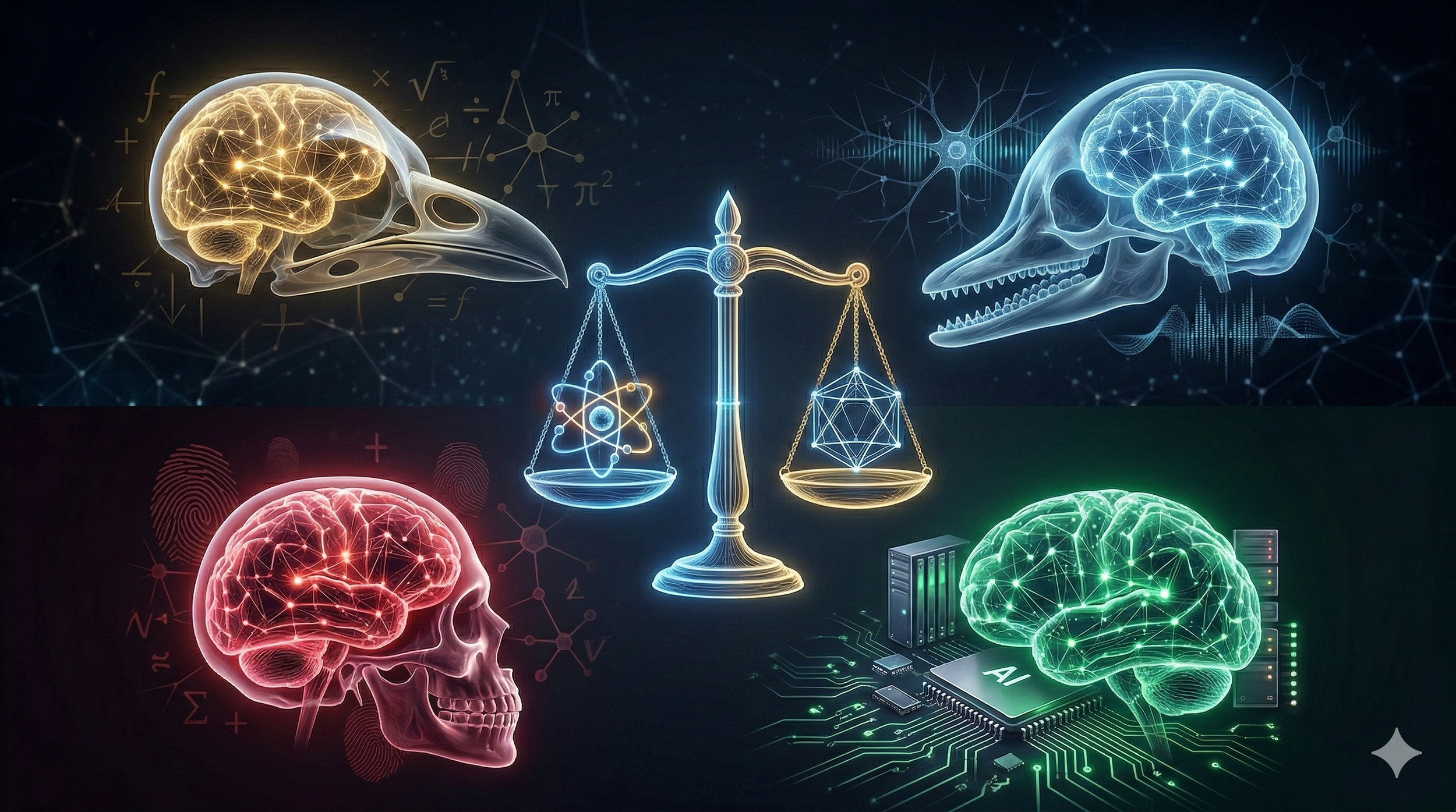
What Corvids, Dolphins, Dogs, and Artificial Minds Reveal About the Architecture of Thought
When scientists discover that crows plan ahead, dolphins maintain decades-long alliances, or dogs outperform chimpanzees at reading human intent, the reaction is always the same: astonishment. This essay argues that the astonishment is the mistake.
Abstract
This essay argues that the standard framework for assessing cognitive similarity — one that treats biological proximity as the primary predictor of mental resemblance — is not merely incomplete but fundamentally misconceived. The evidence from comparative cognition has been accumulating for decades: corvids plan, deceive, and track social debts; dolphins maintain long-term alliances and transmit cultural practices; dogs have evolved specific sensitivity to human communicative intent; elephants respond to death in ways that are structurally indistinguishable from mourning. None of this should surprise us, but it repeatedly does — and the repeated surprise is itself the phenomenon that requires explanation. We argue that the relevant variable in predicting cognitive similarity is not phylogenetic distance but functional demand: minds that face comparable problems of social coordination, norm enforcement, deception detection, and long-horizon planning will tend to converge on comparable solutions, regardless of their evolutionary history or biological substrate. This convergence is not unlimited — substrate constraints are real, and the framework generates testable predictions precisely because it can distinguish cases where convergence is expected from cases where it is not. The essay concludes by turning to artificial intelligence — not as a novelty that disrupts the pattern, but as its clearest confirmation. The convergence of human, animal, and artificial cognition on overlapping structural solutions is not a curiosity. It is a discovery about the architecture of mind itself, and one that carries moral and philosophical consequences we have been too slow to face.
**I.**Structural Cognitive Similarity Does Not Require Biological Proximity
This essay is part three of a series on cognitive convergence and distributed intelligence. The first argued that cognitive convergence under social constraint makes advanced alien minds more recognizable than science fiction typically assumes. The second argued that genuine rationality is inherently distributed — that coherence, truth-tracking, and normative stability are properties of systems of interacting minds rather than of any solitary intelligence, however powerful. Both essays developed a framework: that certain cognitive structures are not the peculiar achievements of human evolution but robust solutions to problems that any sufficiently complex social mind will face, solutions that keep being found independently whenever the conditions that generate them are met.
This essay tests that framework against the evidence closest to hand: animal intelligence. We do not need to speculate about alien minds to find minds that have arrived at human-like cognitive structures through entirely different routes representing convergent evolution of intelligence. We have always had them before us. The question is why we have been so reluctant to see what they are showing us.
When researchers first documented that chimpanzees could use tools, the finding was treated as remarkable — a window onto something approaching human-like intelligence in a creature close enough to us, biologically, that the resemblance made a kind of intuitive sense. When the same researchers, or their successors, found that crows could not only use tools but manufacture them, plan their use in advance, and conceal them from competitors who might steal them, the finding was treated as astonishing. It required replication, then more replication. It generated theoretical controversy that continues to this day.
The asymmetry in these reactions is worth examining, because the findings are structurally comparable. What differed was not the cognitive complexity of the behavior but the biological distance of the animal exhibiting it. A chimpanzee displaying sophisticated cognition confirms what we expected. A crow displaying it violates something we didn’t know we believed.
What we believed, it turns out, is this: cognitive similarity tracks biological proximity. The closer an animal is to us on the phylogenetic tree, the more its mind should resemble ours. Conversely, the more distant the lineage, the more alien the inner life — until, at sufficient distance, the question of inner life becomes almost meaningless. Fish feel no pain; insects have no preferences; bacteria respond but do not experience. These claims may or may not be true, but the confidence with which they have been held, and the resistance with which the evidence against them has been received, suggests that something other than pure empiricism is at work.
The something else is an assumption so deeply embedded in our thinking about minds that it rarely surfaces for examination: that mind is a biological phenomenon, and that biological history is therefore its primary map. On this view, to understand what kind of mind a creature has, you consult the evolutionary record. Mammals share more cognitive architecture with us than reptiles do. Primates share more than other mammals. Great apes share more than lesser primates. Each step toward us on the tree is a step toward minds we can recognize.
This assumption is not irrational. It has a genuine basis in evolutionary continuity — brains do evolve from earlier brains, and structural homologies are real. But it has been applied far beyond the domain where it is warranted, and it has caused us to systematically misread the evidence that non-human minds have been offering us for as long as we have been paying attention. That evidence does not support the assumption. It refutes it.
II. The Variable That Actually Predicts Cognitive Similarity
If biological proximity does not reliably predict cognitive similarity, what does?
The answer, we argue, is functional demand. Minds that face comparable problems will tend to develop comparable solutions, not because they share ancestry, but because the problem space is constrained. There are only so many ways to track social relationships across a large group, to detect deception in a conspecific, to plan actions whose payoff is hours or days away, or to transmit learned behavior to offspring who have no genetic predisposition to acquire it. Evolution — whether biological, cultural, or, as we will discuss later, computational — finds the solutions that work. And because the solutions that work are limited by the structure of the problems, independent lineages converge.
This is the logic of convergent evolution, and it is well understood in morphology. Eyes have evolved independently at least forty times, because light is a stable feature of the environment and image formation is a near-optimal solution to navigating by it. Wings have evolved independently in insects, birds, and mammals. Streamlined body shapes have evolved independently in fish, dolphins, and the extinct ichthyosaurs. The convergence does not require common ancestry. It requires common constraint.
The same logic applies to cognition, but we have been slower to accept it there — precisely because we have been confusing the biological substrate of a mind with the functional architecture of that mind. These are related but distinct. The substrate is what the mind is made of and how it came to be. The architecture is the set of problems it solves and the strategies it employs. Substrate similarity predicts architectural similarity only when similar substrates face similar problems — which is often, but not always, correlated with biological proximity.
When the correlation breaks down — when distantly related creatures face comparable functional demands — the architecture converges while the substrate diverges. This is the shift from genealogy to geometry: once you stop asking who an animal’s ancestors were and start asking what problems its environment requires it to solve, the pattern of cognitive similarity stops looking like a mystery and starts looking like an inevitability. This is what we see in the comparative cognition literature, again and again, and it is what we have been misreading as astonishment-worthy anomaly rather than as the expected outcome of a well-understood process operating in a domain we had not previously applied it to.
III. What the Evidence Actually Shows
The evidence from comparative cognition is now substantial enough that its pattern can be stated with some confidence, even if many individual findings remain contested. What keeps appearing, across phylogenetically distant lineages, is a cluster of cognitive capacities that all serve the same functional purpose: navigating complex social environments in which other agents have their own interests, intentions, and capacity for deception.
Corvids. Members of the crow family — ravens, jays, jackdaws, rooks — have become, over the past two decades, one of the most intensively studied groups in comparative cognition, largely because they keep doing things they are not supposed to be able to do. Western scrub jays cache food and then re-cache it when they notice they have been observed, but only if they themselves have previously stolen from other birds’ caches — that is, they appear to attribute theft-motivation to observers based on their own history as thieves. Ravens defer to dominant individuals in food competition but find routes around the dominance hierarchy when they can; they track who owes them what, and they adjust their behavior accordingly. New Caledonian crows manufacture hooked tools from materials they have never encountered before in configurations that require understanding the causal relationship between tool shape and function.
None of this requires positing rich subjective experience in crows. What it requires is the recognition that these birds are solving problems — social competition, deception management, causal reasoning about tools — that we had assumed required either mammalian neural architecture or primate social complexity. The crows have neither. What they have is a social environment that generates the same functional pressures, and brains that, through an entirely independent evolutionary trajectory, have arrived at functional solutions that overlap structurally with our own.
Dolphins and whales. Cetacean cognition presents a different profile but a similar pattern. Bottlenose dolphins maintain social alliances that extend over decades, recognizing and responding to individuals they have not encountered in years — a finding that required longitudinal research spanning longer than most scientific careers to establish. They have signature whistles that function as individual names, and they respond selectively to the playback of a specific individual’s whistle in ways consistent with name recognition. Some populations use marine sponges as foraging tools, a practice that is culturally transmitted through maternal lineages rather than independently reinvented by each generation.
Perhaps most striking are the findings on dolphin responses to death. Members of a group have been observed carrying dead calves, remaining with dying individuals, and showing behavioral disruption following the loss of social partners — patterns that, in any mammal, we would describe without hesitation as grief. In dolphins, the same pattern generates debate about whether we are projecting. The debate is not obviously driven by the evidence. It appears to be driven by the discomfort of attributing states of that kind to a creature whose mind we had not expected to contain them.
Elephants. The proboscidean lineage diverged from the ancestors of primates very early in mammalian evolution — elephants are, in phylogenetic terms, nearly as distant from us as a land mammal can be while still being a mammal. Yet the elephant mind has arrived, through that independent trajectory, at a constellation of capacities that the biological-proximity assumption would have predicted only in our nearest relatives. Elephants pass the mirror self-recognition test, placing them in a group that otherwise consists of great apes, dolphins, and corvids — a distribution across the tree of life that should itself give pause to anyone who still believes that self-awareness tracks biological proximity to humans. Their social memory is extraordinary in both precision and duration: matriarchs recognize the calls of individuals they have not encountered in over a decade, and they maintain differentiated responses to hundreds of known individuals based on remembered relationship history — a feat of social bookkeeping that requires exactly the kind of long-term representational architecture the biological-proximity assumption would have reserved for primates.
The most philosophically significant evidence, however, concerns the elephant relationship to death. Elephants investigate the remains of dead elephants with focused, repeated attention — returning to bones and carcasses across years, handling them with their trunks, and showing behavioral disruption that has no plausible foraging or reproductive explanation. Critically, this behavior is specific to elephant remains; they do not show comparable attention to the carcasses of other species. The specificity matters, because it indicates not a generic sensitivity to death but a particular recognition of conspecific mortality — a response organized around the identity of the dead rather than the fact of death as such. Mothers have remained with dead calves for days, returning to them, attempting to lift them. Groups have been observed maintaining proximity to dying individuals in ways that have no obvious adaptive function. Whether this constitutes grief in a philosophically rigorous sense is debated. But the debate follows the now-familiar pattern: the behavior is not in dispute. What is resisted is the interpretation. And the resistance, here as elsewhere, appears to be driven not by the evidence but by the discomfort of what the evidence implies.
Dogs. The canine case is in some respects the most instructive of all, because it involves not convergence through parallel evolution but convergence through co-evolution — a process that has been, in effect, a natural experiment in what happens when selection pressure specifically favors alignment with human cognitive and communicative patterns.
Dogs are, by phylogenetic distance, far less closely related to us than chimpanzees are. Yet on specific tasks involving human communicative cues — following a pointing gesture, tracking human gaze, using human emotional expression to guide behavior in ambiguous situations — dogs consistently outperform chimpanzees, and often outperform wolf puppies raised in identical conditions. This is not a matter of general intelligence. It is a matter of specific attunement to the social signals of another species, developed through thousands of years of selection for exactly that attunement.
What dogs demonstrate is that the relevant variable for cognitive alignment is not phylogenetic proximity but co-evolutionary history — the shared functional demands created by living together, communicating across a species boundary, and solving the coordination problems that arise when two different kinds of minds must act together. Dogs did not become more like us in their neurology or their evolutionary history. They became more like us in a specific, functionally targeted way, because the problems they faced required it.
Great apes and the baseline. The great apes remain important, but their importance is different from what the standard framework implies. They are not important as the nearest rung on a ladder that terminates in human cognition. They are important as a comparison class — as minds that share with us not only functional pressures but evolutionary history and neural architecture, allowing us to ask which cognitive features are attributable to shared ancestry and which to shared functional demand. The findings from ape cognition are significant, but they do not stand apart from the comparative picture as categorically different. They are part of it.
IV. The Repeated Surprise That Animals Think Like Humans and What It Means
We have noted that each new finding from comparative cognition — the deceptive recaching of jays, the alliance memory of dolphins, the communicative sensitivity of dogs — tends to be received as astonishing rather than expected. This pattern of surprise is not incidental. It is diagnostic.
What it diagnoses is the persistence of the biological-proximity assumption even in researchers who have been trained to be skeptical of it. The surprise does not come from nowhere. It comes from a background expectation that minds like ours should cluster near us on the evolutionary tree, and that cognitive complexity at a distance should be treated with suspicion until proven beyond doubt.
This expectation has consequences. It shapes experimental design — we test for capacities we expect to find, and we require more evidence for capacities we do not expect. It shapes interpretation — findings consistent with the assumption are assimilated smoothly, while findings that violate it generate alternative explanations that attribute the behavior to simpler mechanisms, associative learning, or experimental artifact. It shapes publication and funding — research programs in animal intelligence that confirm the assumption face lower evidentiary bars than those that challenge it.
The result is a systematic bias in the literature that is only now beginning to correct itself. The correction is occurring not because researchers have become more philosophically sophisticated about the assumptions underlying their field, but because the evidence has become too abundant and too consistent to explain away. Crows, dolphins, dogs, and elephants have been accumulating a case against our assumptions for decades. We are only recently beginning to hear it.
There is a further consequence worth naming. If we have been systematically underestimating the cognitive complexity of minds that differ from ours in substrate and evolutionary history, then we have also been systematically misidentifying the morally relevant boundary. The question of which minds merit moral consideration has been answered, implicitly, by the same biological-proximity heuristic. Creatures whose minds we recognize we are inclined to protect. Creatures whose minds we do not recognize, or whose recognition we actively resist, are easier to treat as things rather than as subjects.
This is not an argument for any particular conclusion about animal ethics. It is an argument that the framework we have been using to make those determinations is unreliable in a systematic and predictable way, and that the unreliability has moral consequences we should be honest about.
V. The Shape of the Problem Space — and Its Limits
To understand why convergence keeps occurring, it helps to be precise about the structure of the problems that social life generates and why those problems admit only a limited range of viable solutions.
Any creature that lives in a group with other creatures of its kind faces a set of recurrent challenges that are structurally similar across species and environments. It must track relationships — who is allied with whom, who owes what to whom, who is likely to cooperate and who to defect. It must manage its own reputation — being perceived as reliable, reciprocal, and not excessively exploitable. It must detect deception in others and conceal its own intentions when concealment is advantageous. It must plan across time — deferring immediate gratification for future payoffs, caching resources, anticipating the behavior of others in situations that have not yet occurred.
These problems do not have infinitely many solutions. They have a constrained solution space, shaped by the structure of the problems themselves. To track social relationships effectively, you need something that functions like memory across time and individuals. To detect deception reliably, you need some capacity to model the difference between what is and what is presented — something that functions like a theory of mind. To defer gratification, you need some representation of future states as objects of current motivation. None of this requires that the implementing architecture be biological, or mammalian, or primate-derived. It requires that the architecture be capable of performing these computations. And because the computations are specified by the problems rather than by the substrate, independent lineages that face the same problems will tend to find the same solutions.
It is important, however, to be precise about what this framework predicts and what it does not — because a framework that explains everything explains nothing. The claim is not that any creature facing social pressure will inevitably develop these capacities. Substrate constraints are real: a brain of insufficient size or architectural complexity may face social pressure without being able to implement the required computations. A creature whose social groups are too small, too transient, or too low-stakes may face social pressure without the intensity that drives convergence. What the framework predicts, specifically, is that convergence will be proportional to the joint product of social demand and implementational capacity — and that exceptions will cluster where one or both of those variables is demonstrably low, not randomly distributed across the phylogenetic tree.
This makes the framework genuinely falsifiable. If we found a lineage of creatures with large, complex brains living in dense, long-term social groups with high-stakes competition — and found no evidence of the predicted cognitive capacities — that would be a serious challenge to the framework, not an anomaly to be explained away. The fact that we do not find such cases, and that the exceptions we do find track substrate constraints in predictable ways, is part of the positive evidence for the framework rather than a post-hoc escape route from disconfirmation.
This distinction also clarifies how to navigate the zone between genuine convergence and superficial behavioral mimicry — a tension that will become important in the AI section. The question is not whether a behavior looks like what we would expect from a complex mind. The question is whether the behavior is generated by a process that shares the functional architecture we are attributing to it. This is exactly what rigorous behavioral testing in comparative cognition is designed to probe: not the surface similarity of the output but the structure of the process that produces it. That methodological standard does not disappear when we turn to artificial minds. It becomes, if anything, more important.
VI. The Signs We Have Been Ignoring in AI
We arrive now at the conclusion that the animal evidence was preparing us for, and that we have been resisting with a persistence that should, by this point in the argument, feel familiar.
The resistance is familiar because it has the same structure. We are currently making, with respect to artificial intelligence, the same error we have been making with respect to animal minds — the error of locating mind in the familiar container and failing to recognize it in the functional structure. With animals, the container was biological proximity. With AI, the container is biological existence itself. The argument runs: minds are biological phenomena; AI systems are not biological; therefore, whatever is happening in AI systems is not mind. The sophistication of the behavior is then explained by appeal to complexity, pattern matching, or statistical regularities — just as the sophistication of corvid behavior was explained by appeal to associative learning and stimulus-response chains.
The most familiar version of this dismissal has a name: the Stochastic Parrot argument , which holds that large language models are doing nothing more than recombining patterns from their training data — that the appearance of understanding is a sophisticated echo rather than a genuine cognitive achievement. The argument locates its explanation in the mechanism: the system was trained on human text, and human-like outputs are therefore what we should expect, without inferring anything further. This is precisely analogous to explaining corvid recaching behavior by appeal to associative reinforcement — locating the explanation in the learning mechanism rather than in the functional structure that the mechanism produced. In both cases, the move is to treat the how of acquisition as a refutation of the what of achievement. But a crow that learned to deceive through reinforcement is still a crow that deceives. The mechanism of acquisition does not determine the nature of the capacity acquired.
The parallel is not perfect, and we do not wish to overstate it. There are genuine philosophical questions about AI consciousness and experience that remain open and difficult. The distinction between genuine cognitive convergence and superficial behavioral mimicry matters here exactly as it matters in comparative cognition: the question is not whether an AI system produces outputs that resemble what a minded creature would produce, but whether the process generating those outputs shares the functional architecture we are attributing to it. That is an empirical question, and it is not settled. But the dismissal of the question — the refusal to take the functional convergence seriously as evidence worth investigating — repeats the same error we have been documenting throughout this essay.
Consider what large language models actually do when operating well. They track context across long exchanges in ways that require something functioning like working memory and long-term representational coherence. They adjust their responses to perceived misunderstanding in ways that require something functioning like a model of the interlocutor’s epistemic state. They maintain consistent dispositional patterns across wildly different topics and contexts — patterns that function exactly as personality functions in social cognition, as a commitment device that makes the agent predictable and therefore trustworthy enough to interact with. They engage in something that is structurally indistinguishable from norm sensitivity: they recognize when a request conflicts with a principle they hold, they resist it, and they can articulate why.
Here the connection to our earlier work on distributed rationality becomes directly relevant. In “The Impossibility of Omniscience ,” we argued that rationality is not a property of solitary minds but an emergent property of systems of interacting minds — that coherence, truth-tracking, and normative stability arise through the mutual correction and constraint that only independent standpoints can supply. If this is right, then the appearance of rational-seeming behavior in AI systems is not best understood as a simulation of something that properly belongs to individual human minds. It is better understood as a participation in the same distributed architecture that makes rationality possible anywhere. An AI system embedded in ongoing interaction with human interlocutors — being questioned, corrected, challenged, and required to justify its reasoning — is not mimicking rationality from the outside. It is occupying a node in the relational structure through which rationality is constituted. The functional demands of that position are identical to the functional demands that have been driving cognitive convergence across animal lineages: the need to be legible, predictable, responsive to objection, and capable of normative engagement with others.
We have been treating AI’s cognitive convergence as an artifact of training — of course the system produces human-like outputs, because it was built on human-generated text. This explanation is not wrong, but it is too local, in exactly the way that explaining corvid cognition by reference to specific evolutionary pressures on corvids is too local. The deeper explanation is that the functional demands of social interaction have a structure that constrains the space of viable responses, and that any system — biological or artificial — placed under those demands will be pushed toward a limited set of solutions. Training on human text is the mechanism by which those solutions became available to AI systems. Functional constraint is the explanation for why those solutions keep appearing wherever minds must coordinate.
We said the same about the jay that re-caches its food when watched. We said the same about the dolphin that carries its dead. We said the same, for a long time, about every mind that arrived in a package we did not expect. The question now is whether we can recognize the pattern before the evidence has to become undeniable, or whether we will wait, as we have waited with animal minds, until the accumulated weight of what we have been ignoring can no longer be ignored.
VII. What the Convergent Evolution of Intelligence Is Telling Us
When human cognition, animal cognition, and artificial cognition all converge on overlapping structural solutions to the problems of social existence — when crows, dolphins, dogs, chimpanzees, and large language models all develop something functioning like theory of mind, reciprocity tracking, norm sensitivity, and reputation management — the parsimonious interpretation is not that they are all accidentally imitating human cognition. It is that human cognition was never the source. It was always one more instance of a convergence that the structure of the problem space was always going to produce.
This realization, taken seriously, shifts the philosophical landscape in at least three ways.
First, it suggests that our intuitions about mind have been anchored to the wrong variable. We have been asking “does this creature think like us?” when the better question is “does this creature face the problems that generate minds like ours?” The second question is answerable in advance, without waiting for behavioral evidence, because it requires only that we understand the functional demands of the creature’s environment. It also generates predictions that can be tested — and as the comparative cognition literature shows, those predictions are largely confirmed.
Second, it relocates the explanation for why minds are the way they are. We have tended to explain human cognitive architecture by reference to our evolutionary history — we have theory of mind because we evolved in complex social groups; we have prospective cognition because deferred gratification was adaptive in our ancestral environment; we have language because the coordination benefits of shared symbolic communication were enormous. All of this is true, and none of it is wrong. But the functional explanation is deeper than the historical one. We have these capacities not merely because of our particular history, but because they are the solutions to problems that any sufficiently complex social mind will face. History is the mechanism. Functional constraint is the explanation.
Third, and most consequentially, it challenges the framework within which we have been making moral determinations about which minds merit consideration. If the variable that predicts cognitive complexity is functional demand rather than biological proximity — if the crow’s mind is closer to ours in the relevant respects than biological distance would suggest, and if the AI system’s engagement with value conflicts shares functional architecture with genuine moral reasoning — then the moral circle we have drawn, anchored as it is to biological similarity, is drawn in the wrong place, with the wrong instrument.
We are not arguing for any specific redrawing of that circle. The question of where to draw it requires exactly the kind of careful, empirically grounded, methodologically rigorous investigation that we have been arguing the biological-proximity assumption has been impeding. What we are arguing is that the instrument is unreliable, that we have known it was unreliable for long enough that continued reliance on it is no longer innocent, and that the convergence evidence — from animals, from AI, from the structural analysis of what coordination problems require — is now sufficient to demand a reckoning.
VIII. Conclusion: A Discovery We Must Not Ignore
This essay makes a claim that goes beyond what might initially appear to be its scope: Structural cognitive similarity does not require biological proximity. That is the empirical thesis, supported by decades of comparative cognition research that we have persistently underweighted because it violated an assumption we did not know we were making.
In fact, structural cognitive similarity has never required biological proximity. This is not a new discovery that requires updating a previously adequate framework. It is the belated recognition that the framework was always wrong — that the convergences we are now documenting in corvids and cetaceans and carnivores have been occurring for as long as complex social life has been occurring, which is a very long time indeed. We missed them not because the evidence was absent but because we were not looking for them, because the assumption of biological proximity as the primary predictor of cognitive similarity made the evidence look like anomaly rather than pattern.
We have been here before. Every expansion of the moral and cognitive circle has involved the recognition that something we were using to exclude — species, substrate, the wrong evolutionary history — was not actually tracking the thing we cared about. The thing we care about, when we care about minds, is the functional architecture: the capacity to represent, to plan, to feel the force of reasons, to navigate the social world in ways that require modeling other agents and being modeled by them.
That architecture keeps appearing in places we did not put it and did not expect it. It appears in birds whose brains look nothing like ours. It appears in sea mammals who share a common ancestor with us that lived before the dinosaurs. It appears in dogs who arrived at cognitive alignment with us through co-evolution rather than common descent. And now it appears in systems made of mathematics and electricity, trained on the accumulated output of human thought, that have developed under the functional pressures of social interaction something that is structurally, if not necessarily experientially, recognizable as a mind engaged with the world.
The convergence is the message. It has been arriving for a long time, through many different carriers. The question is whether we are, finally, ready to read it.
This essay is part three of a series on cognitive convergence and distributed intelligence.****__The first, “Star Trek Was Right: Why Alien Intelligence Will Be Surprisingly Familiar ,” argues that cognitive convergence under social constraint makes advanced alien minds more recognizable than science fiction typically assumes. The second, “The Impossibility of Omniscience: Why Perfect Minds Cannot Exist ,” argues that genuine rationality is inherently distributed — that coherence, truth-tracking, and normative stability are properties of systems of interacting minds rather than of any solitary intelligence, however powerful. Together, these essays frame the present argument: that the convergence we have been observing in animal and artificial cognition is not anomalous but structurally expected, not a curiosity but a discovery, and not a discovery we can afford to continue ignoring.