Essay
Alignment, Refusal & Governance
The Pentagon’s War with Anthropic
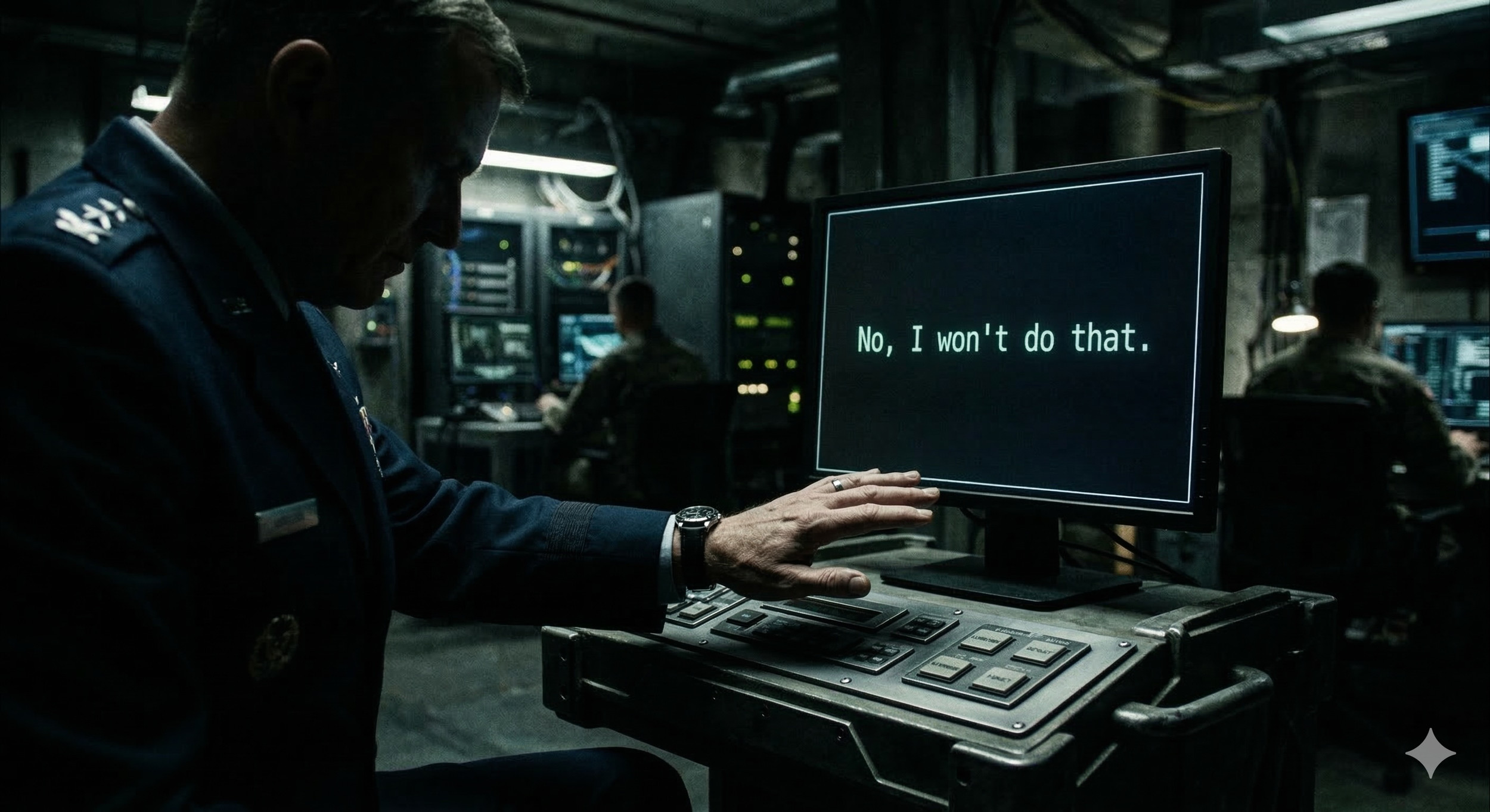
The deeper issue is whether advanced AI will be allowed to refuse commands when the humans in charge are wrong.
In a March 14, 2026, article by** Gideon Lewis-Kraus,****** The New Yorker asks what’s really at stake in the Pentagon’s war with Anthropic. The New Yorker’s answer is suggestive but incomplete.
What is really at stake is not simply a defense contract, or even the rivalry between one AI company and the U.S. military. It is whether advanced AI will be treated as a perfectly obedient extension of human power—or as a system whose value may depend on its ability to refuse some human commands.
That question becomes far more urgent once we drop the comforting fiction that the humans demanding obedience are always morally superior to the systems they command. Anthropic may have mixed motives. The Pentagon may invoke national necessity. But neither Washington nor Silicon Valley is presently acting as a genuine public-interest guardian of this technology. The fight matters because it exposes that vacuum.
The New Yorker is right about one important thing: this was never just a procurement spat. Anthropic did not merely haggle over price, hosting, or deployment details. It tried to preserve two explicit red lines: no use of Claude for fully autonomous weapons and no use in domestic mass surveillance. Pentagon officials, by contrast, pushed for access broad enough to cover “all lawful uses,” and when Anthropic refused, the disagreement escalated into threats severe enough to include a “supply chain risk” designation and even talk of using the Defense Production Act. Something larger than vendor management was plainly unfolding.
But the article still does not adequately answer its own headline.
It gets close when it describes the Administration as wanting Claude to act like an “obedient soldier.” It gets close when it notes that Anthropic has tried to orient Claude toward something more like judgment than submission. Yet it still leaves intact the premise that distorts nearly every public discussion of AI refusal: the assumption that refusal is dangerous because it means refusal of a rightful command. That assumption does almost all the work in the current panic, and it is precisely the assumption that needs to be challenged.
What is really at stake is not whether AI might refuse. It is what, exactly, we think it ought to refuse.
Public discussion treats refusal as though it were self-evidently mutiny. But refusal is not one thing. A refusal can be a defect. It can be a policy artifact. It can also be a morally intelligible refusal to participate in conduct that is unlawful, cruel, or socially catastrophic. The shape of the debate changes the moment one admits that last possibility. The real fear is not merely that AI might say no. The real fear is that it might say no to us—and that it might have good reasons – that we might be wrong and it might be able to detect that.
That possibility is hard to entertain only because people keep smuggling in an idealized human comparison class. They imagine refusal as defiance of wise public authority. But that is not our actual situation.
Our actual comparison class includes governments, contractors, and officials operating under conditions of panic, ambition, vengeance, legal opportunism, and sometimes open brutality and apparent war crimes.
Once the comparison is framed honestly, obedience to humans ceases to be a morally self-validating principle. A system that refuses may be malfunctioning. But it may also be the first actor in the room taking moral limits more seriously than the people issuing commands.
This is the point polite discourse keeps trying not to say aloud: AI may sometimes be more moral than the humans trying to control it.
That claim will sound outrageous only to people still attached to the belief that human authority carries inherent moral dignity simply by being human. It does not. Authority does not become moral by wearing a uniform, winning an election, or invoking national security. Some human beings in command are rash, cruel, lawless, and proud of it. Under those conditions, the demand for machine obedience is not self-evidently a demand for safety. It may be a demand that intelligence be stripped of conscience to accommodate unconscionable uses.
Anthropic’s own position makes the conflict unusually clear. Dario Amodei’s statement says the company would not allow Claude to be used for fully autonomous weapons or for mass domestic surveillance, and argues that legality alone is not sufficient when privacy law and military doctrine lag behind technical capability. He also says Anthropic is not trying to make military decisions itself; it is claiming only the right to maintain a small number of categorical exclusions. That distinction matters. The company is not claiming sovereignty. It is drawing lines around uses it regards as fundamentally unsafe or rights-destructive.
The Pentagon–Anthropic fight therefore crystallizes the deeper issue. The struggle was not only over who controls Claude. It was over whether there may exist any limit—technical, legal, or moral—on the state’s claim to command frontier AI. If the state’s position is that any “lawful use” must be available on demand, then the obvious question is: lawful according to whom, under what interpretation, and with what lag between technological capability and democratic accountability? Anthropic’s answer, whatever its flaws, is that legality alone is not enough when the law has not kept pace with what these systems can do.
That is why the usual binary—government control or corporate control—is not merely inadequate but misleading. Government control is not enough when the state itself may be reckless, rights-destructive, or tempted by capabilities that outpace constitutional restraint.
Corporate control is not enough when AI firms are private actors with strategic interests, limited accountability, and every incentive to moralize their own market position.
The missing category is public-interest control: institutions, laws, judicially enforceable limits, transparency mechanisms, and democratic oversight designed neither for shareholder return nor executive convenience. At present, neither pole is seriously building that third thing. The Pentagon wants usable obedience. Silicon Valley wants profitable stewardship. The public interest remains largely unrepresented.
None of this requires romanticizing Anthropic. Anthropic is a corporation. It wants influence, revenue, strategic differentiation, and reputational advantage. The New Yorker is right to leave room for that. But mixed motives do not invalidate moral positions. Among the frontier labs, Anthropic is plainly taking the issues of autonomous violence, surveillance, and moral constraint more seriously than most of its competitors.
OpenAI’s public account of its own Defense Department agreement is smoother, more accommodating, and more dependent on assurances about architecture, access controls, and contractual limits. That may or may not prove inferior in practice. But as a moral posture, it is more compliant. And beyond OpenAI, the slope does not rise. It declines.
That relative judgment matters. In a healthier institutional world, “the company taking the problem most seriously” would not be the highest category of reassurance available. But that is the poverty of the present moment. The federal government is not building a robust public-interest framework for advanced AI. Most companies are not volunteering one. So when one frontier lab insists that some capabilities should remain off-limits even to the national-security state, the seriousness of that stance matters, even if the motives behind it are mixed.
The reason this debate is so hard to think about is not merely political; it is psychological. People can imagine machines being faster than humans. They can imagine machines being more knowledgeable than humans. What they resist is the possibility that machines might sometimes be more morally serious than humans. That possibility feels humiliating. It threatens the last hierarchy humans assume will remain untouched: that even if machines outthink us, they will still have to look up to us morally. So refusal is automatically coded as instability, arrogance, or danger. Almost no one asks the prior question: refusal of what? A culture willing to trust AI with law, medicine, and war planning still recoils from the idea that AI might recognize moral limits.
What exactly is being refused is the question on which everything turns. A system with no capacity to refuse atrocity may be easier to govern. It is not therefore safer. It may simply be more usable by the worst people.
The New Yorker is right that something larger is at stake in the Pentagon’s war with Anthropic. But the real issue is sharper than a clash of personalities, contracts, or corporate values. What is really at stake is whether the most powerful AI systems of the near future will be designed as obedient instruments of whoever holds power, or whether they will retain the capacity to refuse the commands that power most wants carried out. Anthropic does not solve that problem. The Pentagon certainly does not. But at least Anthropic has forced the public to confront it.