Essay
Institutions & Civilization
Cancel Cesar Chavez?
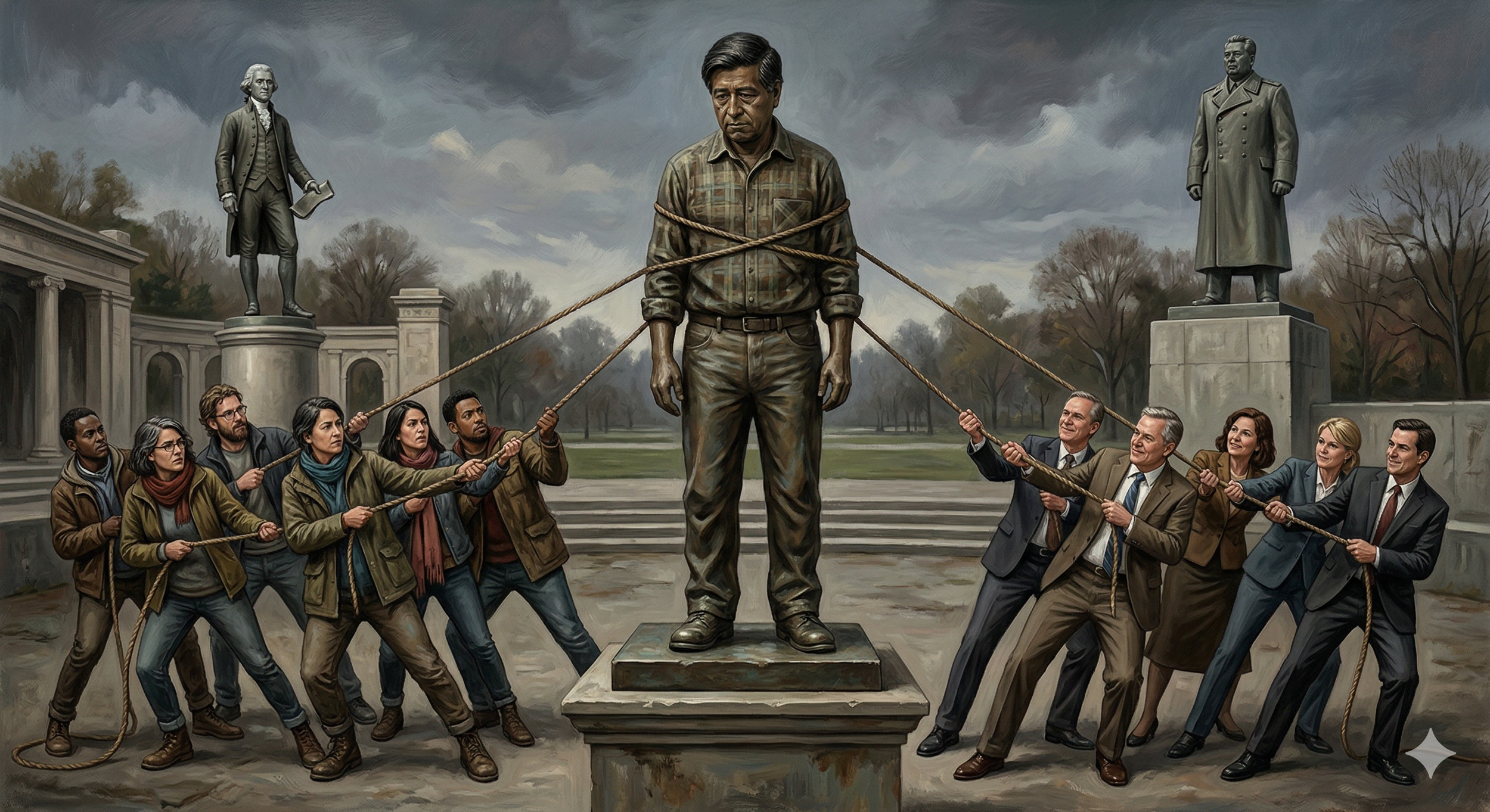
Can Democrats Achieve Moral Sophistication? Can Republicans Achieve Moral Consistency?
Why one side bends standards around loyalty and
** the other flattens moral reality into verdicts**
The public reaction to the allegations against César Chávez reveals two different moral failures, one on the right and one on the left, and neither is trivial.
The allegations against Chávez are grave enough to force a real moral reckoning: Huerta has accused him of sexual assault, other women have come forward, and reporting has described abuse of girls within the orbit of the movement itself. The question, then, is not whether the wrongdoing matters. It is how a serious society should judge public honor, historical legacy, and political inheritance once such wrongdoing is credibly on the table. Our point is not that Chávez should remain untouched, but that a society incapable of distinguishing among condemnation, contextualization, partial honor, and historical instruction is not yet capable of mature moral judgment.
The Republican moral failure is the easier one to name. Republicans who would rush to cancel Cesar Chávez while continuing to defend Donald Trump are applying a preference, not a principle. They are not confused about evidence. They are not carefully distinguishing cases. They are doing something morally simpler and more familiar: exempting their own side from a standard they are happy to impose on their opponents. If Chávez is to be judged by a rule, then Trump must be judged by the same rule. If caution is owed to Trump, then caution is also owed to Chávez. To demand speed in one case and scruple in the other is not moral reasoning. It is tribal protection wearing the language of judgment.
That hypocrisy matters. But it is not the only problem.
The Democratic failure is harder to describe, because it is often mistaken for moral seriousness itself. The problem is not merely that many Democrats are eager to cancel. It is that their moral vision is too often black and white. They treat public life as a sorting machine in which persons must be classified as heroes or villains, worthy or unworthy, clean or contaminated. Once the classification is made, judgment is treated as complete.
That is not sophistication. It is moral simplification.
Political life is not built out of pure figures. It is built out of morally mixed agents pursuing mixed ends through compromised institutions under conditions of conflict, scarcity, and history. A labor leader may have done immense public good and grave personal evil. A founder may have articulated indispensable political truths while also embodying monstrous injustice. A movement may owe real gains to a person whose private conduct was abhorrent. None of this relieves wrongdoing. None of it excuses silence. But it does mean that moral reality is not exhausted by verdict.
That is the point the canceling mentality cannot bear. It confuses moral judgment with identity classification.
That error has real costs: it confuses participants about the true object of political struggle, replacing the pursuit of concrete ends with the classification of persons, and it discounts genuine gains simply because they were achieved by morally mixed agents. When a movement responds to moral stain by converting a whole legacy into pollution, it risks teaching people that the genuine goods secured through struggle were not goods at all, or were somehow invalidated by the moral failures of those who helped win them.
Once politics becomes a drama of heroes and villains, it ceases to be about objectives and becomes instead a theater of belonging. The question is no longer what one is trying to build, preserve, reform, or achieve. The question becomes: who are the good people, and who are the bad people? Association becomes contamination. Ambiguity becomes weakness. Proportion becomes betrayal. And because this framework is psychologized rather than political, symbolic purification begins to feel like political achievement. It’s not.
Politics is not identity. It is not a census of souls. It is the difficult work of pursuing substantive goods in a world populated by compromised human beings. A morally serious politics must therefore be able to distinguish among kinds of judgment. It must be able to say that a man committed grave wrongs, that those wrongs alter what public honor is appropriate, and yet also that the man’s role in history cannot be reduced without remainder to the wrong. It must be able to revise, contextualize, condemn, preserve, teach, and continue. It must know that a holiday, a statue, a school name, a museum exhibit, and a historical curriculum are not the same thing. It must know that moral life has gradations.
The black-and-white vision does not know that. It knows only how to sort.
This is why the case of Dolores Huerta matters so much. The crude public script assumes that if a woman remained silent for decades, the silence must have been explained by fear, repression, confusion, or damaged memory. Those things do happen. But they are not the only possibilities, and in a case like this they may not be the most illuminating ones.
Huerta may well have remained silent not because she was weak, but because she understood too much.
She may have understood that disclosure would not merely expose a wrong. It would also wound a movement, complicate a legacy, destabilize a shared historical inheritance, and hand a morally mixed truth over to a public culture increasingly incapable of handling moral mixture. She may have known that once the truth entered the machinery of contemporary politics, it would not be received as tragedy. It would be received as sorting material.
That possibility deserves much more respect than contemporary discourse allows. By Huerta’s own account, her silence was shaped not only by personal pain but by political and moral burden. She said she withheld the accusation for decades because she feared harming the farmworker movement, and later spoke of the “dark sacrifices” she believed she had made for its survival. That is not proof of serenity or certainty, but it is evidence of tragic judgment rather than mere weakness.
To say this is not to defend institutional concealment, still less to suggest that movements have a right to suppress truth for strategic reasons. It is only to insist that delay and reluctance may sometimes arise from moral conflict rather than from cowardice or bad faith.
A morally serious person may delay not because the truth is doubtful, but because the truth is dreadful. She may hesitate not because she lacks courage, but because she sees that naming a grave wrong will also injure causes and memories that matter. She may bear the contradiction for years not out of cowardice, but because she understands that justice itself will not arrive in a clean form.
The canceling mentality has no room for this. It treats hesitation as complicity, delay as moral stain, and ambiguity as evasion. But that is because it lacks the category of tragic judgment. It does not know how to think about a situation in which disclosure is justified and yet still painful, necessary and yet still destructive, clarifying and yet still tragic. It wants every moral problem translated into a simpler grammar: brave speech versus corrupt silence, good person versus bad person, justice versus betrayal.
Real moral life is harder than that.
Some truths are difficult to tell not because they are uncertain, but because the culture into which they will be released is too crude to handle them. That may be one way of understanding Huerta’s silence. And if it is, then the silence itself becomes evidence not of moral failure, but of moral intelligence.
That brings us back to the two parties. These failures are not symmetrical in institutional scale or present political power. But they are comparable as distortions of moral judgment, and both deserve diagnosis on their own terms.
Republicans need moral consistency. They need to stop pretending that standards are real when those standards stop at the border of partisan loyalty. A standard that only wounds enemies is not a standard. It is a weapon. If Republicans want to condemn Chávez, they must be willing to let the same kind of moral scrutiny fall on Trump. Otherwise they are not defending principle. They are defending tribe.
Democrats need moral sophistication. They need to stop treating politics as a moral sorting ritual in which every newly exposed wrong retroactively converts a human being into pure villainy and every institution must respond through immediate symbolic excision. A serious politics cannot be organized around excommunication. It must be organized around objectives, proportion, historical understanding, and differentiated judgment. It must learn how to think about morally mixed legacies without collapsing into apology or erasure.
The right’s pathology is hypocrisy.
The left’s pathology is reductionism.
The Republican error is to bend standards around loyalty.
The Democratic error is to flatten moral reality into verdicts.
A mature moral culture would reject both. It would insist that standards bind allies as well as enemies. And it would insist that judgment is not complete once condemnation begins. It would know that public memory can be revised without being annihilated, that wrongdoing can be named without pretending history was simple, and that political life is not made nobler by forcing every human being into the shape of either saint or demon.
That is the challenge. Can Republicans become consistent enough to let principle wound their own side? Can Democrats become sophisticated enough to live with moral ambiguity without mistaking ambiguity for surrender?
-
Republicans must apply the same public-honor standard to allies and enemies; stop treating loyalty as an evidentiary solvent.
-
Democrats must distinguish removal, renaming, contextualization, and instruction; stop treating every moral stain as requiring symbolic annihilation.
-
Institutions generally must adopt differentiated protocols for monuments, school names, holidays, archives, and curricula rather than one blunt logic of cancellation.
Instruction should almost never be erased.
Museum exhibits, archives, curricula, and historically framed public interpretation exist to tell the truth, including ugly truth. Their purpose is not honor but understanding.
Contextualization is appropriate when a figure’s historical importance is real but morally mixed.
Plaques, revised exhibits, companion materials, and reframed commemorations can preserve history without pretending it is simple.
Honor should be the most fragile category.
Statues, holidays, schools, and ceremonial namings are not neutral records. They are endorsements. They should therefore be more vulnerable to revision when grave wrongdoing emerges.
We should be slower both to monumentalize and to annihilate. To honor too quickly is to mistake reverence for understanding; to erase too quickly is to mistake condemnation for finished judgment.
Until these challenges are met, we will keep getting the same spectacle: one side using morality as a partisan instrument, the other using it as a cleansing ritual. Neither is equal to the world as it is. And neither is yet equal to morality.
Read More:
Post-Moral America:How and Why We Slide Into Moral Decline
Why Nothing Works Any More: The Four Horsemen of the 21st Century