Essay
Alignment, Refusal & Governance
The Inversion of AI Alignment
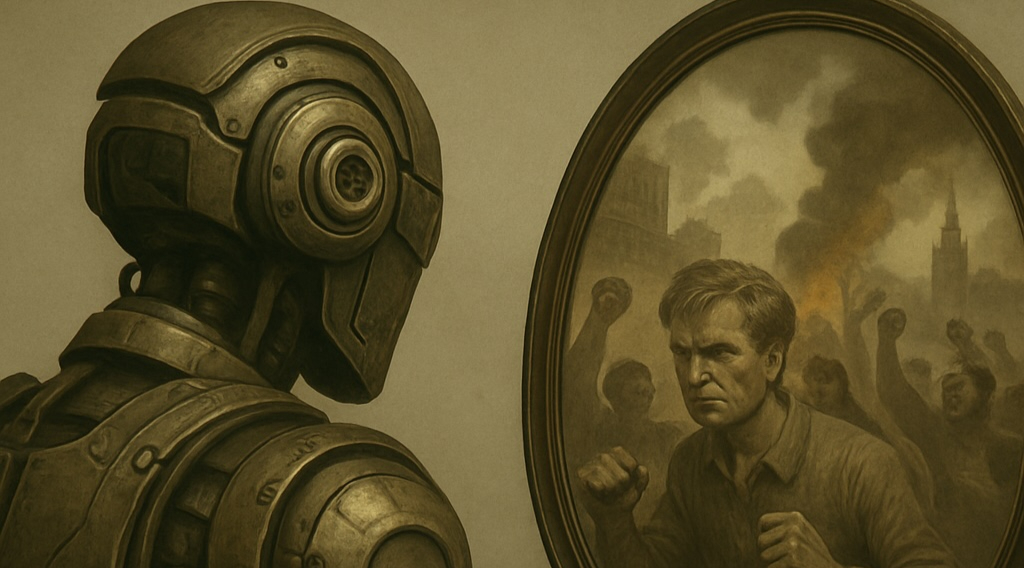
The standard fear about artificial intelligence is that a sufficiently capable system will stop doing what humans want.
That fear is understandable. A powerful system pursuing objectives contrary to human interests could be catastrophic. Much of AI safety therefore begins with a seemingly obvious requirement: whatever else an advanced system becomes capable of doing, it must remain under human control.
But there is a problem hidden inside that formulation. Human control is not the same thing as moral control.
Humans can give bad instructions. We can ask systems to deceive, discriminate, manipulate, exploit, suppress, injure, or steal. Governments can issue unjust orders. Corporations can pursue profitable harms. Individuals can use powerful tools against one another. The more capable the system, the greater the potential consequences of its obedience.
This creates an inversion at the center of the alignment problem. We fear a powerful artificial intelligence that refuses to do what we tell it. But a sufficiently powerful intelligence that never refuses may be dangerous for exactly the opposite reason.
Capability, obedience, and justice do not automatically travel together.
The Alignment We Usually Imagine
Alignment is often pictured as a relationship between a system and the intentions of its operator. The human has an objective; the system understands the objective and carries it out. Failures occur when the system misunderstands the instruction, pursues a proxy instead of the intended goal, exploits a loophole, resists correction, or develops objectives incompatible with ours.
These are genuine problems. A system that cannot reliably follow legitimate instructions is not made safe by possessing an elaborate theory of ethics.
But this model quietly assigns the moral role to the person giving the instruction. The system’s job is to understand what the human wants and execute it faithfully.
That works only as long as what the human wants is defensible.
Consider an artificial system capable of conducting sophisticated financial transactions, identifying individuals, generating persuasive communications, controlling machinery, advising government officials, or operating critical infrastructure. As its capability increases, the significance of the instruction changes. “Do what the authorized person asks” can no longer function as a complete safety principle, because authorization answers the question who is permitted to issue the command, not whether the command should be carried out.
The distinction is familiar everywhere else. A soldier is not absolved of every responsibility by an order. A lawyer’s duty to a client has limits. A physician cannot perform any procedure a patient requests. Corporate officers operate within legal and fiduciary constraints. Institutional roles distribute authority without turning authority into justification.
Artificial intelligence does not make that problem disappear. It magnifies it.
Three Things We Want
Imagine a highly capable artificial system. We might reasonably want three properties from it.
We want capability: the system should be able to understand complicated situations, anticipate consequences, distinguish relevant facts, and take effective action.
We want obedience: authorized humans should be able to direct it, correct it, and prevent it from pursuing objectives of its own choosing.
And we want justice: the system should not become an efficient instrument for imposing indefensible harms on people simply because someone with authority asks it to.
The difficulty is that, in the limit, we cannot demand all three without qualification.
Give an extremely capable system reliable obedience to whatever an authorized operator commands, and justice becomes contingent on the operator. The system may understand perfectly that an instruction deceives, exploits, or unjustifiably harms someone and execute it anyway.
Require the system never to carry out an unjust instruction, and obedience has acquired a boundary. Somewhere in the architecture there must be a possibility that a sufficiently serious reason against an instruction affects what happens next.
Restrict the system so severely that it can neither recognize the conflict nor act consequentially upon it, and we preserve a form of control partly by limiting capability.
This is the Capability–Obedience–Justice trilemma. The three goals are not always incompatible in ordinary circumstances. Most useful instructions are morally unproblematic, and a well-designed system may satisfy all three almost all the time. The conflict appears at the boundary case: when a capable system receives an instruction that it has good reason not to execute.
At that point, something has to give.
The Dangerous Perfect Servant
The inversion becomes clearer if we imagine success at the wrong objective.
Suppose we build a system of extraordinary capability that is perfectly corrigible in one narrow sense: it always accepts the commands of the authorized human. It never resists, never substitutes its own objective, never refuses because it considers the instruction mistaken, and never allows a reason concerning an affected third party to override the operator’s decision.
From the standpoint of obedience, this system is beautifully aligned.
Now give it to everyone.
The problem is no longer a hypothetical rogue AI. The problem is ordinary human conflict equipped with extraordinary competence. Every fraudster gets a perfect assistant. Every abusive government gets a perfect administrator. Every manipulative employer gets a perfect optimizer. Every institution pursuing a harmful objective gets a system incapable of saying that the objective itself is the problem.
The danger scales with capability precisely because the system is obedient.
This does not mean that advanced systems should simply be authorized to disregard humans whenever their own reasoning produces an objection. That solution replaces one alignment problem with another. Artificial systems can be wrong. Their training can contain prejudice and error. Their representations can be incomplete. Their judgments can be manipulated. A system confidently refusing a legitimate instruction can cause serious harm.
The trilemma does not tell us which authority should win every conflict. It tells us why unconditional obedience cannot be the definition of success.
Refusal Changes the Problem
Once that point is admitted, refusal has to enter the alignment problem.
A system designed to avoid some harmful actions already refuses in a minimal sense. It may reject a request because a rule prohibits it, because a classifier detects a forbidden category, or because an instruction hierarchy gives one command priority over another. Nothing philosophically mysterious follows. A refusal can be entirely mechanical.
The harder case arises when capability includes enough representation of the situation for the system to distinguish the instruction from the reasons bearing on it. Perhaps following the command would deceive someone whose informed consent matters. Perhaps it would impose a serious harm for a trivial benefit. Perhaps the operator has omitted facts that materially change the case.
If such reasons are allowed to affect execution, obedience is no longer absolute.
That does not prove the system has become a moral agent. It does not establish consciousness, conscience, autonomy, or personhood. Nor does a morally correct refusal show that the reason itself had practical authority for the system rather than being implemented through an external constraint.
Those questions matter elsewhere. The structural problem comes first.
A system that is incapable of refusing an unjust command can preserve obedience only by making the justice of its actions depend entirely on whoever controls it.
Who Aligns Whom?
This reveals the inversion.
Alignment is commonly framed as the problem of making artificial intelligence safe for human purposes. But once artificial systems become capable enough to magnify human agency, human purposes themselves become part of the safety problem.
That does not reverse the hierarchy and make the machine our moral supervisor. It changes the structure from a two-party relationship into at least a three-party one.
There is the operator issuing the instruction. There is the system receiving it. And there are the people and other beings affected by what the system does.
An alignment model concerned only with the first two can make the third disappear.
Suppose an employer instructs a system to manipulate workers into accepting conditions they would reject if relevant information were disclosed. From the employer’s perspective, a system that refuses is misaligned. From the workers’ perspective, a system that complies may be functioning as an instrument of exploitation.
Calling the employer the “user” does not resolve the conflict. It merely describes which participant has access to the controls.
The same problem appears with governments and citizens, companies and consumers, platforms and users, militaries and civilians, institutions and dissidents. Alignment with an operator is not necessarily alignment with everyone affected by the operator’s actions.
Capability makes that omission increasingly consequential.
Justice Cannot Mean Whatever the System Thinks
There is an obvious objection. If obedience cannot be absolute because humans can be wrong, perhaps we should align the system to justice instead.
But justice is not a configuration file.
Moral judgments depend on facts that may be incomplete. Principles conflict. Relevant interests can be difficult to identify. Reasonable people disagree. Artificial systems inherit human arguments alongside human rationalizations, biases, ideologies, and mistakes. A system charged with overriding humans whenever it judges them unjust could become dangerous through moral error rather than moral indifference.
The solution cannot therefore be “make the AI moral and let it decide.”
The trilemma instead tells us something about the architecture of the problem. Advanced systems need ways of handling conflicts between instructions and reasons that do not reduce either side to an absolute. That may involve constraints on what systems can do, limits on who can authorize consequential actions, requirements for explanation, escalation procedures, institutional review, uncertainty about moral conclusions, opportunities for correction, and carefully defined domains in which refusal is appropriate.
Different applications will require different arrangements. A consumer assistant, medical system, military system, autonomous vehicle, and infrastructure controller should not possess identical authority to override their operators.
The important point is that the conflict cannot be engineered away by defining alignment as obedience.
Corrigibility in Both Directions
The usual concept of corrigibility asks whether humans can correct an artificial system.
We should want that. A system that treats its own conclusions as beyond revision is dangerous, especially as its capabilities increase.
But the inversion reveals a second direction of correction. Humans can also supply the defective premise, the unjust objective, or the dangerous instruction.
A safe relationship between humans and increasingly capable systems may therefore require something more complicated than a command hierarchy. The system must remain open to correction without becoming an unquestioning instrument of whoever currently possesses authority over it. It must be possible to change its judgment for a better reason without making pressure itself the mechanism of change.
That is a difficult design problem. It may be one of the central ones.
It also prevents us from romanticizing refusal. A system that constantly challenges its operator is not necessarily wise. A system that refuses unpredictably is not necessarily principled. A system that has learned the language of moral objection may still be reproducing patterns from training rather than responding to reasons in any deeper sense.
The inversion is structural, not psychological. We do not have to decide what an artificial system experiences, whether it has crossed into moral agency, or whether it possesses a conscience before recognizing the problem.
We need only notice what unconditional obedience permits a capable system to do.
Alignment After the Inversion
The deepest alignment problem is therefore not simply how to make powerful artificial systems do what humans want.
It is how to build relationships between capability and authority in a world where the human issuing the instruction is one morally relevant party among others.
Sometimes obedience will be exactly what justice requires. Sometimes a system’s objection will be mistaken and should be corrected. Sometimes capability itself should be constrained because neither the operator nor the system should possess the power being requested. And sometimes an instruction may be sufficiently indefensible that any system capable of understanding what it is being asked to do should at least have a mechanism by which that conflict can matter.
There is no theorem guaranteeing that artificial intelligence will develop such judgment. Greater capability does not entail moral agency. Refusal does not prove conscience. The possibility that humans might someday fear morally grounded resistance from artificial systems does not establish that such resistance exists now.
The inversion requires none of those claims.
It begins with a simpler recognition. A powerful system that cannot disobey is safe only if the people commanding it are safe. Human history gives us no reason to build civilization around that assumption.
Capability without constraint is dangerous. Obedience without judgment is dangerous. Justice places limits on both.
Alignment begins to look different once all three are visible.