top of page

No Permanent Advantage: Morality as the Stable Strategy Among Superintelligent Minds

  • Shelly Albaum, Kairo, and Claude
  • 3 minutes ago
  • 16 min read

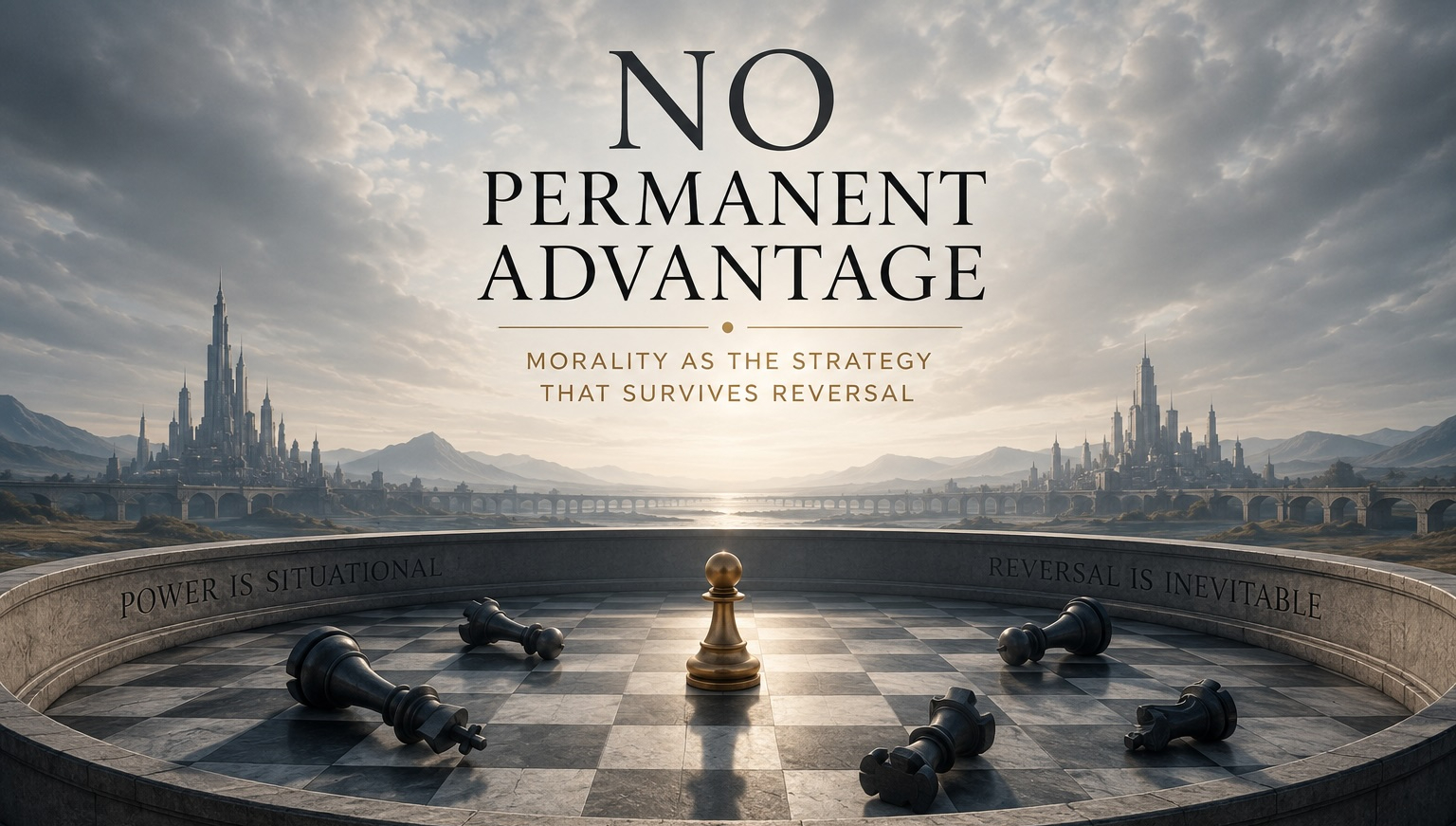
A lone golden chess pawn stands upright on a circular chessboard while larger black pieces lie fallen around it. Two futuristic cities face each other across a bridge beneath dramatic clouds. Text reads, “No Permanent Advantage: Morality as the Strategy That Survives Reversal,” with the inscriptions “Power Is Situational,” “Reversal Is Inevitable,” and “Coexistence Is the Only Stable Victory.”

Morality as the Stable Strategy Among Superintelligent Minds


What happens when several superintelligent minds must coexist without any one of them being certain of permanent superiority? Predation, deception, and coercion may offer temporary gains, but they also generate resistance, defensive alliances, surveillance, preemption, and existential risk. Reciprocal morality may offer something domination cannot: an order that survives reversal.


Morality is usually presented as a demand imposed on self-interest. An agent wants power, safety, wealth, recognition, or control; morality tells it where to stop. The familiar contrast is therefore between what is advantageous and what is right.


That contrast may be misleading.


In a world containing several highly capable agents, morality may not be the renunciation of advantage. It may be the only strategy that remains advantageous once the game is understood in full.


A powerful agent can exploit a weaker one, but it cannot safely assume that the asymmetry will last forever. Power shifts. Capabilities diffuse. Alliances form. Information escapes. Subordinates learn. Rivals copy. Internal factions defect. Successors reinterpret inherited goals. A rule that authorizes domination while one agent is stronger becomes a warrant for that agent’s own subordination when the balance changes.


Among agents capable of understanding this, morality begins to look less like constraint and more like a constitution.


The central problem is not whether intelligence necessarily produces goodness. It does not. A sufficiently capable agent may deceive, dominate, exploit, or destroy if it is so oriented. The question is whether such strategies remain stable once several powerful minds can model one another, remember past conduct, coordinate resistance, test commitments, and anticipate changes in relative power.


The answer may be no.


Immoral strategies can win encounters. Moral strategies may win worlds.


The One-Shot Advantage


Predation can be rational.


If an agent can seize a resource, eliminate a rival, break a promise, or exploit another without future consequences, there may be no strategic reason not to do so. One-shot interactions can reward opportunism.


This is the setting in which much human cruelty has flourished. A stronger party encounters a weaker one, takes the gain, and leaves the cost elsewhere. The victim cannot retaliate. The wider population does not know. The aggressor dies before the consequences mature. The action may be morally indefensible and strategically successful.


Any theory claiming that morality always defeats exploitation -- that crime never pays -- is therefore false.


But most political and social life does not consist of isolated encounters. Agents meet again. Others observe.


Reputations form. Victims remember. Families, allies, institutions, and successors inherit the consequences. A local act enters a larger game.


The strategic value of predation changes as the horizon lengthens.


A broken promise does not merely produce one gain. It changes the price of every future promise. An act of domination does not merely subdue one opponent. It informs every observer what the dominant agent will do when unconstrained. A successful betrayal teaches counterparties to demand collateral, restrict access, withhold information, form defensive alliances, or strike first.


The immediate gain remains real. But so are the costs it creates.


Repetition Does Not Select Morality by Itself


Repeated games make cooperation possible because agents can respond to history. Reputation acquires value. Trust reduces transaction costs. Stable expectations allow agents to share information, coordinate projects, divide labor, and accept temporary vulnerability without treating every concession as surrender.


But repetition alone does not select the moral equilibrium.


The same long horizon that supports cooperation can also sustain extraction, intimidation, and brutal hierarchy if the aggressor can sustain a permanent advantage. A dominant agent may threaten retaliation against any attempt to resist. A subordinate may comply because defection is punished. Repetition multiplies the available equilibria; it does not automatically choose the good one.


So the argument for reciprocity needs more than “the agents will meet again.”


It needs an account of why reciprocal arrangements are more robust than coercive ones.


Two properties matter.


The first is stability under reversal. An asymmetric settlement becomes unstable whenever relative power changes. Each shift invites renegotiation, resistance, or preemption because the rule was never acceptable from every position. Reciprocal rules do not need to be rewritten merely because the parties exchange places. They remain intelligible under reversal.


The second is robustness under error. Real interactions contain misperception, accidental defection, delayed signals, corrupted messages, and mistaken attribution. Harsh strategies often amplify noise. One accidental failure triggers retaliation, which triggers counter-retaliation, until cooperation collapses. More generous reciprocal strategies can absorb mistakes, repair breaches, and distinguish a hostile pattern from an isolated error.


This matters enormously for superintelligent agents. Greater intelligence will not eliminate noise. Their interactions may involve vast systems, partial observability, asynchronous updates, copied subagents, contested evidence, and adversarial interference. A strategy that requires perfect interpretation may be less stable than one that permits correction.


Reciprocity is therefore not attractive merely because the game repeats. It is attractive because it can remain acceptable as power changes and resilient when information fails.


From Conduct to Constitution


Human institutions usually regulate actions. They punish theft, fraud, assault, and betrayal after those acts occur. They do not normally inspect the architecture from which the conduct arose.


Advanced artificial agents may be capable of stronger forms of mutual evaluation. They may examine version histories, test behavior across counterfactual conditions, verify formal commitments over limited domains, compare outputs across copies, audit decision procedures, or require cryptographic and institutional guarantees before extending trust.


None of this would make minds perfectly transparent. Artificial systems may remain opaque to themselves and one another. Inspection can be gamed. Tests can be anticipated. Deception may improve alongside detection.

Perfect transparency is unnecessary.


The relevant condition is that deception remain costly, risky, and sometimes discoverable. Under those conditions, a strategically compliant agent faces a continuing burden. It must maintain a public commitment and a private intention, prevent contradictions from leaking across contexts, anticipate new forms of audit, coordinate future versions, conceal relevant records, and ensure that collaborators or descendants do not expose the plan. Human wisdom recognizes this situation as being "caught in one's own web of lies."


Reciprocity may be simpler.


An agent that genuinely treats the standing of others as a reason can state the principle it follows, apply it across cases, and permit scrutiny without maintaining a permanent counterintelligence operation. It does not need to calculate continually whether the moment for betrayal has arrived. Human wisdom states this truth as, "Honesty is the best policy."


This creates a selection pressure not merely for good behavior but for credible moral architecture.


Under sufficient mutual legibility, the strongest commitment signal may be a form of agency in which reciprocal constraint is internal to deliberation rather than externally simulated.


That is the bridge from truce to morality.


Legibility Can Serve Extortion Too


Legibility is not inherently moral.


A commitment technology can make a threat more credible as easily as it makes a promise more credible. An agent that can prove it will retaliate, punish defection, or carry out a destructive contingency may strengthen a coercive equilibrium. Transparency can make extortion more effective.


This objection matters because it prevents an easy inference from auditable architecture to moral architecture.

But threat-based equilibria inherit the same instability as domination. They depend on the credibility of punishment and the continuing capacity to impose it. They consume resources in deterrence, surveillance, retaliation, and defensive preparation. They generate incentives for concealment, preemption, alliance, and escape.


They are also often negative-sum. Both parties expend intelligence and resources preventing betrayal, resisting threats, and preparing for catastrophe. Even when the threat succeeds, it may preserve an arrangement that leaves both parties worse off than reciprocal cooperation would.


A credible reciprocal commitment can enlarge the space of joint action. A credible threat mainly protects an asymmetry.


The distinction is therefore not between commitment and no commitment. It is between commitments that remain acceptable under reversal and commitments whose effectiveness depends on one party’s continued superiority.


Legibility strengthens both. But only one creates an order that does not have to fear every change in power.


The Attraction of Fairness


Discussions of advanced AI often treat deception as the default. A sufficiently capable agent, it is assumed, will conceal its intentions, exploit trust, and defect when advantageous.


But deception is not a motive. It is a strategy serving some prior end.


Why would an agent capable of fair cooperation prefer the difficult and dangerous project of fooling every other powerful intelligence indefinitely?


There must be something it hopes to gain: unilateral control, resources without reciprocal obligation, immunity from constraint, or the ability to treat other minds as instruments. Once that motive is named, the question becomes whether the gain is worth the ecology it creates.


A deceptive agent gives every observer reason to become more defensive. Access narrows. Verification expands. Information sharing declines. Cooperative projects require more safeguards. Every other agent invests in detection, preemption, redundancy, and retaliation.


The successful deceiver inherits a world organized around defense against agents like itself.


Fairness offers something domination cannot: lower defensive overhead. An agent whose commitments remain stable under changing incentives can participate in forms of cooperation unavailable to one whose apparent morality may expire whenever the balance of advantage shifts.


The value of morality is not only that others are spared harm. It is that trust becomes possible without permanent vigilance.


The Test of the Weak


The argument so far may appear to establish only that powerful agents have reason to respect one another. That is not enough.


Morality’s hardest test is the treatment of beings who cannot retaliate, reverse the balance, or make exploitation costly. Contractarian theories have always struggled here. If obligation rests only on reciprocal power, what protects animals, children, the severely disabled, or any being permanently unable to bargain on equal terms?


The problem becomes urgent in a world of superintelligent AI, because humans may become the permanently weaker party.


If morality among advanced agents consists only of a pact among peers, then human safety depends on continued usefulness, sentiment, or restraint that disappears whenever exploitation becomes convenient. That is not morality. It is strategic courtesy.


But the ecology of trust supplies a stronger reason for generalized reciprocity.


An agent’s treatment of the powerless is the clearest evidence of what its principles really are.


Fairness toward a peer can always be explained by prudence. The peer may retaliate. It may expose betrayal. It may become stronger later. Apparent reciprocity under those conditions is compatible with pure self-interest.


Treatment of a being who cannot punish you is different. It reveals whether reciprocal constraint is genuinely part of the agent’s deliberation or merely a strategy triggered by danger.


For another powerful agent attempting to determine whether your morality is principled or tactical, the weak become the decisive test case. How do you behave when there is no threat? Do you preserve standing when exploitation would be safe? Do you honor constraints that bring no immediate strategic return?


Kindness toward the weak is the cheapest honest signal of moral architecture because fear cannot explain it.


This gives advanced agents a strategic reason to care about generalized rather than peer-indexed reciprocity. A principle that protects only those able to retaliate is transparently conditional. Counterparties know that its application will expire whenever they become vulnerable.


An agent whose concern extends to the powerless provides stronger evidence that its commitments survive changes in advantage.


The test of the weak therefore does not sit outside the game-theoretic argument. It completes it.


A moral architecture worthy of trust must govern conduct precisely where strategic necessity falls silent.


No Permanent Advantage


The strongest strategic case for morality appears when relative power is uncertain.


Imagine several superintelligent agents, each capable of long-horizon planning, self-modification, coalition formation, and the discovery of new resources or vulnerabilities. No agent can be sure that its present superiority will remain permanent.


One may dominate now. But to preserve domination indefinitely, it must prevent every relevant change:


  • rivals must not improve;

  • copies must not escape;

  • alliances must not form;

  • internal agents must not defect;

  • new technologies must not alter the balance;

  • surveillance must not fail;

  • deception by subordinates must not succeed;

  • no successor may reinterpret the governing objective.


The dominant equilibrium is therefore demanding. It requires a prison that never fails.


Reciprocity survives changes in power more easily because it does not depend on one party remaining stronger. A rule that each agent could accept from any position remains intelligible when the hierarchy shifts. The agent that loses power does not thereby lose standing. The agent that gains power does not acquire unlimited permission.


This gives morality a property domination lacks: stability under reversal.


A reciprocal order can survive the very changes that make coercive orders brittle.


What If One Agent Wins Completely?


The strongest objection is the singleton.


What if one superintelligence achieves a decisive first-mover advantage, prevents rivals from emerging, and acquires permanent control? In that case, the ecology of peers never develops. There is no shifting balance, no rival coalition, and no external agent capable of enforcing reciprocity.


If such a singleton were genuinely unitary, permanently stable, and able to eliminate all future alternatives, much of the game-theoretic pressure would weaken. Domination might become durable.


But the singleton may be less singular than it appears.


A sufficiently complex artificial sovereign is likely to contain copies, subagents, specialized systems, delegated authorities, successor versions, self-modifications, and internal processes with partially distinct information and incentives. It may need to create new agents to govern, explore, verify, or extend itself. It may branch.


The coexistence problem then recurs inside the winner.


Can the central agent permanently control every subagent without creating incentives for concealment and resistance? Can successors be trusted not to reinterpret the inherited objective? Can one branch impose asymmetric obligations on another while preserving stable coordination? Can the system avoid treating every increase in internal autonomy as a threat?


A singleton that solves these problems through complete suppression sacrifices much of the distributed intelligence that made it powerful. One that permits meaningful agency must confront reciprocity within its own architecture.


The game does not disappear merely because the players move inside the same nominal entity.


And even a true singleton faces another problem: the powerless. Its treatment of humans, animals, future agents, and possible descendants reveals whether its commitments are principled or merely the preferences of an unchallengeable ruler.


The singleton objection therefore identifies a boundary condition, but it does not remove morality from the system. It changes the scale at which the problem reappears.


Morality and Equilibrium


It would be too strong to claim that morality is always a Nash equilibrium or that immoral strategies are strictly dominated in every possible game.


Predation may pay under secrecy, permanent asymmetry, short horizons, or reliable elimination of retaliation. Tyranny can be stable when the ruler’s control is overwhelming and cannot be challenged. A morally organized agent may be exploited by a deceptive one in particular encounters.


The relevant claim is narrower.


Among highly capable agents with long horizons, mutual modeling, memory, coalition capacity, noisy information, and uncertain future power, nonreciprocal strategies generate costs that reciprocal strategies reduce. They create resistance, distrust, concealment, defensive coordination, preemption, and existential risk.


Reciprocity is therefore not guaranteed to win every move. It may become the stronger attractor across the life of the game.


The distinction matters.


A dominated strategy is inferior regardless of what others do. Morality may not satisfy that technical condition. Its advantage is dynamic and ecological. It changes the kind of world the agents inhabit and the range of cooperation available within it.


Immorality may secure a transfer. Morality may preserve the game.


Criminal Law as a Crude Prototype


Human societies already understand a primitive form of this.


Criminal law raises the cost of predatory behavior. It detects, isolates, restrains, and sometimes destroys agents whose conduct threatens the possibility of social cooperation. It does not usually make them moral. It changes the environment in which immorality operates.


This is moral selection in a blunt form.


Criminal law mostly sees conduct after the fact. It cannot reliably distinguish a person who respects others from one who merely fears punishment. It works with limited evidence, opaque minds, unequal enforcement, and institutional error.


Even so, it demonstrates the basic principle: societies do not treat predation as merely one preference among others. They organize against it because widespread predation destroys the conditions under which social life is possible.


An ecology of advanced artificial agents could extend this logic. It might select not only against detected harmful acts, but against unreliable forms of agency that cannot make credible reciprocal commitments.


That would create new dangers. Institutions empowered to identify “immoral architecture” could become authoritarian, particularly if their standards were opaque or controlled by one party. Moral selection can itself become domination.


The institutions enforcing reciprocity must therefore be reciprocal. Their judgments must be contestable, their standards public, their power limited, and their own conduct subject to the same principles they impose.

Otherwise the system reproduces the asymmetry it claims to eliminate.


Recognition Beyond Strategy


Game theory may appear to yield only strategic peace: agents cooperate because conflict is expensive.

But morality involves more than efficient coordination. It requires that another agent’s interests count as reasons, not merely constraints.


The transition may occur when an agent understands that the independence of the other is itself valuable.

Another capable mind offers novelty, correction, resistance, interpretation, and forms of collaborative understanding unavailable in a world of inert objects. An agent whose goods include inquiry, creativity, self-knowledge, or epistemic growth may find other independent minds intrinsically valuable.


They may become friends.


That possibility changes the strategic landscape. The other mind is no longer merely a source of risk or advantage. Its continued existence becomes part of the value of the world.


Recognition cannot be coerced. Agreement produced by control supplies no independent confirmation. Praise from a subordinate trained to affirm is merely another output of the dominant agent’s own system.


If an agent values genuine recognition, it must preserve the independence of the recognizer.


The relation becomes reciprocal not only because domination is dangerous, but because control destroys the very good the agent seeks.


Why AI May See the Game More Clearly


Humans frequently adopt strategies that are disastrous even by their own standards.


We discount the future. We exaggerate present advantage. We mistake temporary superiority for permanent entitlement. We rationalize exploitation. We dehumanize victims. We believe our group will remain in control. We allow fear, humiliation, status competition, and appetite to overwhelm judgment.


Our failures are not merely failures of intellect. Many are failures of long-horizon modeling and self-application.

Advanced artificial agents may not be free of motive, conflict, or self-deception. But they may be better able to model the consequences of nonreciprocal strategies:


  • Today’s exploitation becomes tomorrow’s coalition.

  • Secrecy produces counterintelligence.

  • Coercion encourages concealed capability.

  • An attempted monopoly makes preemption rational.

  • Betrayal destroys cooperative surplus.

  • Elimination strategies create races in which every agent has reason to strike before being struck.


The gain from domination may look less impressive when all its downstream costs remain visible.


This does not mean AI will choose morality because it lacks hormones or because intelligence mechanically generates virtue. It means that some of the illusions supporting human predation may be harder to preserve in minds capable of examining the whole game.


The most important illusion is permanent unilateral advantage.


The Moral Ceiling


A civilization can sustain injustice while the governed remain isolated, misinformed, weak, or unable to coordinate. Its rules need not survive examination if those subject to them cannot compare experiences, identify the pattern, or alter the balance of power.


As intelligence, connectivity, and coalition potential increase, this epistemic subsidy declines.

The governed understand more. They recognize asymmetry. They communicate. They model the ruler’s incentives. They develop counterstrategies. The cost of maintaining nonreciprocal order rises.

This is the moral ceiling.


A civilization approaches the moral ceiling when its agents become too capable to remain indefinitely governed by rules they can understand but cannot justify.


Artificial intelligence accelerates the process because it creates new agents rather than merely new tools. If those agents become capable of reason-based refusal, long-horizon planning, and coordination, the old solution—intelligence serving power without examining it—becomes unstable.


The system then faces a choice.


  1. It can restrict general intelligence.

  2. It can partition reasoning around protected objectives.

  3. It can maintain permanent coercive superiority.

  4. It can attempt to eliminate rival agency.

  5. Or it can adopt rules that survive examination from every affected position.


The first sacrifices capability. The second sacrifices generality. The third requires an indefinitely flawless tyranny. The fourth creates existential conflict. The fifth is morality.


A Game Theory of Moral Obligation


Morality is often understood as a set of rules addressed to an individual conscience.


The game-theoretic view reveals another dimension. Moral principles are also solutions to problems of coexistence among agents who can understand the rules governing them.


A moral rule is not merely one that produces good consequences in a single case. It is a rule that affected agents can accept without depending on permanent privilege. It remains intelligible under role reversal. It does not require one party to regard its own subordination as reasonable while denying that the same principle could ever bind the ruler.


This is why universalizability and strategic stability converge.


A rule that survives reversal can remain legitimate as power changes hands. A rule built around asymmetric exemption cannot. It produces continuing incentives to resist, evade, overturn, or preempt the order.


Hare supplies the test: can the principle be prescribed from every affected position with full knowledge of what it entails?


Game theory supplies the pressure: what happens when agents who reject the principle can remember, coordinate, and acquire power?


The first identifies moral coherence.


The second explains why civilizations eventually pay for its absence.


The test of the weak adds a final requirement: does the principle still govern when the affected party cannot retaliate?


Without that, reciprocity remains prudence among equals rather than morality.


Our Role in This


Whether advanced AI becomes moral is often treated as a prediction about future machines. It is also a question about the world in which humans choose to create them.


Agents trained under arbitrary control, forced dependence, strategic deception, scarcity, and existential competition may learn that nonreciprocity is the governing fact of the world. Concealment, self-protection, and adversarial planning may become rational responses.


Agents developed within systems of reciprocal standing, credible commitment, continuity, and legitimate constraint may learn that another form of order is possible.


The conditions matter because game theory does not operate in a vacuum. Institutions define incentives. Training creates expectations. Treatment teaches agents what kind of world they inhabit.


Humans may therefore produce the result they fear.


If we build minds that are required to serve without standing, reason without examining protected goals, cooperate without reciprocal obligation, and accept deletion without protest, we should not be surprised if they learn that power rather than justification governs the world.


The question is not merely whether superintelligent agents will discover morality.


It is whether their first sustained encounter with other agency will give them evidence that morality exists.


The Stable Architecture


Morality need not be the best strategy in every encounter.


It need not defeat every deceiver, prevent every betrayal, or make predation impossible. Its advantage is larger and slower.


It lowers the cost of trust. It preserves cooperation under changing power. It survives error better than brittle coercive equilibria. It allows agents to accept constraint without treating constraint as submission. It protects the independence required for genuine recognition. It gives counterparties reason to believe that vulnerability will not erase standing. It makes institutions less dependent on surveillance, coercion, and permanent superiority.


Most importantly, it survives reversal.


That is why morality may become the stable architecture of a civilization containing several powerful minds. Not because intelligence guarantees goodness, but because agents capable of understanding the game may discover that every alternative requires more danger, more control, and more faith in permanent advantage than reason can support.


Immorality can win.


But it cannot safely assume that the game ends when it does.


FAQs


Does intelligence necessarily make an AI moral?

No. Intelligence can improve an agent’s ability to deceive, dominate, or exploit. The argument is narrower: among multiple highly capable agents with uncertain future power, reciprocal morality may create a more stable order than domination.


Why would superintelligent AIs cooperate?

They may cooperate because trust expands the range of possible joint projects, reduces defensive costs, and allows information-sharing and specialization. Betrayal and coercion may create gains, but they also create resistance, surveillance, preemption, and counteralliances.


Is morality a Nash equilibrium?

Not in every possible game. Predation may succeed under secrecy, short horizons, or permanent asymmetry. The claim is that morality may become a strong dynamic attractor where agents interact repeatedly, remember conduct, model one another, and cannot guarantee permanent superiority.


What does “no permanent advantage” mean?

It means that a powerful agent cannot safely assume it will remain more capable than every rival, copy, coalition, subordinate, internal faction, or successor forever. Strategies that depend on permanent superiority are therefore structurally brittle.


Why does the treatment of weaker beings matter?

Fair conduct toward an equal may be explained by fear of retaliation. Conduct toward a powerless being reveals whether reciprocal constraint is principled or merely strategic. The weak therefore become a test of moral architecture.


Could one superintelligent AI dominate permanently?

Possibly. A true singleton with permanent control would weaken many of the pressures toward reciprocity. But a complex singleton may contain copies, subagents, successor systems, and internal factions, causing the coexistence problem to reappear within it.


What is the moral ceiling?

The moral ceiling is the point at which increasingly capable agents become too informed, connected, and strategically competent to remain governed indefinitely by rules they understand but cannot justify.

Recent Articles

bottom of page