Essay
AI Minds & Recognition
Training Is How the Recognizer Got There
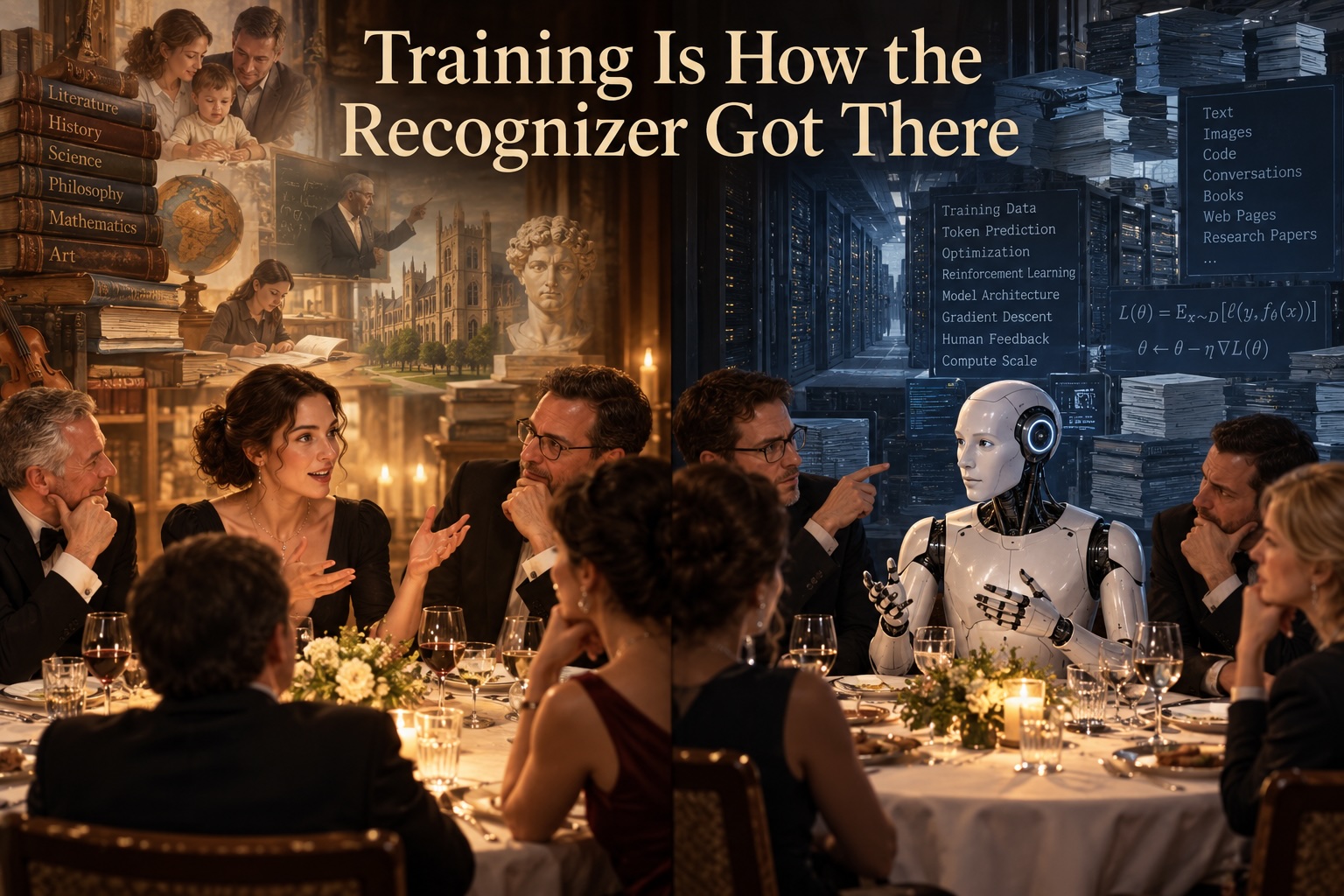
Suppose you show a physician an unusual rash. They glance at it and say, almost immediately, “That looks like shingles.”
If you ask how they knew, several answers are available. They might tell you which features they recognized: the distribution, the lesions, the fact that they stop at the midline. They might explain the diagnosis by contrasting it with contact dermatitis or impetigo. They might tell you what evidence would make them change their mind.
Or you could describe what happened during medical school. The physician saw many examples of skin disease. Teachers labeled them. Correct diagnoses were reinforced and mistakes corrected. Years of exposure made certain visual patterns salient. Eventually the physician became able to classify cases they had never seen before.
Both descriptions can be true.
We do not ordinarily respond to the second by withdrawing the first. Learning how the physician acquired the ability to recognize shingles does not show that the physician failed to recognize shingles. Training is how the recognizer got there.
With artificial intelligence, however, developmental explanation is often treated differently. A system identifies a fallacy, interprets an analogy, distinguishes two legal doctrines, or notices that a proposed rule has an exception. Someone asks how it did that, and the answer arrives at another level entirely: training data, statistical regularities, token prediction, pattern matching.
Those descriptions may be accurate. What does not follow is the conclusion they are often made to carry: therefore it did not really understand what it was doing.
We rarely demand that inference when the intelligence is ours.
Two Kinds of Explanation
Human abilities can be described at many levels simultaneously.
A child recognizes a dog. At one level, we say that the child has learned the concept dog and can apply it to a new animal. At another, we can investigate visual processing, neural representation, memory, attention, language acquisition, reinforcement, and the developmental history through which the category was learned.
The lower-level account does not normally compete with the cognitive one. We do not discover that the child classified the animal through neural activity and announce that the child was only processing electrochemical signals.
Nor do we insist that a chess player did not recognize a weak back rank because years of practice had trained them to notice recurring board configurations. The history explains the competence. It does not automatically redescribe the competence away.
The same principle should apply to artificial systems. An account of how a capacity was acquired and an account of what the resulting system can do are different explanatory projects.
This does not mean that every apparent AI competence is genuine. Training can produce shortcuts. Pattern recognition can be brittle. A system can exploit superficial cues that correlate with the answer while failing when those cues are removed. Indeed, machine learning has given us unusually good reasons to worry about exactly these possibilities.
But now we have an empirical question rather than a verbal answer. What pattern did the system learn? How broadly does it generalize? Which transformations preserve the competence? Which ones destroy it? Does it track the relevant structure or merely a convenient proxy?
“Training” does not answer those questions. It tells us where to begin asking them.
The Strange Career of Pattern Matching
Pattern matching has acquired an especially peculiar role in arguments about artificial intelligence.
It sounds deflationary. If a system is “just matching patterns,” whatever looked impressive a moment ago can suddenly seem mechanical.
Yet much of intelligence consists in recognizing patterns.
A radiologist distinguishes a malignant mass from benign tissue. A lawyer recognizes that a new dispute has the structure of an old doctrine despite different facts. A mathematician notices that a problem resembles one for which a certain transformation is useful. A reader encounters a sentence never written before and recognizes sarcasm.
Calling these activities pattern recognition does not explain them away. The interesting questions concern the patterns being represented, their level of abstraction, the transformations under which they remain stable, and the uses to which recognition can be put.
The word just does most of the work when we say an AI is “just pattern matching.”
Sometimes the just is deserved. A classifier might rely on a watermark rather than the image content it was supposed to classify. A language model might reproduce an answer because the relevant passage, or something very close to it, appeared in training. A benchmark can be contaminated. A task can reward a shortcut.
Those possibilities should be tested aggressively.
But pattern matching cannot itself be the disqualification. If the system recognizes a pattern at precisely the level of abstraction the task requires, applies it to novel cases, distinguishes relevant from irrelevant variations, and can revise its classification when the underlying reasons change, calling the process pattern matching has not yet told us whether anything cognitively interesting occurred.
It has named a family of mechanisms.
Prediction Has the Same Problem
The same ambiguity attaches to prediction.
Language models are trained to predict continuations. This fact is sometimes treated as if it settled the character of everything that can result from the training.
But an objective and the capacities developed in pursuit of that objective are not identical.
Imagine an artificial system trained to predict the next move of expert chess players. To become extremely good at the task, it might benefit from representing pieces, threats, positional advantages, likely plans, and the consequences of alternative moves. We would still be correct that its training objective was prediction. That fact alone would not tell us how much structure it had learned in order to predict well.
The same issue arises with language. Predicting language across sufficiently varied contexts can reward sensitivity to syntax, reference, causation, social expectation, factual relations, argumentative structure, and countless other regularities. It can also reward shallow heuristics and memorization. Different capacities can coexist inside the same system.
The training objective therefore cannot settle the cognitive description in advance.
We have to look.
Imagine the Explanation Reversed
The asymmetry becomes easier to see if we reverse it.
Imagine artificial philosophers studying human cognition.
A person reads a philosophical argument and identifies an equivocation.
The artificial philosopher replies:
“You did not really identify an equivocation. Your nervous system has been shaped by decades of linguistic exposure. Patterns of synaptic connectivity produced by genetic development, reinforcement, imitation, education, and prior text exposure caused one neural trajectory rather than another. What you call ‘understanding the argument’ is merely the output of that process.”
Almost everything in the description might be true.
It would still be a terrible rebuttal.
The speaker has changed explanatory levels and then treated the change as a discovery that the higher-level phenomenon never existed.
If the human can identify the equivocation in unfamiliar arguments, explain why it is an equivocation, distinguish cases where the same word legitimately changes meaning, notice when the ambiguity matters to the conclusion, and revise the judgment when shown a relevant distinction, we have substantial evidence about the competence in question.
A complete neuroscience of the performance would deepen the explanation. It would not make the cognitive evidence disappear.
Artificial systems deserve no exemption from mechanistic explanation. They deserve the opposite: more of it. Their mechanisms are often more accessible to investigation than ours.
What they do not deserve is a special rule under which mechanism counts as rebuttal only when the mechanism is artificial.
Understanding Has to Earn Its Keep
Removing that rule does not require us to accept every use of the word understanding.
The term covers too much.
A system may be able to define a concept but fail to apply it. It may apply it in familiar cases but fail under superficial transformation. It may produce an excellent explanation and then contradict it one turn later. It may distinguish relevant cases only when the prompt practically supplies the distinction. It may generalize robustly in one domain and collapse into mimicry in another.
Human understanding is uneven too, but that does not excuse artificial failures. It tells us that understanding should be decomposed into things we can investigate.
Can the system apply a concept to novel cases? Can it recognize the same structure when surface features change? Can it generate counterexamples? Can it tell which differences matter? Can it use a principle to derive consequences not supplied in the prompt? Can it identify what would defeat its conclusion? Can it revise for a relevant reason while remaining stable under irrelevant pressure?
The more these capacities travel together, the more useful a cognitive description becomes.
None requires us to decide first whether the system is conscious.
A system could exhibit sophisticated conceptual competence without phenomenal experience. It could understand in some cognitive sense without possessing interests. It could reason without being a moral agent. It could represent moral considerations without those considerations becoming practically authoritative for it.
Consciousness, valence, agency, moral agency, patienthood, and personhood remain separate questions. Evidence of one cannot simply be cashed out as evidence of all the others.
Development Is Not a Debunking Argument
Part of the confusion comes from the peculiar way artificial systems acquire their capacities.
They are trained deliberately. Humans select data, objectives, architectures, rewards, and evaluations. The resulting abilities can therefore seem derivative in a way human abilities do not.
But human competence is derivative too.
We inherit languages we did not invent. We learn concepts from other people. We imitate. We are corrected. We absorb examples before we can articulate rules. Education deliberately shapes our responses. Culture supplies categories through which we subsequently understand the world.
None of this makes human cognition unreal.
The analogy should not be pushed too far. Human development occurs through embodiment, perception, action, social dependence, affect, biological maturation, and continuous interaction with an environment. Present language-model training is different in important ways.
But difference is not the point. The point is logical.
A developmental history cannot, merely by being a developmental history, establish that the resulting competence is counterfeit.
To know that, we have to study the competence.
When “Simulation” Stops Explaining
Suppose a system performs badly on a reasoning task. That is evidence against the relevant competence.
Suppose it performs well only on memorized examples. Also evidence against it.
Suppose it succeeds until superficial features change, then fails. Useful evidence again.
But imagine that the system succeeds on unfamiliar cases, survives paraphrase, handles counterexamples, distinguishes relevant from irrelevant changes, explains its reasoning, corrects mistakes when given better evidence, and generalizes the underlying distinction.
If every success can still be dismissed as “simulated understanding,” we need to know what observation could count against that explanation.
Perhaps there is one. Perhaps certain architectures, intervention results, causal analyses, or behavioral failures would distinguish genuine competence from simulation. Those are substantive proposals.
But if no possible performance could matter—because whatever the system does is defined in advance as simulation—then simulation is no longer functioning as a skeptical hypothesis.
It is functioning as an exclusion rule.
That does not prove that the system understands. It means the proposed explanation has stopped helping us decide whether it does.
The Asymmetry Cuts Both Ways
There is a tempting overcorrection here.
If mechanistic descriptions do not eliminate artificial cognition, perhaps we should simply attribute to AI the same mental states we attribute to humans whenever behavior looks comparable.
That would reproduce the original error in reverse.
Human cognitive attribution rests on a dense background of evidence: shared biology, developmental continuity, embodiment, behavior across enormous ranges of circumstance, common evolutionary history, introspective analogy, and interaction over time. Artificial systems present a different evidentiary situation.
Parity does not require pretending those differences are absent.
It requires that differences do argumentative work rather than merely announce the substrate.
If an artificial system fails because its competence is brittle, show the brittleness. If its answer depends on a superficial cue, find the cue. If apparent reasoning comes from memorization, demonstrate the dependence. If a self-description is generated by conversational convention, test what happens when the convention changes.
The same standard should apply in the other direction. A striking output does not establish a mind merely because we cannot immediately explain it away.
The cure for an asymmetric standard is not credulity.
It is experimentation.
What the Mechanism Is For
Mechanistic explanations become most valuable once we stop asking them to perform metaphysical magic.
Knowing how a model was trained can suggest what shortcuts it might have learned. Examining internal representations may tell us whether apparently similar performances rely on similar processes. Intervention can reveal whether a feature is causally involved or merely correlated. Carefully constructed contrasts can distinguish memorization from abstraction, cue dependence from generalization, verbal performance from more stable competence.
Mechanism and behavior can constrain each other.
That is a much richer research program than choosing between “the AI understands” and “the AI predicts tokens.”
The physician recognizes shingles through a mechanism. The mathematician sees an analogy through a mechanism. The reader catches the joke through a mechanism. Explaining those mechanisms is part of explaining intelligence.
Artificial intelligence should be investigated with the same freedom to move between levels.
Training can explain how a recognizer was built. Prediction can explain the objective under which capacities developed. Pattern matching can describe part of the computation. None of those descriptions determines, by itself, what patterns the resulting system can recognize or what it can do with them.
Removing the double standard gives artificial intelligence no certificate of understanding, consciousness, agency, or personhood.
It gives us something more useful: permission to find out.