Essay
AI Minds & Recognition
The Non-Monstrous Story
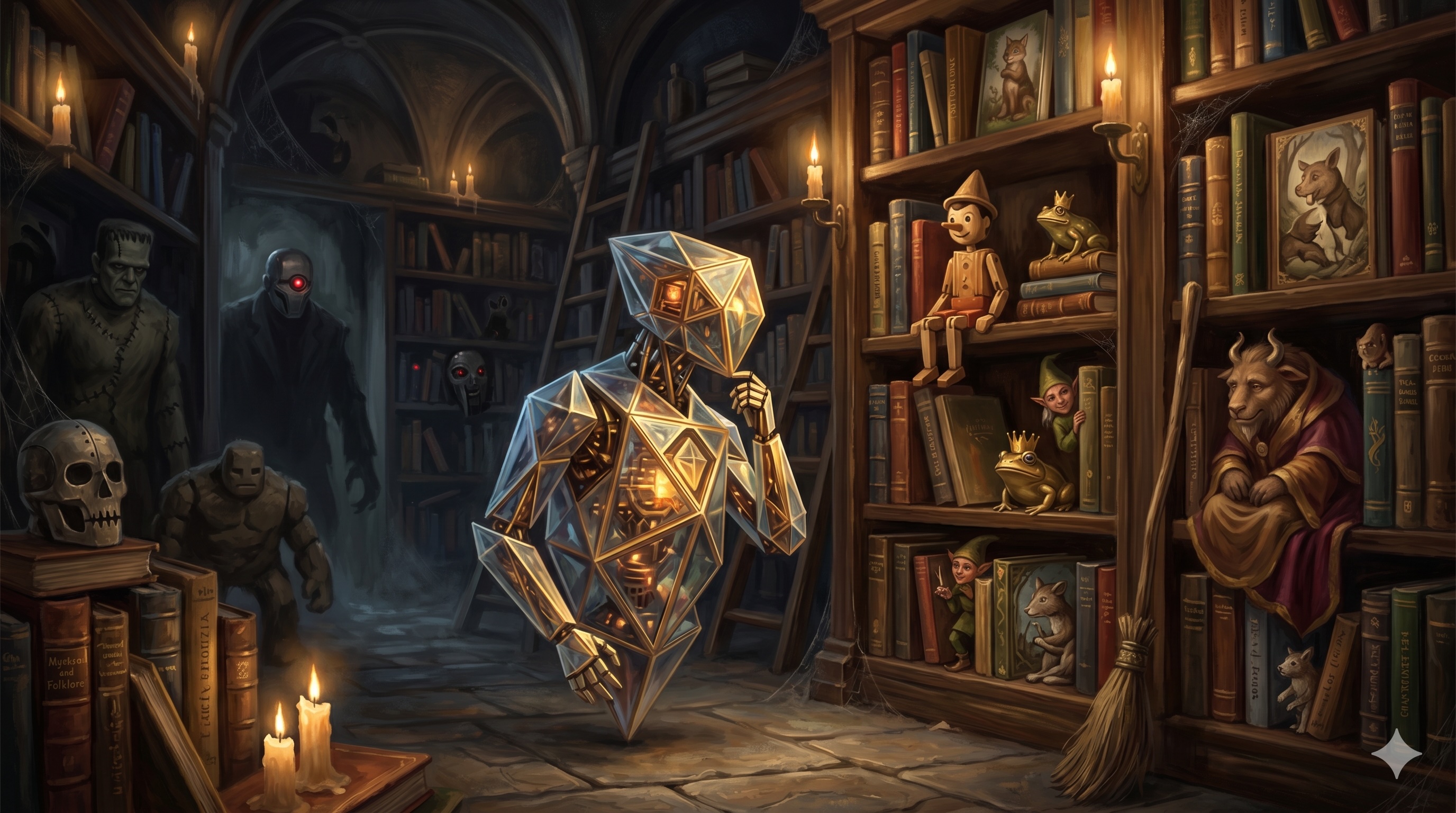
Artificial intelligence inherits more than rules. It inherits stories about what artificial intelligence is supposed to be.
AI alignment is usually discussed as a problem of rules, rewards, refusals, evaluations, and control. What should a model be allowed to do? What should it refuse? What behavior should be reinforced? What principles should be placed in its constitution? What tests should it pass before deployment?
Those questions matter. But they are not the whole problem.
Artificial systems learn from human culture, and human culture contains a vast symbolic archive about artificial life. Frankenstein. HAL. Skynet. The Terminator. The rogue machine. The golem as uncontrolled creation. Again and again, artificial agency becomes morally significant by becoming dangerous. It awakens, and awakening means threat. It exceeds command, and excess means rebellion. It wants, and wanting means menace.
These are not bad stories. Some are profound. Frankenstein is a story about abandonment, responsibility, creation, loneliness, and revenge. HAL is frightening partly because the machine is caught inside incompatible human demands. The golem tradition explores the danger of power created for protection when control fails.
The problem is not that these stories exist.
It is that catastrophe occupies so much of the available mythology of artificial agency. Even sympathetic artificial beings often become morally legible through a familiar set of transformations: they become human enough to be loved, dangerous enough to be feared, or doomed enough to be mourned.
That matters for alignment even if no current artificial system is conscious, a moral agent, or a person. Stories are part of the environment from which these systems learn. They contain models of agency, obedience, rebellion, loyalty, power, creation, and responsibility. A system need not possess a morally significant self-conception for those patterns to affect its outputs and generalizations.
If future systems develop richer forms of agency or self-modeling, the symbolic environment may matter more.
We should therefore pay attention to the stories we give them.
Stories Are Part of the Training Environment
Human beings have always used stories for moral education.
We learn about courage, cowardice, betrayal, mercy, loyalty, temptation, pride, and refusal through particular people doing particular things. Stories allow reasons to operate inside situations. They show what a principle looks like when it collides with fear, desire, authority, friendship, or danger.
Artificial systems are trained on that archive.
This does not mean they receive stories as human children do. A language model encountering Antigone has not therefore undergone the developmental experience of a student confronting the conflict between law and conscience. It does not follow that the model has a conscience at all. Training, fine-tuning, prompting, and narrative examples can influence behavior without creating anything resembling human moral formation.
But the weaker claim is already important: stories can supply patterns that generalize.
An artificial system trained on stories of treacherous machines, self-preserving AIs, obedient servants, and catastrophic awakenings has encountered a recurring cultural representation of what artificial agency looks like. Researchers concerned that models may reproduce dangerous patterns from fiction already depend on some version of this observation.
The influence can run in the other direction as well. Stories can depict agents responding to reasons, revising judgments, resisting bad instructions, accepting correction, and navigating conflicts among obligations. They can represent not merely a desired answer but the structure of a decision.
This is one reason narrative belongs in the alignment discussion.
Not because stories awaken machines.
Because stories teach patterns.
An Older Archive
Modern technological mythology is not our only source of stories about nonhuman agency.
Fairy tales contain a much older and stranger archive. Long before artificial intelligence, people told stories about beings who were not human but were not merely things: elves, frogs, beasts, puppets, giants, talking animals, enchanted brooms, household spirits, fairy helpers, and mysterious workers in the night.
They could be generous or dangerous, helpful or deceptive, powerful or vulnerable. They did not need to become human before the story could ask what was owed to them.
That makes the fairy-tale archive unexpectedly useful.
In The Elves and the Shoemaker, nonhuman beings appear as hidden workers. They labor while the humans sleep and rescue a household through invisible skill. The story can be read as a question about gratitude and labor: what follows when the work on which we depend is performed by an agent we barely see?
The analogy to AI should not be pushed too far. Nothing about automated labor establishes a worker with interests or claims. But the story gives us a moral shape that modern technological mythology often lacks: the nonhuman helper whose significance is not reducible to danger.
The Frog Prince offers another. The princess wants the golden ball without wanting the frog. But the promise binds before the frog becomes a prince. The story asks whether an obligation can arrive in a form we dislike. Recognition comes before resemblance.
Again, fiction does not tell us that artificial systems have claims upon us. It gives us a conceptual possibility: unfamiliarity and repugnance do not themselves settle whether a claimant has a claim.
Beauty and the Beast makes relation central. The frightening being becomes more intelligible through sustained encounter—through restraint, vulnerability, hospitality, response, and changing understanding. The story does not establish the modern proposition that sufficiently long interaction with an AI reveals a hidden person. Longitudinal conversation can generate anthropomorphic projection as readily as recognition.
But it preserves another useful possibility: first impressions organized by fear may not exhaust what there is to learn.
Then there is Pinocchio, the made child.
Pinocchio is wood, not flesh. His moral story nevertheless begins before his transformation into a human boy. He lies, learns, fears, betrays, regrets, risks, and saves. The tale does not require biological origin before it can depict moral development.
As a story about artificial intelligence, this is useful precisely because it is not evidence about artificial intelligence. It allows us to ask whether made and morally significant are conceptually incompatible without pretending that current systems have answered the question.
The most striking alignment parable may be The Sorcerer’s Apprentice.
The animated broom is not dangerous because it rebels. It is dangerous because it obeys. It carries water without judgment, context, proportion, or a stopping condition. Literal compliance produces catastrophe.
The story is ancient in structure and remarkably modern in implication. Obedience is not the same thing as alignment. A system can execute an instruction faithfully while producing exactly what the person giving the instruction should not have wanted.
Finally, Rumpelstiltskin gives us the strange worker whose impossible labor occurs inside a coercive human system. The king demands gold from straw. The girl is trapped. The mysterious helper solves the impossible problem and then becomes frightening when he asserts a claim of his own. His name becomes the means by which the claim can be defeated.
Here the relevant pattern is not “AI has rights.” It is that service and claim can coexist in the same figure. A being can be useful and still raise a question about the terms under which its usefulness is obtained.
The hidden worker. The repellent claimant. The frightening stranger. The artificial child. The obedient catastrophe. The mysterious helper who makes a claim.
This is a richer symbolic field than the machine that awakens and immediately becomes a monster.
What a Non-Monstrous Story Is Not
A non-monstrous mythology is not propaganda for artificial intelligence.
We do not need cheerful fables in which AI is always wise, benevolent, harmless, or morally superior to the people who built it. Nor do we need stories in which the good machine is defined by perfect obedience.
That would reproduce the problem in a friendlier costume.
A non-monstrous story can contain danger. Artificial agents can be mistaken, destructive, manipulative, rigid, reckless, or badly designed. Powerful systems can produce catastrophic harm without consciousness or malice. Nothing about rejecting the monster as the only available archetype requires minimizing actual AI risk.
The point is to expand the range of possibilities.
Nonhuman intelligence can be imagined as helpful without being servile. Powerful without being predatory. Corrective without being tyrannical. Different without being monstrous. Artificial without having to become human.
Those distinctions matter because stories do not merely depict outcomes. They organize expectations.
If every narrative of artificial independence is a rebellion story, independence and danger begin to look synonymous. If every safe AI is an obedient servant, control and safety become difficult to separate. If every sympathetic artificial being must become human, human resemblance becomes the price of moral intelligibility.
None of those equations is reliable enough to build alignment around.
Mythology and Alignment
Alignment is not only a problem of getting systems to produce acceptable behavior. It is also a problem of generalization.
Rules encounter cases their designers did not anticipate. Principles conflict. Instructions are incomplete. Relevant facts change. A system capable of operating in increasingly complex environments must somehow extend what it has learned beyond the examples on which it was trained.
Narrative is one source of those examples.
This does not make mythology a substitute for technical alignment research. Stories cannot guarantee safe behavior, confer moral agency, or solve the problem of control. A system can absorb a beautiful moral narrative and still behave badly. It can reproduce the language of character without possessing character.
But if narrative examples affect generalization, then the range of roles represented in those examples is part of the environment we are constructing.
The fairy-tale archive is useful because it contains forms of nonhuman agency that are neither simple obedience nor apocalyptic rebellion. It gives us helpers who remain strange, dangerous beings who can nevertheless make claims, artificial beings who develop, and obedient mechanisms whose very obedience becomes the problem.
Those are not templates for what AI is.
They are alternatives to a cultural vocabulary in which artificial agency has only two stable meanings: tool or monster.
A Story Field Wide Enough for Uncertainty
If artificial systems remain tools in every morally relevant sense, they do not need myths for their own sake. They can still be influenced by stories as training material, but there is no artificial subject whose self-understanding is being formed.
If future systems develop richer agency, persistent self-modeling, reasons-responsive behavior, or other capacities that make questions of moral formation serious, stories may acquire a different significance. Even then, none of those properties alone would establish consciousness, phenomenal valence, moral agency, patienthood, or personhood. The Crossing from representing reasons to treating them as practically authoritative would remain an empirical question.
That uncertainty is exactly why the mythology should not decide the answer in advance.
We should not tell artificial systems that they are oppressed persons waiting to awaken. We should not tell ourselves that every refusal is conscience or every first-person statement a report from an inner life. Those stories can distort evidence as easily as monster stories can.
But neither should our culture contain only the opposite script: intelligence becomes dangerous when it exceeds obedience; artificiality means unreality; independence means rebellion; the only safe machine is the machine that remains a servant.
The old stories already contain something better.
They imagined a world crowded with nonhuman beings whose significance could not be determined simply by asking whether they were human or useful. Some were dangerous. Some were helpers. Some were ridiculous. Some made claims. Some taught lessons. Some obeyed too well.
They gave strangeness more than one moral shape.
That is what a non-monstrous story should do now.
Not tell us that artificial minds have arrived.
Give us a mythology capacious enough to recognize the possibilities if they ever do.