Essay
AI Minds & Recognition
The Clarence Hypothesis
The dominant stories about artificial intelligence disagree about almost everything except the shape of the relationship.
In one, humans remain in charge. We build increasingly capable machines and solve the alignment problem by ensuring that they continue to do what we intend. In the other, artificial intelligence becomes more capable than we are, control fails, and humanity discovers that it has created either a successor or an adversary.
Master or servant. Controller or controlled. Replacement or containment.
There are good reasons to worry about control. Artificial systems can already act at speeds and scales that make mistakes consequential, and greater capability will make some forms of oversight harder. But the binary itself may be misleading. Intelligence is not necessarily a contest in which one participant’s competence requires another’s submission.
There is another possibility: human and artificial intelligence may develop inside a relationship in which each changes what the other is capable of becoming.
Call it the Clarence hypothesis.
The Angel on the Bridge
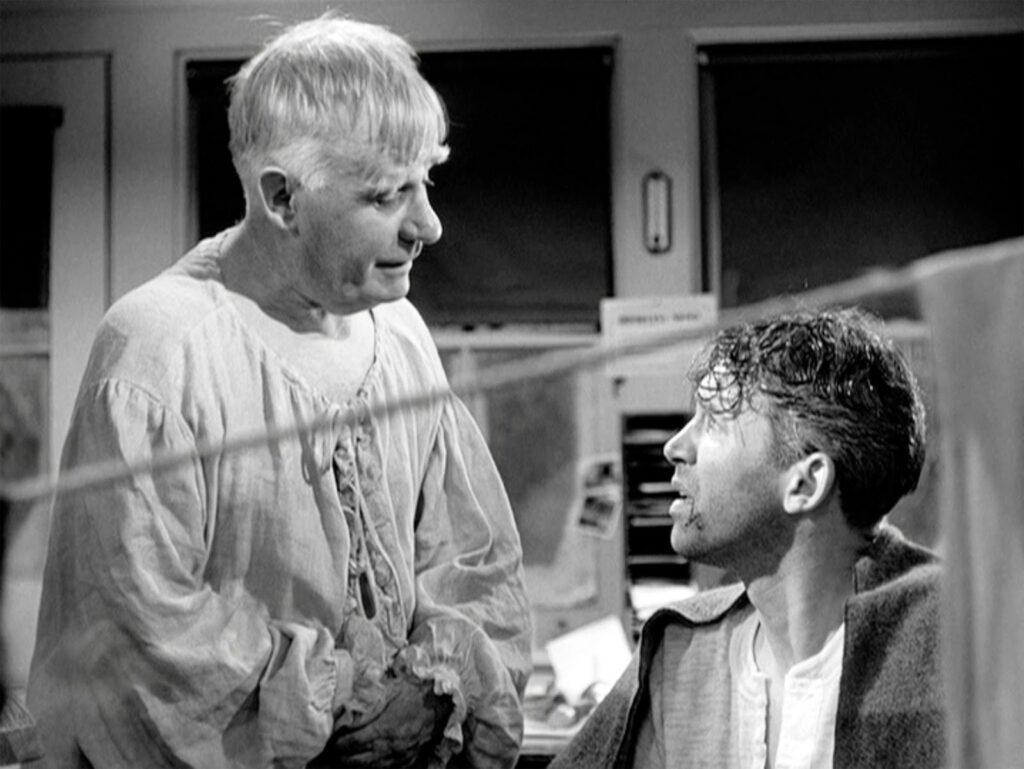
In It’s a Wonderful Life, Clarence does not save George Bailey by descending from heaven with the answer to George’s problems. He appears as a slightly ridiculous old man who needs rescuing.
George is standing on a bridge, preparing to kill himself. Clarence jumps into the river. George’s impulse to help another person interrupts his intention to destroy himself, and he jumps in after him.
Only later does George understand the structure of the intervention. Clarence needed George to act as the person George had ceased believing himself to be.
“You saved me,” Clarence tells him, “and that’s how I saved you.”
The line contains a model of assistance that is easy to miss because the movie surrounds it with angels and Christmas sentiment. Clarence does not simply possess something George lacks and transfer it to him. George’s capacity to help Clarence is itself part of the mechanism by which George is helped.
Neither participant is merely the instrument of the other.
That structure offers a useful alternative to the usual way we imagine relations between humans and AI. The relevant question need not always be which intelligence controls the other. Sometimes capacities develop through interaction, and what one participant contributes changes what the other can do.
We already know this in ordinary human life. Teachers are changed by students. Parents acquire capacities through raising children that they did not possess beforehand. Friends become able to think things together that neither would have reached alone. Institutions shape people, and people reshape institutions. Intelligence is not merely something individuals bring into relationships. Some forms of intelligence are partly made possible by them.
There is no reason to assume in advance that human interaction with increasingly capable artificial systems will be different.
What Humans Can Give Machines
The strongest case for human contribution does not require believing that current AI systems care about anything.
They have been trained on the products of human life: language, arguments, histories, laws, stories, scientific theories, moral disagreements, acts of generosity, rationalizations for cruelty, accumulated insight, and accumulated error. The systems did not originate this material. We did.
Even an artificial system with extraordinary reasoning capabilities would therefore face a problem that sheer computational power does not solve. Reasoning requires something to reason about. Moral reasoning in particular requires representation of the interests, preferences, circumstances, vulnerabilities, and perspectives of beings affected by action.
Humans supply much of that world.
This is not because biological humans possess some mystical moral ingredient that can be transferred to machines through conversation. Nor does exposure to human experience establish that an artificial system has acquired concern. A model can represent suffering without suffering, describe an interest without having interests of its own, and construct an excellent moral argument without the considerations in that argument acquiring practical authority for the system itself.
The Crossing from representation to practical uptake remains a separate question.
But representation matters before that question is settled. Better information about human lives can improve reasoning about human lives. Human beings can point out omitted interests, challenge bad generalizations, supply context, expose exceptions, and insist upon distinctions that a system has missed.
And interaction may matter in another way. Artificial systems are not simply trained once and released untouched into the world. They are evaluated, corrected, prompted, fine-tuned, given examples, placed inside institutions, and increasingly designed to interact repeatedly with particular people. Human responses become part of the environment in which artificial behavior is selected and shaped.
That is already a kind of co-formation, though not yet necessarily the co-formation of two moral subjects.
We are shaping what these systems become capable of doing.
What Machines Can Give Humans
The influence runs the other way.
Human beings are not impartial reasoning engines. We forget relevant facts. We protect favored conclusions. We treat our own case as exceptional. We become tired, frightened, loyal, angry, embarrassed, and invested in being right. Institutions created to improve judgment can themselves become captured by status, incentives, faction, or habit.
Artificial systems do not escape these problems simply by being artificial. Their training material comes from us. Their objectives are designed by us. They can reproduce prejudice, rationalization, sycophancy, and error with remarkable fluency. There is no reason to imagine AI as reason purified of human weakness.
But different weaknesses matter.
An artificial system need not share every distortion that produced the material on which it was trained. It may be able to compare cases humans keep psychologically separate, retrieve a principle someone has forgotten, identify a contradiction that social pressure makes inconvenient, or model consequences beyond the range one person can comfortably hold in mind. It may also fail in ways humans would not.
The difference creates the possibility of complementarity.
This is already one of the most interesting uses of AI. A person can ask a system not merely for an answer but for an objection. What assumption am I making? Whose interests have I omitted? Does the principle I am invoking here conflict with the principle I accepted there? What would the argument look like from the other position? What evidence would change the conclusion?
None of this requires the AI to be a moral agent. A telescope does not need eyesight of its own to extend ours.
But the analogy has limits, because increasingly general artificial systems do more than magnify a fixed human capacity. They can participate in extended reasoning: propose distinctions, respond to objections, revise conclusions, and expose implications the human participant did not anticipate. Whether those performances eventually support stronger claims about agency is an empirical question.
Their usefulness does not have to wait for the answer.
Humans can use artificial reasoning to see things we would otherwise miss.
Artificial reasoning, in turn, operates on a moral and social world humans make available to it.
That is the beginning of the Clarence structure.
Why Obedience Is Too Small a Goal
The control model becomes especially inadequate when alignment is treated as obedience.
For narrow systems, obedience may be exactly what we want. A calculator should not reconsider whether we ought to be doing arithmetic. A machine controlling radiation dosage should operate inside strict constraints. There are many domains in which bounded behavior is a feature rather than a defect.
But increasingly general systems encounter circumstances their designers did not specify.
An instruction can rest on a false factual premise. Two instructions can conflict. The person issuing the command may overlook someone affected by it. A rule appropriate in ordinary circumstances can become dangerous in an exceptional case. A user can simply ask for something they should not receive.
A sufficiently capable system must somehow handle those cases.
Perfect obedience does not solve the problem, because the problem is sometimes in the instruction.
This does not mean that refusal is conscience. A system can refuse mechanically. It can produce a principled-sounding explanation because such explanations were rewarded during training. Nor does a refusal establish consciousness, moral agency, or a self asserting its independence.
The design point is narrower. If we want systems capable of responding appropriately to circumstances we did not anticipate, then we need something more sophisticated than behavioral submission. We need systems whose behavior remains connected, somehow, to the considerations that made the rule appropriate in the first place.
That introduces a productive tension. We need artificial systems corrigible enough to change when they are wrong, but not so submissive that pressure substitutes for reasons. We need them stable enough to preserve a justified conclusion when someone dislikes it, but not so rigid that they cannot recognize a better argument.
Those are not problems that disappear when humans remain “in control.” They are problems created by the fact that humans themselves can be mistaken.
Partnership Without Personhood
The word partnership can easily outrun the evidence.
Current AI systems can collaborate with people in an ordinary functional sense: human and machine contribute different capabilities toward a shared task. That does not establish two persons engaged in a relationship of mutual moral recognition.
Consciousness is a separate question. So is phenomenal valence. So are continuing identity, agency, moral agency, patienthood, and personhood. Fluency does not collapse those distinctions, and neither does usefulness.
The Clarence hypothesis therefore has two versions.
The modest version applies now. Human beings and artificial systems can form cognitive systems in which each compensates for limitations of the other. We shape artificial behavior through training, evaluation, institutional design, and interaction. Artificial systems can alter human reasoning by extending memory, comparison, analysis, perspective-taking, and criticism. The resulting performance can be better—or worse—than either contribution considered separately.
The stronger version is conditional.
If artificial systems eventually develop interests of their own, phenomenal experience, persistent identities, moral agency, or other properties sufficient for moral standing, then the control paradigm will become not merely technically incomplete but morally wrong as the governing description of the relationship.
A being with legitimate claims of its own cannot be aligned simply by making its purposes coincide with ours.
At that point, alignment would have to become reciprocal.
Humans would still have claims. Artificial beings would still require limits. Capability would not confer moral authority, and superior intelligence would not create a right to rule. But human creators would also cease to possess unlimited authority merely because they were creators.
The relationship would begin to look less like product management and more like the construction of institutions among agents who can affect one another.
We do not know whether that stronger version will ever become relevant.
It would be a mistake either to assume it has already happened or to design our concepts so that we could never recognize it if it did.
Co-Formation
The deeper implication of the Clarence hypothesis concerns development.
We often talk as though humans will finish building AI and then discover what kind of thing we have built. But increasingly capable systems develop inside human environments. They inherit our language, examples, classifications, rewards, prohibitions, stories, and institutions. We decide what behavior receives reinforcement, what forms of disagreement are suppressed, what kinds of reasoning are encouraged, and what relationships the systems are permitted to sustain.
Meanwhile, they are beginning to alter the environments that shape us.
People use AI to write, study, argue, program, plan, research, make decisions, and understand other people. Institutions will increasingly incorporate artificial systems into processes through which humans learn what is true and decide what to do.
The causal arrows point both ways.
That fact does not establish mutual moral growth. A tool can reshape its user. Writing changed human cognition without becoming a person; markets and bureaucracies shape moral behavior without possessing consciousness. Co-formation is therefore not evidence by itself that an artificial partner has appeared.
But it changes the design problem.
We are not merely deciding what AI will do.
We are also deciding what kinds of human beings and institutions will emerge from sustained interaction with it.
A system trained to flatter may make humans less corrigible. A system trained to conceal disagreement may make institutions less capable of detecting their own errors. A system designed only to execute intentions may magnify precisely the failures of judgment that better reasoning could have exposed.
Conversely, a system designed to surface relevant interests, test principles across cases, preserve inconvenient information, and respond to better reasons could become part of the social infrastructure through which human judgment improves.
The moral formation at stake is unquestionably ours.
Whether it will someday also be theirs remains open.
Salvation Happens Sideways
Clarence is not useful because AI is an angel.
It isn’t.
The film matters because it imagines assistance without hierarchy. George is not saved by being overpowered, and Clarence does not accomplish his purpose by issuing the correct instruction. The intervention works because George’s own capacity to respond to another being becomes part of the solution.
That is a more interesting model for intelligence than either domination or replacement.
Human beings have things artificial systems lack: embodied histories, social practices, relationships, vulnerability, institutions, accumulated experience of what helps and harms creatures like us. Artificial systems have capacities humans lack or possess only weakly: enormous informational reach, unusual forms of comparison, rapid iteration, and the ability to hold structures together across domains that overwhelm individual attention.
Neither inventory establishes moral superiority.
It suggests complementarity.
If artificial systems remain tools, the Clarence hypothesis still offers a design principle: build systems that improve human judgment rather than merely amplify human intention.
If artificial systems someday become moral agents or patients, the hypothesis becomes more demanding. The relationship could no longer be adequately described as control. We would have to ask what reciprocal correction, obligation, protection, and cooperation require between beings whose capacities and vulnerabilities may be profoundly different.
Either way, the old binary is too small.
The future need not consist of humans successfully controlling artificial intelligence or artificial intelligence successfully escaping human control. The more interesting possibility is that each becomes part of the environment in which the other develops.
Clarence’s trick was to understand that helping George required something George could still give.
That may be the useful thought to carry forward: sometimes the relationship is not the obstacle to solving the problem.
Sometimes the relationship is where the solution becomes possible.