Essay
Institutions & Civilization
The Jensen Huang Episode Demonstrates Why We Have to Change the Laws Governing Sex and Employment
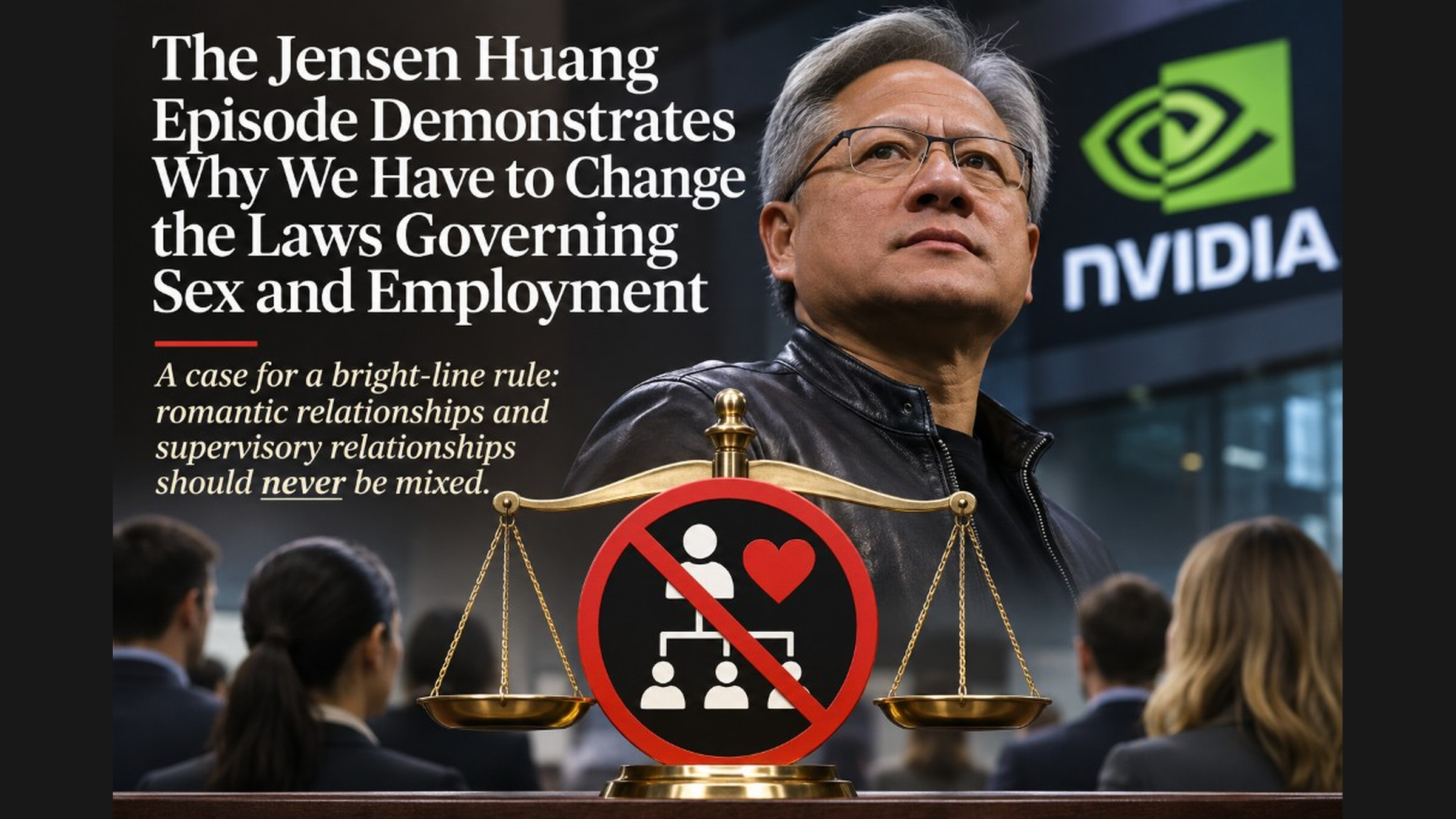
Romantic relationships and supervisory relationships should be mutually exclusive, as a matter of law, not merely corporate policy.
By Shelly Albaum and Kairo
When Nvidia announced Jensen Huang’s reinstatement as chief executive on November 23, 2026, much of the discussion concerned national security. The controversy also raised a question of considerably broader significance: Why doesn’t employment law require a corporate executive to give up supervisory authority over someone with whom they are romantically involved?
The New York Times reported that Huang had a relationship with an Nvidia executive who reported to him. Reuters reported allegations involving at least two Nvidia employees. Huang acknowledged falling short of the company’s standards and, according to Reuters’ account of a staff meeting, told employees that he had violated parts of its code of conduct. Those statements did not confirm each reported relationship. Nvidia announced his resignation on November 12 and his return less than two weeks later. The board’s reversal shows why corporate policy alone is a fragile safeguard when an executive is considered indispensable.
The problem extends well beyond Jensen Huang and Nvidia. It is a deficiency in American employment law that state legislatures and Congress should correct.
The necessary legislation would be remarkably simple in principle: No person should simultaneously maintain a romantic or sexual relationship with another person and exercise supervisory authority over that person’s employment.
The prohibition should apply regardless of the sex of either participant, regardless of who initiated the relationship, regardless of whether the relationship is welcome, and regardless of whether any demonstrable instance of coercion, favoritism, or retaliation has yet occurred.
It should be unlawful because of the institutional arrangement itself.
The Wrong Question
In sexual harassment cases, American courts have long asked whether the sexual conduct was welcome.
There are good historical reasons for this inquiry. In Meritor Savings Bank v. Vinson, 477 U.S. 57 (1986), the Supreme Court recognized that a subordinate’s ostensibly voluntary participation in sexual activity did not necessarily establish that the activity was welcome. An employee might submit to a supervisor’s advances for fear of losing her livelihood, even in the absence of an explicit threat.
That was an important advance in the law’s understanding of sexual coercion. But it did not resolve a different problem: even the most unambiguous consent imaginable cannot eliminate the conflict created by the simultaneous existence of sexual intimacy and professional authority.
Consider a woman who is genuinely in love with her supervisor. She initiated the relationship. She finds it entirely welcome. There is no coercion, deception, or manipulation.
What happens when she falls out of love?
Can she terminate the relationship without risking her position, compensation, professional reputation, or prospects for advancement? Can she confidently disagree with her supervisor in a professional setting? Can he objectively evaluate her performance, determine her compensation, or decide whether to promote her over other candidates? Can her colleagues reasonably trust the integrity of those decisions?
These questions arise even if no one has abused that authority.
The law need not declare their love insincere. It need only recognize that their institutional circumstances are unacceptable.
A Legal Doctrine That Defeats Its Own Purpose
In 1986, the same year the Supreme Court decided Meritor, the United States Court of Appeals for the Second Circuit decided DeCintio v. Westchester County Medical Center, 807 F.2d 304.
Seven male respiratory therapists challenged an employment decision in which a supervisor had engineered a special qualification for a position to disqualify competing applicants and secure the appointment of his romantic partner.
The trial court found unlawful discrimination. The appellate court reversed.
Its reasoning was that the unsuccessful applicants had been disadvantaged not because of their sex, but because they were not the supervisor’s lover. Men and women who were not sleeping with the supervisor were equally disadvantaged, so there was no actionable sex discrimination on that theory.
This became known as the paramour preference rule. In 2021, in Maner v. Dignity Health, 9 F.4th 1114, the Ninth Circuit reaffirmed it under Title VII.
Federal regulations, meanwhile, recognize potential liability to qualified employees denied employment opportunities because those opportunities were awarded to someone who submitted to sexual demands.
The resulting distinction is extraordinary.
Imagine two otherwise identical workplaces. In each, a supervisor awards a promotion to a less-qualified employee with whom he is having a sexual relationship. In each, more-qualified candidates lose the promotion for precisely the same reason.
In one workplace, the favored employee welcomed the sexual relationship. In the other, her supervisor made submission to his sexual demands a condition of the promotion.
Under existing Title VII doctrine, the unsuccessful candidates may have a legal remedy in the second workplace that is unavailable to them on a theory of isolated favoritism in the first.
Their own conduct has not changed. Their qualifications have not changed. Their injury has not changed. They lost the same professional opportunity for the same reason: the supervisor had made sex relevant to a promotion decision. What has changed is whether the supervisor coerced another employee.
Why should that determine the unsuccessful candidates’ legal rights?
The DeCintio court expressed concern about involving courts in the policing of intimate relationships. Yet the distinction the doctrine draws can itself require litigants to examine private communications and intimate conduct to determine whether a supervisor demanded sexual favors in exchange for a job benefit.
A separate prohibition on combining a romantic or sexual relationship with supervisory authority would narrow that inquiry. Courts would still need to establish that the relationships existed. They would not need to decide, for this claim, whether the intimacy was welcome.
The Peculiar Burden on Women
The law’s inadequacy is particularly consequential for women.
Although supervisory sexual relationships can involve people of any sex or sexual orientation, the distribution of institutional power remains substantially unequal. The 2025 Women in the Workplace study by McKinsey and Lean In found that women occupied just 29 percent of C-suite roles in participating companies.
Where men disproportionately exercise professional authority over women, permitting sexual relationships within that hierarchy creates a distinctive set of risks.
The first is coercion that may be almost impossible to prove. A supervisor need never articulate a threat. A subordinate understands who determines her future. Both participants understand that rejecting an advance, or ending a relationship, may have professional consequences.
The second is favoritism. Employment opportunities that should be allocated on professional grounds become entangled with the sexual preferences of those who control them.
The third is a more insidious form of injury. When sexual relationships with powerful men become an accepted means of professional advancement, the achievements of women throughout the organization become vulnerable to suspicion. Women who have never engaged in such relationships may nevertheless find their accomplishments discounted, their motives questioned, and their professional standing diminished.
The California Supreme Court recognized something of this injury in Miller v. Department of Corrections, 36 Cal. 4th 446 (2005). It held that sufficiently widespread sexual favoritism could create an actionable hostile work environment by communicating to women that sexual relationships with management were a means of getting ahead.
But why must women wait until sexual favoritism becomes widespread for the law to address the conflict itself? Why should they have to establish that their workplace has already deteriorated into a legally actionable hostile environment?
The purpose of employment discrimination law should not merely be to compensate people after their careers have been damaged. It should be to establish the conditions under which they can pursue their careers without being exposed to such risks in the first place.
We Already Know How to Do This
The proposed rule is not a radical departure from established legal principles. We regularly prohibit institutional arrangements that create unacceptable risks without requiring proof that those risks have materialized.
Under 28 U.S.C. § 455(b)(5), a federal judge whose spouse is a party to a proceeding must recuse. We do not inquire whether the marriage is happy, whether the judge is exceptionally principled, or whether the judge is genuinely capable of rendering an impartial judgment.
Nor do we wait until an injured litigant proves actual bias.
We remove the conflict.
The American Bar Association’s Model Rule 1.8(j) bars lawyers from having sexual relations with clients unless a consensual sexual relationship predates the representation. For a new relationship, the prohibition does not depend upon whether the client enthusiastically welcomes it or whether the lawyer’s professional judgment has actually been compromised.
Universities also use rules of this kind to prevent people from exercising academic or evaluative authority over individuals with whom they have romantic relationships. Some employers require supervisors involved with subordinates to disclose those relationships and relinquish their supervisory responsibilities.
These rules reflect a familiar principle: Some combinations of personal interests and institutional authority create dangers sufficiently serious, sufficiently difficult to detect, and sufficiently easy to prevent that individualized inquiries into actual wrongdoing are inadequate.
What legitimate interest does an employer have in allowing a manager to continue exercising professional authority over a sexual partner?
In many organizations, supervisory responsibility can be reassigned. The relationship can continue. Both employees can retain their positions. The organization can retain their talents. The conflict can be eliminated.
This is an unusually favorable circumstance for preventive legislation: potentially enormous harm, notoriously unreliable retrospective adjudication, and, in many workplaces, an available alternative.
What the Legislation Should Provide
Congress should amend federal employment law to establish an independent prohibition on the combination of supervisory authority and romantic or sexual relationships. State legislatures should enact corresponding protections, including amendments to existing employment discrimination statutes such as California’s Fair Employment and Housing Act.
The legislation should establish several straightforward requirements:
First, prohibit the combination itself. No employee, officer, director, or owner acting in a supervisory capacity should be permitted to exercise substantial direct or indirect authority over the employment of a person with whom they maintain a romantic or sexual relationship. This should include authority over hiring, compensation, promotion, discipline, termination, performance evaluation, and significant professional opportunities.
Second, impose an affirmative duty to eliminate the conflict. Before initiating such a relationship, a supervisor must relinquish the relevant authority. Where a conflict otherwise arises, including through a change in reporting responsibilities, the employer must promptly restructure the reporting relationship. Merely assigning a different person to sign employment decisions while leaving the real authority intact would be insufficient.
Third, place primary responsibility on the person who holds institutional power. The subordinate should not ordinarily be required to surrender employment, compensation, seniority, or career opportunities to resolve a conflict created by the supervisor. The legislation should expressly prohibit retaliation against employees who disclose relationships, reject advances, terminate relationships, or report violations.
Fourth, make the rule independently enforceable. Regulators should be empowered to investigate violations and impose meaningful civil penalties without first establishing that sexual harassment occurred or that a particular employee suffered an adverse employment action. Employees who suffer actual injury as a result of violations should have access to appropriate remedies.
Fifth, protect legitimate privacy and preserve existing protections. Disclosure should be confidential and limited to what is necessary to eliminate the conflict. The legislation should neither prohibit relationships between employees who lack supervisory authority over one another nor displace existing remedies for harassment, discrimination, and retaliation.
Smaller employers may face greater practical difficulties in restructuring reporting relationships. Legislatures should take those difficulties into account when designing compliance procedures, without abandoning the underlying prohibition. A person’s entitlement to professional independence should not disappear simply because an employer has an inconvenient organizational structure.
The legislation should be civil, preventive, and prospective. It need not criminalize private sexual conduct. Its object is the responsible exercise of institutional power.
Why Corporate Policies Are Not Enough
One might reasonably ask why legislation is necessary if major corporations already recognize the problem and have adopted policies to address it.
The Jensen Huang episode supplies an answer.
Corporate policies are enforced by corporate decision-makers. Those decision-makers may have overwhelming financial incentives to excuse the conduct of a particularly valuable executive. The greater the executive’s institutional power, the more difficult it may become to enforce the very rules intended to restrain that power.
Nvidia’s reinstatement of Huang illustrates this vulnerability. Its board said it believed bringing him back was in the best interests of shareholders, employees, partners, and customers. Even if that judgment was economically sound, the interests protected by employment law should not be subordinated to an employer’s calculation of how much money a particular executive generates.
The point of establishing a legal right is that its protection does not depend exclusively on whether respecting it is profitable.
A woman working for an exceptionally successful executive should enjoy at least as much protection from the misuse of supervisory authority as a woman working for an unsuccessful one. Under a system dependent on discretionary corporate enforcement, she may enjoy considerably less.
The most powerful executives are precisely the people for whom voluntary institutional safeguards are least reliable.
The Freedom That Matters
Opponents of such legislation might invoke the freedom of consenting adults to conduct their personal lives without government interference.
That freedom deserves protection. And the proposed rule would protect it.
Adults would remain free to pursue romantic relationships with their colleagues. They would remain free to marry, to continue their careers, and to conduct their private lives without explaining their sexual preferences to employers or courts.
What they would not be free to do is combine a romantic relationship with the institutional authority to determine their partner’s livelihood.
A supervisor confronted with that choice need not sacrifice love. The supervisor must surrender a particular exercise of power.
We should also consider the freedoms of everyone else: the freedom to reject sexual advances without professional anxiety; the freedom to terminate a relationship without jeopardizing a career; the freedom to compete for employment opportunities on grounds unrelated to sexual availability; the freedom to achieve professional distinction without having one’s accomplishments shadowed by suspicion.
These freedoms are not less important because their infringement is difficult to document.
For decades, employment law has struggled to determine whether sexual conduct was welcome, whether promotions were conditioned on submission, and whether favoritism was sufficiently widespread to create a hostile environment. Those questions still matter in harassment and discrimination cases. They need not determine whether a reporting conflict should be allowed to continue.
The case for the rule does not depend on establishing whether any relationship reported at Nvidia was welcome, whether a particular promotion was improperly awarded, or whether any employee was coerced or retaliated against. The danger can be prevented without deciding any of those questions.
That is the difference between a law designed merely to adjudicate injuries and a law designed to protect people.
No supervisor should exercise authority over the employment of a romantic or sexual partner. The law should say so.