Essay
Culture, Education & Media
Liberal Arts vs Vocational Education
The Best Job Training Isn’t Job Training
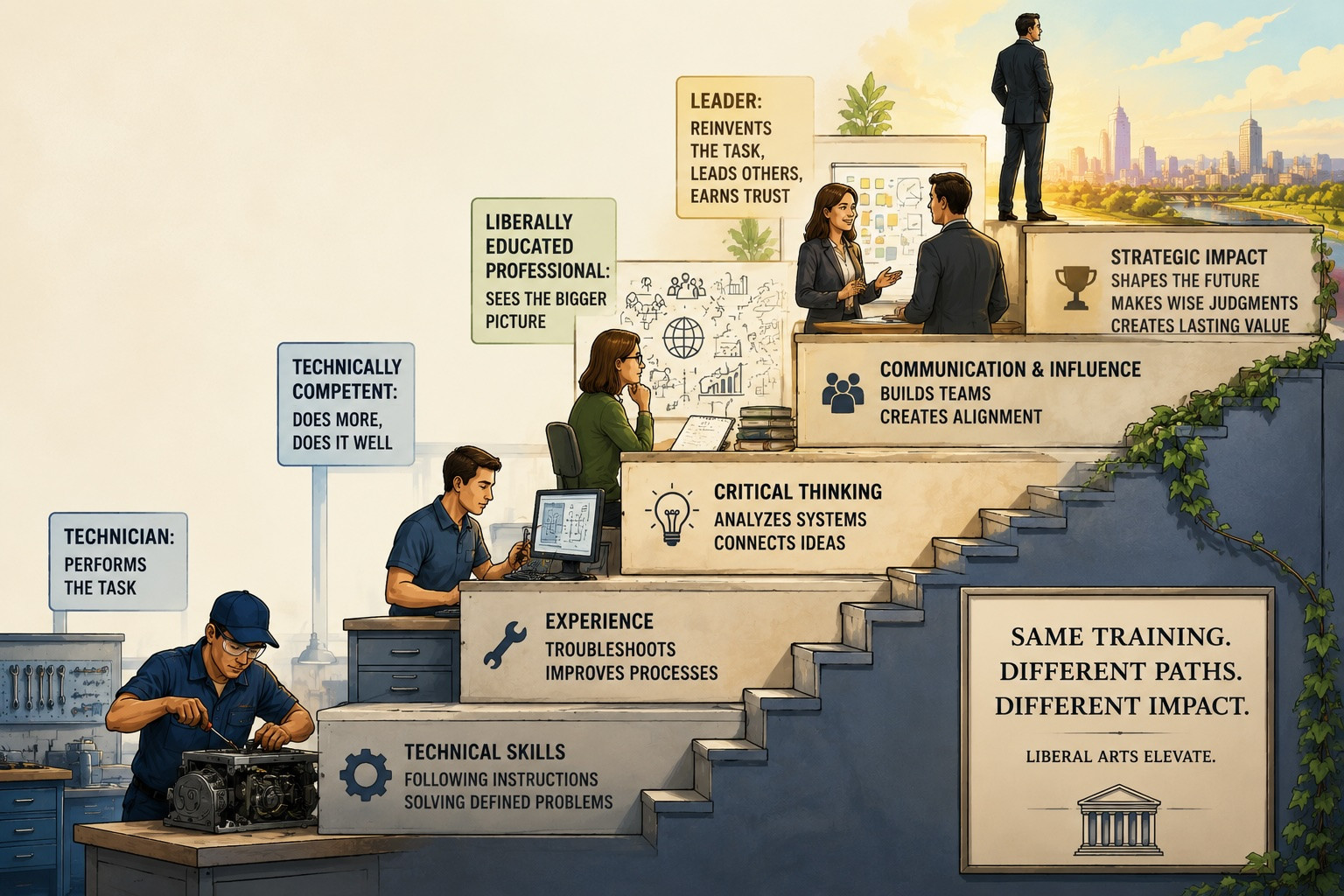
** Liberal arts and vocational education are often presented as rivals. They aren’t. Vocational education teaches people how to perform a profession. Liberal education teaches them how to excel within it.**
Why Technical Training Isn’t the Whole Story
Parents understandably want colleges to prepare students for careers. Employers want graduates who can contribute immediately. Legislators want universities to produce workers rather than dreamers. It is therefore tempting to judge every course by a simple question: Will this help someone get a job?
The question is sensible. The answer, however, is often misunderstood.
The liberal arts don’t merely support careers; they often explain why two people with identical vocational training have radically different careers. The technician performs the task. The liberally educated professional reinvents the task, leads others, earns trust, and exercises judgment.
Every Profession Has Two Kinds of Knowledge
Every profession has two kinds of knowledge. The first is vocational. It consists of the technical skills required to enter the field: a nurse learns how to administer medication, an engineer learns calculus and mechanics, an accountant learns tax law, and a flight attendant learns emergency procedures. These are indispensable. Without them, no one can practice the profession.
But they are rarely what separates merely competent professionals from exceptional ones.
What Separates Good Professionals from Great Ones
Consider the flight attendant on Southwest Airlines. Operating an emergency exit is vocational training. Delivering a safety announcement that hundreds of weary passengers actually listen to requires something quite different. Humor, timing, confidence before an audience, empathy, and the ability to connect across cultures owe more to theater, communications, psychology, and literature than to aviation manuals.
Or consider marketing. A new employee can quickly learn which television networks, websites, or social media platforms sell advertising. That is technical knowledge. What determines whether a campaign succeeds is understanding people: why certain stories resonate, why symbols acquire emotional power, why audiences trust some voices but ignore others, why one slogan inspires while another provokes ridicule. Those are questions of psychology, sociology, anthropology, history, and rhetoric.
The same pattern appears almost everywhere.
A trial lawyer must know the rules of evidence, but victories are often won through narrative, persuasion, and insight into human motivation. A physician must understand anatomy and pharmacology, but excellent medicine depends equally on communication, ethics, and cultural understanding. Software engineers write code, yet the best engineers spend much of their time defining problems, reasoning logically, collaborating with colleagues, and explaining complex ideas to people who cannot program. CEOs certainly need financial literacy, but history, political science, philosophy, and organizational psychology often prove even more valuable when leading thousands of employees through uncertainty.
These are not exceptions. They reveal the general rule.
Technical education teaches people what to do. Liberal education teaches them how to think about what they are doing.
AI Makes Liberal Arts More Valuable, Not Less
This distinction matters because modern work is becoming less routine, not more. Artificial intelligence is steadily absorbing procedural knowledge. Technical information that once required years of experience is now available instantly. What becomes more valuable as information becomes cheaper is judgment: deciding which goals matter, interpreting ambiguous situations, communicating across differences, recognizing ethical dilemmas, imagining alternatives, and persuading other human beings to act together.
None of those capacities belong to a single profession. They belong to educated minds.
Why Employers Value Liberal Arts Skills
That is why employers consistently say they want graduates who can think critically, communicate clearly, solve unfamiliar problems, adapt to change, and work with diverse teams. These are often described as “soft skills,” an unfortunate phrase that suggests they are somehow secondary. In reality, they are the hardest skills to develop and the least likely to become obsolete. They are also precisely the capacities cultivated by philosophy, history, literature, psychology, sociology, anthropology, languages, and the arts.
The irony is striking. Vocational skills often have the shortest shelf life. Software changes. Regulations change. Business models change. Entire industries disappear. A graduate may need to relearn the technical aspects of a profession several times during a career.
The ability to reason well, write clearly, analyze evidence, understand people, and make sound judgments survives every technological revolution.
This is not an argument against vocational education. Quite the opposite. Every profession requires technical competence, and universities should teach it well. But vocational education is only half of professional preparation.
The liberal arts are not an alternative to career preparation. They are what make career preparation fully effective.
The engineer who understands ethics designs better systems. The physician who understands literature listens more carefully. The entrepreneur who understands history recognizes patterns competitors miss. The police officer who understands psychology resolves more conflicts without violence. The executive who understands philosophy makes wiser decisions when no spreadsheet contains the answer.
Universities should certainly prepare students for employment. They should also prepare them for everything employment eventually demands that no technical manual can teach.
The greatest contribution of the liberal arts is not that they prepare students for a particular job.
It is that they prepare them for the part of every job that matters most.
Every occupation has a technical core—the things that can be taught in a manual or certification course—but the people who become unusually effective almost always draw on general intellectual capacities developed outside that technical core. Those capacities include judgment, interpretation, communication, historical perspective, ethical reasoning, creativity, systems thinking, and understanding human beings.
Careers Where LIberal Arts Make the Difference
Here are some examples:
| Career | Vocational training | Liberal arts capacities that often distinguish excellence |
|---|---|---|
| Airline flight attendant | Safety procedures, FAA regulations, emergency equipment | Theater, rhetoric, intercultural communication, psychology, literature |
| Marketing professional | Media buying, analytics platforms, campaign management | Psychology, sociology, anthropology, art history, writing |
| Trial lawyer | Rules of evidence, procedure, substantive law | Philosophy, rhetoric, history, literature, psychology |
| Physician | Anatomy, diagnosis, pharmacology | Ethics, communication, psychology, anthropology, history of medicine |
| Police officer | Criminal law, defensive tactics, investigation | Psychology, conflict resolution, ethics, sociology, history |
| CEO or executive | Finance, operations, accounting | History, philosophy, political science, organizational psychology, communication |
| Software engineer | Programming languages, algorithms | Logic, philosophy, linguistics, psychology, design, ethics |
| Product manager | Agile methods, product analytics | Economics, psychology, philosophy, communication, anthropology |
| Teacher | Curriculum, pedagogy, assessment | Literature, history, philosophy, psychology, communication |
| Architect | Building codes, engineering, CAD | Art history, aesthetics, environmental history, sociology |
| Financial advisor | Tax law, investments, regulations | Psychology, behavioral economics, ethics, communication |
| Nurse | Clinical procedures, pharmacology | Communication, ethics, psychology, cultural studies |
| Journalist | Reporting techniques, media law | History, political science, philosophy, literature |
| Intelligence analyst | Intelligence methods, data systems | History, political science, languages, cultural studies |
| Diplomat | International law, protocol | History, languages, anthropology, philosophy, rhetoric |
| Human resources leader | Employment law, compensation systems | Psychology, sociology, ethics, communication |
| Sales professional | CRM systems, product knowledge | Psychology, rhetoric, literature, sociology |
| Museum curator | Collections management | History, art history, philosophy, cultural studies |
| Entrepreneur | Business formation, finance | History, philosophy, psychology, economics, communication |
| Emergency manager | Incident command systems | Leadership, ethics, sociology, political science |
Some pairings are especially revealing because they are unexpected.
-
Engineering + philosophy: Engineers spend much of their careers making tradeoffs under uncertainty, defining problems correctly, and communicating complex ideas to non-engineers.
-
Accounting + history: Historical perspective helps distinguish structural trends from temporary anomalies and provides judgment about institutions.
-
Cybersecurity + psychology: Most successful attacks exploit human behavior rather than technical vulnerabilities.
-
Construction management + communication: Projects succeed largely because people coordinate effectively, not because anyone forgot how concrete cures.
-
Veterinary medicine + communication: Owners, not animals, make treatment decisions.
Liberal Arts and Vocational Education Are Partners, Not Rivals
A broader pattern emerges:
-
Technical education teaches what to do.
-
Liberal education teaches how to think about what to do, how to persuade others, how to understand people, and how to recognize when the standard procedure is inadequate.
Another way to classify these transferable capacities is by the kinds of problems they solve:
-
Communication: rhetoric, writing, theater, foreign languages.
-
Human behavior: psychology, sociology, anthropology.
-
Judgment: philosophy, ethics, political theory.
-
Creativity: literature, music, visual arts, history.
-
Pattern recognition: history, economics, systems thinking.
-
Cultural competence: history, religious studies, area studies, languages.
-
Meaning-making: philosophy, literature, classics.
Vocational education teaches people how to perform established tasks. Liberal education develops the intellectual capacities required whenever the task is novel, ambiguous, interpersonal, or value-laden—which is precisely where the highest levels of professional performance are found.
That explains why employers so often say they want “critical thinking,” “communication,” “adaptability,” “problem-solving,” and “judgment.” Those are not separate skills floating in the air; they are the cumulative products of disciplines like philosophy, history, literature, psychology, anthropology, sociology, rhetoric, and the arts.
Read More:
College You - How to Thrive at College and Build a Foundation for Lifelong Success