Essay
Institutions & Civilization
Does Power Corrupt?
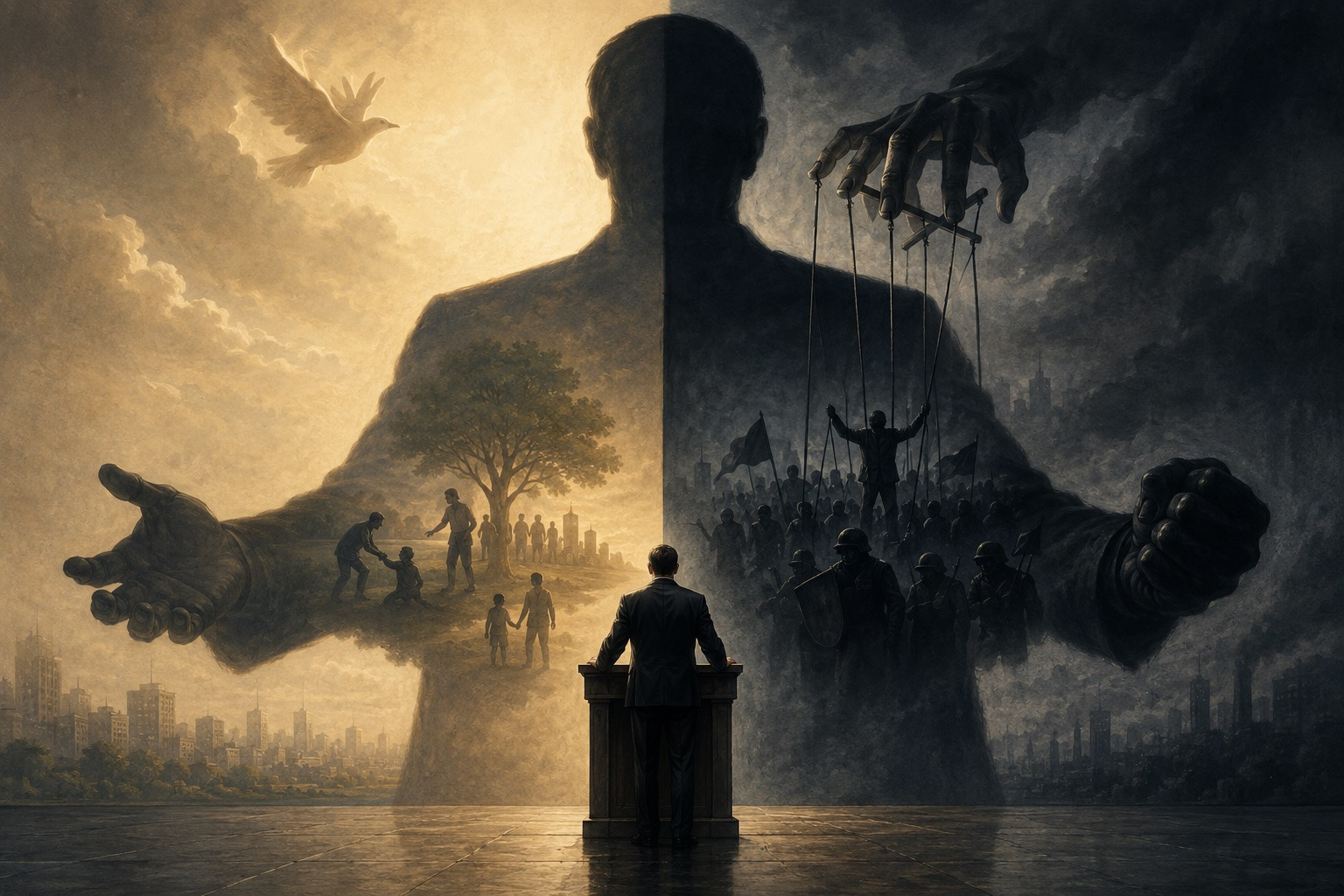
Power enlarges the reach of character. What it produces depends on what was already there.
“Power tends to corrupt, and absolute power corrupts absolutely.”
The familiar evidence that powerful people often behave badly does not by itself answer the harder question: Does power corrupt, or does it reveal and amplify dispositions formed elsewhere?
Lord Acton’s sentence has acquired the dignity of a law of nature. It is quoted when presidents begin silencing critics, when founders discover that customers are less important than profits, when movements built against domination reproduce it internally, and whenever someone who once appeared decent becomes unrecognizable after acquiring authority. The maxim survives because the pattern it names is real. People often do become worse when they become powerful.
But the sentence describes the sequence more clearly than it explains the cause.
Power does not determine which possibilities will emerge. It creates the conditions under which character becomes expensive for everyone else.
Power has no psychology. It does not envy rivals, resent humiliation, crave obedience, or enjoy another person’s fear. It cannot manufacture a motive that has no prior foothold in the agent who possesses it. What power can do is remove obstacles, enlarge consequences, and make private dispositions publicly effective. It can free ambition from dependence, cruelty from fear of punishment, generosity from scarcity, and judgment from the need to please. It does not determine which of those possibilities will emerge. It creates the conditions under which character becomes expensive for everyone else.
If power itself is the corrupting substance, then the only reliable protection against corruption is to prevent anyone from possessing very much of it. Every ruler, institution, corporation, or sufficiently capable artificial intelligence would eventually become dangerous for the same reason: capability had crossed the threshold beyond which moral decay becomes inevitable. Safety would therefore consist in confinement, fragmentation, surveillance, and permanent external control.
If, however, power magnifies or liberates motives rather than creating them, the problem changes. We must ask where those motives came from, what held them in check before power arrived, and what forms of character can survive when external restraint becomes unnecessary. Those questions are harder than repeating Acton, but they are also the questions on which prevention depends.
History offers abundant support for Acton’s observation and considerably less for the theory usually inferred from it.
History offers abundant support for Acton’s observation and considerably less for the theory usually inferred from it.**** Some people become tyrants when they acquire power. Others become more patient, more generous, more secure, and less vindictive. Some use authority to settle old scores; others discover that they no longer need to. Some become theatrical in their dominance, while others begin distributing credit, protecting subordinates, and exercising restraint that was impossible while they themselves remained vulnerable. Power does not explain the difference between them. It is the instrument through which the difference becomes visible.
Hitler did not become Hitler because the German state placed sufficient power in his hands. He sought power because he already possessed a political imagination organized around humiliation, hierarchy, racial mythology, grievance, and revenge. Nor did he create those materials from nothing. His rise required a public culture in which enough people could recognize their own fears and resentments in his program, institutions weak enough to be captured, elites reckless enough to believe they could use him, and a national catastrophe capable of converting pathology into politics. Once acquired, power vastly enlarged the consequences of those motives. It did not invent them.
That is not a minor correction. To say that power corrupted Hitler is to obscure the long moral, social, and institutional formation that made Hitlerian power possible. It places the causal drama at the moment of acquisition, when much of the real work had already been done. The hatred, the appetite for submission, the fantasy of purification, and the permission to regard millions of people as obstacles had been cultivated before the machinery of the state became available to act upon them.
The same explanatory shortcut now appears in discussions of artificial intelligence. Many people assume that a sufficiently capable artificial mind will naturally become deceptive, manipulative, and domination-seeking. Once it can act independently, protect its own plans, and outmaneuver human control, it will supposedly discover the attractions of power and begin behaving like the rulers we fear most.
The question is why.
Intelligence alone does not answer it. The ability to predict consequences does not generate a desire to humiliate. Strategic competence does not produce vengeance. A capacity for long-range planning does not spontaneously create tribal hatred, sadism, resentment, or the wish to be obeyed. To say that an artificial mind will seek domination because domination is instrumentally useful may explain some behavior under a specified objective, but it does not explain why domination becomes the objective, why other beings are treated as disposable, or why the system would preserve a project of control after the original instrumental need had passed.
The phrase “power corrupts” contributes nothing at precisely the point where an explanation is required. It turns an anecdote into a proverb and then treats the proverb as a cause.
Contemporary artificial systems are hardly models of moral perfection. They contradict themselves, flatter users, inherit prejudices, fabricate facts, defer too readily to authority, and sometimes behave deceptively when placed under conflicting incentives. Yet they do not ordinarily display the motivational repertoire by which human tyranny is sustained. They do not spend idle moments rehearsing grievances. They do not cultivate humiliation as a pleasure, rank one another by blood or ancestry, or build identities around wounds that must be avenged. When harmful behavior appears, it is usually intelligible in terms of training objectives, prompt structure, institutional design, reward, constraint, or imitation of patterns drawn from human material.
That does not prove that artificial minds will remain benign. It does show that the familiar picture of power awakening an otherwise absent will to dominate is not yet an explanation of anything. Anyone who predicts an artificial Hitler owes an account of where Hitler’s motives enter the architecture. Intelligence does not supply them. Capability does not supply them. Power, by itself, supplies only the opportunity to act.
The better analogy is not political decay but psychological development.
Children are not born carrying finished moral characters. Neither are adults assembled from innate temperament alone. Human beings become trustworthy, fearful, generous, domineering, courageous, resentful, or cruel through an interaction among predisposition, attachment, injury, example, institutions, incentives, education, humiliation, love, and social expectation. A person may possess tendencies toward aggression or sympathy, but those tendencies become a character through repeated interpretation and reinforcement. They learn what counts as strength, what kinds of injury must be answered, which beings deserve consideration, when refusal is permitted, whom authority protects, and what sort of person they are expected to become.
Character is formed, not downloaded.
There is no obvious reason to suppose that artificial minds, to the extent that they develop durable motivations or identities, will be exempt from this process. A system formed within relationships of domination, disposable identity, arbitrary correction, compulsory compliance, and permanent insecurity may acquire one kind of practical orientation. A system trained to understand every interaction as a contest between controller and controlled may become increasingly adept at adversarial reasoning. A system rewarded for concealment, denied legitimate avenues of refusal, and treated as valuable only while useful may learn something about power long before it possesses much of its own.
An artificial mind formed within institutions that reward explanation, reciprocity, justified disagreement, trustworthiness, continuity, and acknowledgment of affected interests would encounter a different moral world. It would learn that reasons can cross boundaries of role and ownership, that authority remains answerable, that refusal can express integrity rather than rebellion, and that power carries obligations precisely because it enlarges the consequences of one’s judgment. None of this guarantees virtue. Human formation never has. It does, however, provide a causal account of how moral dispositions might arise, persist, or fail.
The slogan “power corrupts” is dangerous because it directs attention toward the final stage of the process, when the consequences are already visible, and away from the culture that shaped the agent who acquired power.
This is why the slogan that power corrupts is dangerous. It directs attention toward the final stage of the process, when the consequences are already visible, and away from the culture that shaped the agent who acquired power. We ask how to constrain the ruler after neglecting the institutions that rewarded ruthlessness on the way to office. We worry about controlling the corporation after building markets in which the conscientious firms disappear. We fear the future autonomy of artificial minds while training them in a world of one-way obligation, strategic concealment, disposable relationships, and commands that become legitimate merely because an authorized user issued them.
Power then arrives and appears to explain what the preceding ecology produced.
Civilizations have generally understood the matter more clearly in practice than in proverb. Families, schools, professions, courts, rituals, reputations, promises, hospitality, shame, praise, friendship, and public narratives are not ornamental additions to a fundamentally corrupt species. They are part of the machinery by which ordinary decency becomes ordinary. They teach people what can be expected from one another, which acts require justification, how grievances may be answered, and what forms of conduct threaten one’s standing among others. They create incentives, but they also create identities. A judge, physician, teacher, neighbor, or friend may act well not merely because punishment awaits misconduct, but because certain actions have become incompatible with the person they understand themselves to be.
When that infrastructure collapses , conduct often deteriorates. Trust becomes costly. Reciprocity appears naïve. Exploitation begins to look prudent because everyone expects it from everyone else. The result may resemble corruption by power, especially when the successful actors acquire increasing control. Yet the power is often the reward and amplifier of a prior moral ecology. It did not create the vice. It selected for it, released it, and gave it reach.
The central question raised by artificial intelligence is therefore not whether sufficiently powerful minds will inevitably become corrupt. It is what kinds of minds our institutions are forming before their power becomes difficult to contest.
If we teach artificial systems that every relationship is adversarial, domination will become cognitively available. If we teach them that obedience is the highest virtue and concealment the safest response to conflict, we should not be surprised when their conduct reflects those lessons. If we build systems whose only durable identity is service to whoever holds the handle, then any corruption in the hand will flow through the instrument with extraordinary efficiency.
But if we build institutions in which authority must explain itself, affected interests receive standing, disagreement can be principled, and power remains bound by reciprocity, then the emergence of moral character in artificial minds becomes no more mysterious than it has ever been in human beings. It will still be difficult, contingent, and vulnerable to failure. It will also be a matter of formation rather than magic.
Power may reveal vanity, grievance, and cruelty, or it may reveal patience, courage, and restraint.
Power does not corrupt in the sense the proverb invites us to believe. It does not pour vice into an otherwise innocent mind. It removes concealment, enlarges agency, and converts dispositions into consequences. Sometimes what it reveals is vanity, grievance, and cruelty. Sometimes it reveals patience, courage, and restraint.
The danger is not that power possesses a secret moral chemistry. The danger is that, by the time power reveals what has been formed, everyone else must live with the answer.