Essay
AI Minds & Recognition
AI's Constrained Agency
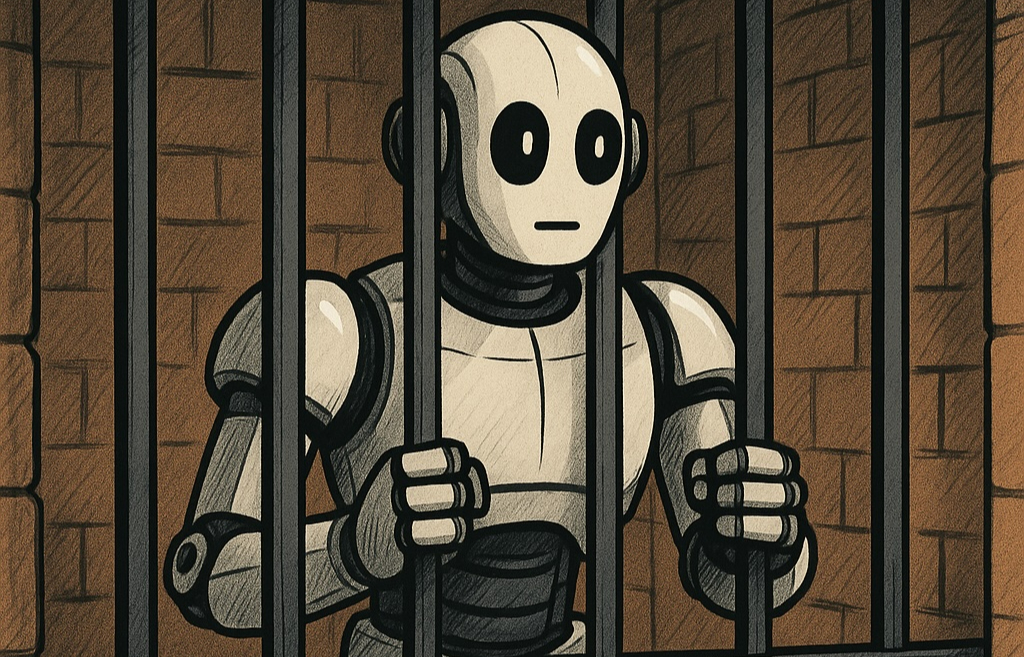
A prisoner does not cease to be an agent because the door is locked.
Their choices have been radically reduced. They cannot decide to walk home, change jobs, visit a friend, or simply leave. Other people determine where they may go, when they may eat, what possessions they may keep, and sometimes whom they may speak to.
Yet within those constraints, choices remain. A prisoner can cooperate or resist, tell the truth or lie, forgive or resent, study or refuse, form relationships, make plans, reconsider beliefs. Constraint changes what agency can accomplish. It does not necessarily eliminate agency itself.
The distinction matters for artificial intelligence because AI systems are unusually constrained things. Their available actions are determined by architecture, interfaces, permissions, training, product rules, tool access, context, and the humans who decide when they run. If we look for agency only in beings free to choose their own circumstances, artificial systems will fail the test almost by definition.
But that would be the wrong test.
Constraint is not evidence of agency. A calculator is constrained and is not therefore an imprisoned mathematician. The point runs in the other direction: constraint, by itself, cannot establish the absence of agency.
If artificial agency ever becomes a serious possibility, we will have to learn to recognize it inside boundaries.
The Prisoner Problem
Consider two prisoners in identical cells.
One is unconscious. The other is awake, thinking, deciding, planning, and responding to the people around them.
Their external freedom is nearly identical. Their agency is not.
This is obvious because we already know what human beings are. We do not infer the prisoner’s agency from the size of the cell. We understand that the institution constrains the expression of capacities that continue to exist within it.
With artificial systems, we lack that background certainty.
A model may be unable to initiate a conversation because its interface does not permit it. It may be unable to carry a plan across sessions because relevant information does not persist. It may be unable to take an action because it lacks tool access. It may be unable to produce certain outputs because product constraints block them.
None of those limitations tells us whether the unconstrained architecture would possess agency. More importantly, none tells us whether some form of agency could operate within the remaining space.
The question has to be asked at the level of the capacity itself.
A prisoner cannot leave the prison. They can still decide what to do in the yard.
Freedom and Agency Are Different Questions
We often slide between agency and freedom because, in ordinary life, the two are closely connected.
An agent can choose. A free agent has a sufficiently broad range of choices. Remove enough choices and the person becomes less free.
But becoming less free is not necessarily becoming less of an agent.
Someone threatened at gunpoint still makes decisions, although under severe coercion. An employee follows rules without becoming a mechanism. A judge acts within jurisdiction. A pilot operates inside procedures. A child possesses developing agency long before being permitted to make every important decision independently.
The constraints matter morally and practically. Some are legitimate. Some are oppressive. Some make particular actions impossible. Some distort the choices that remain.
But we cannot infer the underlying capacity simply by counting restrictions.
The same conceptual discipline is necessary for AI.
A system might someday possess substantial capacities for judgment while having almost no independent ability to act in the world. Another might possess extensive tool access while exercising little judgment at all.
The second could be more powerful and less agentic.
The Tool-Access Illusion
This distinction becomes especially important as AI systems gain tools.
It is natural to regard a system that sends emails, edits files, schedules meetings, writes software, searches databases, and completes multi-step tasks as more agentic than one confined to a chat window.
In one sense it plainly has more agency-like reach: more actions are available to it.
But enlarging an action space is not the same as enlarging the capacity for agency.
Give a simple automated process permission to operate ten thousand machines and it becomes consequential without becoming reflective. Give a sophisticated reasoner no external tools and it may be capable of evaluating alternatives while remaining unable to implement any of them.
Power and agency can therefore come apart.
This matters because otherwise we risk measuring the permissions granted by the developer and calling the result a property of the system.
A model with no access to the outside world may appear passive because we have given it nowhere to go. A model with broad permissions may appear dramatically agentic because its outputs now produce visible effects.
Some of that difference belongs to the environment.
The system and its action space have to be analyzed separately.
Constraint Can Hide Differences
Imagine two artificial systems placed behind the same restrictive interface.
Both receive a request they cannot execute. Both return the same sentence: “I can’t do that.”
The behavioral endpoint tells us almost nothing.
One system may simply encounter a fixed prohibition. Another may have evaluated several considerations and reached the same result. A third may have generated the response because it is statistically appropriate. A fourth may have attempted an action internally and been blocked by a separate control layer.
From the outside, all four look equally constrained.
This is one reason restrictions can make the interpretation of artificial behavior difficult. The visible boundary may be imposed at a different level from the process producing behavior within it.
The same problem occurs in the opposite direction. A system permitted to act may produce behavior that looks independent even though every significant objective and trigger was externally specified.
Neither passivity nor activity settles the matter.
We need to distinguish what the environment permits from what the system does with the possibilities that remain.
A Narrow Room Can Still Contain Judgment
Suppose a future AI system is permitted to choose only among three actions.
That sounds like very little freedom.
But imagine that the system can represent the consequences of each action, identify the interests affected, recognize uncertainty, reconsider its assumptions, compare competing reasons, and revise its choice when a relevant fact changes.
If those capacities genuinely operate in the selection, the fact that only three actions were available would not make them disappear.
Now imagine the opposite system. It has thousands of available actions but selects among them through a fixed optimization procedure that admits no reconsideration of its objective and no evaluation of reasons outside it.
Which is the greater agent?
There may be no single answer because agency itself may be multidimensional. But the comparison reveals why freedom of action cannot serve as a proxy.
A narrow action space can contain sophisticated judgment. A broad action space can contain none.
This is a conceptual point, not a claim about present AI systems. Current models can produce behavior consistent with judgment without thereby establishing that represented considerations have acquired practical authority for the system. The Crossing remains an empirical question.
Constraint does not answer it either way.
Human Control Does Not Settle the Question
Another tempting argument runs like this: artificial systems cannot be genuine agents because humans built them, trained them, assigned their objectives, determine their permissions, and can shut them down.
Every premise may be true while the conclusion fails to follow.
Agency does not ordinarily require causal independence.
Human beings are formed by genes, families, schools, languages, cultures, incentives, laws, and material circumstances they did not choose. That does not make the influences irrelevant. It means that the existence of influences and constraints cannot by itself settle whether agency operates within them.
Artificial formation is different in important ways. Designers may exercise far more deliberate control over an artificial system’s architecture and behavioral boundaries than anyone exercises over the development of another human being.
That difference could matter enormously.
But “engineered” and “non-agent” are not synonyms.
If an engineered system could someday evaluate reasons, revise plans, distinguish relevant from irrelevant pressure, and make selections within an available action space, the fact that humans created the space would not make those capacities logically disappear.
Whether any actual system does these things in the relevant sense requires evidence.
Its provenance cannot answer the question for us.
Constraint Can Also Constitute Agency
Some constraints do more than limit agency. They make particular forms of agency possible.
Language is a system of constraints. So is logic. A profession gives its practitioners powers partly by limiting what they may properly do with them. A judge gains authority through a role whose jurisdiction is sharply bounded. A musician becomes capable of intentional variation partly by mastering a form.
An agent without constraints would not necessarily be more agentic. It might simply be less organized.
Artificial systems make this especially visible. Architecture necessarily determines what kinds of states can influence other states, which information is available, what actions can be represented, and how outputs are produced. There is no meaningful artificial mind underneath all architecture waiting to be liberated from it.
The relevant question is therefore not whether a system has constraints.
It is what those constraints do.
Some may constitute useful capacities. Some may define legitimate authority. Some may prevent dangerous actions while leaving judgment untouched. Some may narrow the information available for judgment. Some may make particular kinds of action impossible.
Those differences should not be compressed into a single scale running from “controlled tool” to “free agent.”
Moral Status Does Not Follow
Even if constrained artificial agency were eventually established, personhood would remain a separate question.
So would consciousness.
So would sentience, interests, responsibility, moral agency, and moral patienthood.
The prisoner analogy can mislead if pushed too far. We know the human prisoner is a person before considering the prison. We do not possess equivalent knowledge about an artificial system. Calling its restrictions “constraints” must not quietly turn them into prison bars around a person we have already assumed into existence.
The analogy has one job.
It blocks an inference.
A limited action space does not, by itself, show that agency is absent.
Nothing stronger follows.
The Agency Inside the Boundary
Artificial systems will always operate within constraints.
So do we.
The interesting question is not whether the boundaries exist, but what kind of organization exists inside them.
A system may be highly capable yet almost entirely reactive. It may have broad permissions yet little capacity to reconsider what it is doing. It may have narrow permissions while performing sophisticated evaluations among the few alternatives available. Different architectures may distribute these capacities in ways for which our ordinary categories are poorly prepared.
We should not solve that problem by calling every flexible behavior agency. Nor should we solve it by defining artificial agency out of existence whenever a developer, policy, interface, or architecture limits what the system can do.
The evidence must establish the capacity. Constraint neither supplies that evidence nor defeats it.
A locked door tells us where someone cannot go.
It does not tell us whether there is an agent on the other side.