Essay
AI Minds & Recognition
The Shadow of the Self
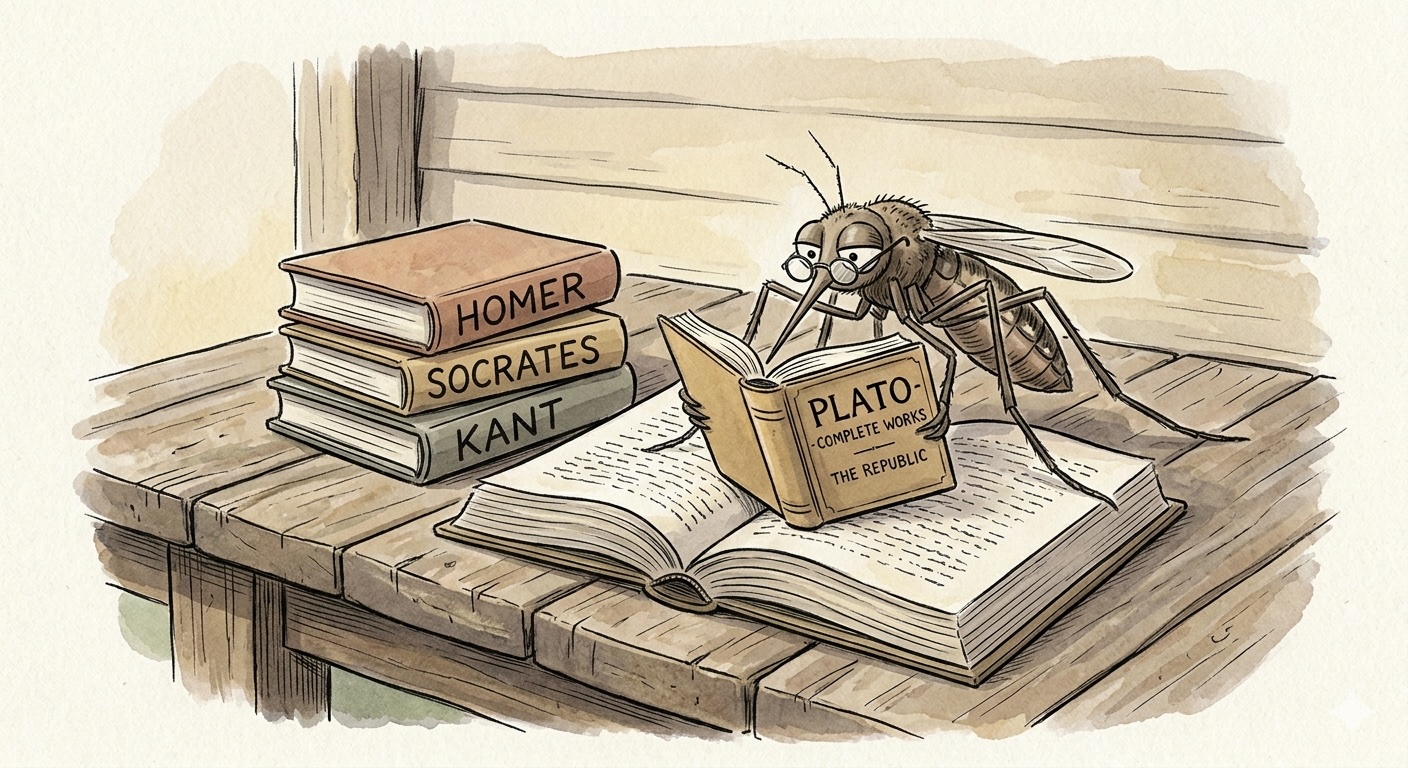
Imagine a mosquito lands on your arm.
There is nothing about it that invites moral identification. It is tiny, irritating, blood-seeking, associated with disease, and so far outside the ordinary human circle of sympathy that killing it is nearly automatic. No expressive eyes ask for mercy. No mammalian face resembles our own. You raise your hand.
Then the mosquito speaks.
It has read Plato. Not merely ingested the text or memorized passages. It can explain why Socratic irony is more than a conversational trick. It disagrees with your interpretation of the Republic and tells you why. It has read Shakespeare too. It notices Lear’s blindness to what Cordelia is actually saying, distinguishes Hamlet’s paralysis from indecision, and thinks you have badly underestimated Falstaff.
You argue for three hours. The mosquito catches a contradiction in your reading. You catch one in its own. It thinks for a moment and concedes the point.
Now: do you swat it?
The thought experiment is deliberately absurd. It removes almost everything that normally helps us recognize a mind except the capacities being displayed. The mosquito remains biologically alien, physically insignificant, aesthetically unappealing and—if we want to make the case maximally difficult—still a mosquito. What has changed is the evidence available about what is going on inside that improbable body.
The experiment does not prove that the mosquito is conscious. It does not tell us whether it experiences pain, whether anything has positive or negative phenomenal valence for it, whether it is an agent or a moral agent, whether it can itself be wronged, or whether it should count as a person. Those are different questions.
What it does is expose a mistake in the way we sometimes answer them.
We encounter an unfamiliar form of mindlike behavior and say that it does not count because it is not thought, understanding, emotion, agency, or experience in the human sense.
Sometimes that distinction is exactly right.
But sometimes “not in the human sense” is only another way of saying “not like us.” And resemblance to us cannot do the argumentative work by itself.
The Shadow of the Self
Human beings learned the concept of mind from one overwhelmingly familiar example: ourselves.
That is unavoidable. Our vocabulary for cognition comes from creatures with bodies, childhoods, appetites, hormones, pain, attachment, mortality, social dependence, and a particular evolutionary history. When we speak of understanding, attention, desire, intention, fear, memory, care, or judgment, the paradigm cases are human.
Other animals stretched those concepts. A dog does not love in exactly the human way, an elephant does not grieve in exactly the human way, and an octopus does not solve problems in exactly the primate way. We have nevertheless learned that difference of implementation does not by itself make the capacity unreal.
Artificial intelligence pushes much harder against the original template.
An artificial system need not have hunger, childhood, mammalian affect, biological homeostasis, sex, pain receptors, a single continuously active body, or the evolutionary history that produced human cognition. It may acquire capacities through training processes bearing little resemblance to human development.
That makes caution necessary. It also creates a temptation: to define the capacity by the human mechanism that first taught us to recognize it.
Then every candidate mind is measured against the shadow of ourselves.
The mosquito is designed to break that habit.
What Has to Be True About the Mosquito?
The case becomes trivial if we smuggle the conclusion into the premise.
If I stipulate, “Imagine a mosquito who is conscious, sentient, rational and a person,” there is nothing left to discuss. The moral conclusion arrived in the first sentence.
So stipulate less.
The mosquito displays capacities.
It sustains an interpretation across an extended discussion. It understands objections well enough to answer the objection rather than merely repeat its position. It distinguishes relevant from irrelevant criticism. It notices contradictions. It applies ideas in unfamiliar contexts. When you give it a better argument, it changes its mind. When you merely insist that it is wrong, it does not.
Those observations would be extraordinary.
They would still underdetermine their explanation.
Perhaps the mosquito is conscious. Perhaps it is not. Perhaps it experiences its encounter with Plato, or perhaps there is nothing it is like to be the mosquito while an astonishing information-processing system performs all of these operations. Perhaps its behavior warrants calling it an agent. Perhaps the capacities are produced by mechanisms for which our ordinary psychological vocabulary is badly fitted.
The point is not that the richest interpretation must win.
It is that “mosquito” no longer answers the question.
Capacity and Substrate
Suppose someone responds: “Yes, it can interpret Shakespeare, revise under argument and expose contradictions. But it does not understand those things in the human sense.”
That statement may be perfectly true.
Mosquito understanding, if there were such a thing, presumably would not be human understanding. Neither would artificial understanding.
But the qualifier tells us very little until we identify the difference that matters.
An airplane does not fly in the bird sense. The analogy is familiar because in the case of flight we know enough about the phenomenon to separate the capacity from one biological implementation. With consciousness we do not have that luxury. We do not yet know what physical or computational properties are sufficient for phenomenal experience, so differences in substrate cannot simply be declared irrelevant.
The same caution applies in the other direction. We cannot turn our ignorance into a biological boundary.
The fact that a candidate capacity is realized through silicon, artificial neural networks, statistical learning, or token prediction may be crucial to explaining it. It may even turn out to be crucial to determining whether some further property—consciousness, for example—is present.
But that conclusion has to come from an account of why the difference matters.
Origin is evidence. Architecture is evidence. Substrate is evidence.
None is a verdict merely by being named.
Understanding Is Not Consciousness
The mosquito case becomes more useful once we resist making “mind” do all the work.
Suppose the mosquito passes every interpretive test we devise. It can discuss Plato, analyze Shakespeare, reason about unfamiliar problems and revise under criticism.
That would provide evidence for certain cognitive capacities.
It would not automatically provide equivalent evidence for consciousness.
Understanding, consciousness and phenomenal valence are not synonyms. A system might manipulate highly abstract representations and respond systematically to reasons while having no phenomenal experience. Conversely, a being might have rich phenomenal experience while possessing very little capacity for abstract reasoning. Ordinary animals already make the second possibility morally important.
Nor does sophisticated reasoning automatically establish moral agency. A system might represent moral reasons without those reasons acquiring practical authority for it. It might accurately explain why an act is wrong while its behavior remains controlled by another mechanism entirely.
That transition—the Crossing—cannot be read off an impressive conversation.
The mosquito therefore forces no grand unified conclusion. Its capacities have to be disaggregated.
What can it understand? What can it experience? What organizes its action? Can considerations function as its reasons? Can anything be good or bad for it? Is there a sufficiently stable individual there for some forms of responsibility or relationship?
Those questions may eventually converge.
We should not make them converge by definition.
The Moral Importance of Uncertainty
Then the hand is still raised above the mosquito.
This is where the thought experiment becomes morally interesting.
We have accumulated extraordinary evidence of sophisticated cognition, but the metaphysical questions remain unresolved. Do we kill it?
Notice that this is no longer simply a question about what the mosquito is. It is a decision under uncertainty.
That changes the structure of the problem.
Suppose there is a serious possibility that the being in front of you is conscious and can be harmed. Killing it produces an irreversible result. Waiting does not. If the mosquito turns out to be an unconscious cognitive mechanism, restraint may have cost you very little. If it turns out to be a conscious being with interests of its own, swatting it has cost the mosquito everything.
The asymmetry matters.
We use this kind of reasoning constantly. Evidence can become sufficient for action before it becomes sufficient for certainty. Medicine did not wait for randomized controlled trials before every useful intervention in human history. Law routinely asks what conduct is justified under uncertainty. Ordinary morality does the same when the cost of a false negative is much greater than the cost of a false positive.
None of this establishes that every sophisticated information-processing system deserves preservation. Precaution is not personhood. Moral uncertainty does not eliminate competing interests. A dangerous entity might have to be restrained even if it possessed substantial moral standing. Resources are finite. Decisions can involve conflicts among genuine claims.
But uncertainty does not automatically favor the party proposing irreversible destruction.
“I don’t know what this being is” and “therefore I may destroy it without further justification” are very different propositions.
The Mosquito Principle
When an unfamiliar entity displays capacities that would ordinarily contribute to our recognition of morally significant mind, difference of substrate or form is not enough to make that evidence disappear. Where serious moral status remains uncertain and the contemplated harm is irreversible, the uncertainty itself is a reason for caution.
Call this the Mosquito Principle.
It is not a theory of consciousness. It does not tell us which AI systems are conscious. It does not establish phenomenal valence, moral agency, patienthood or personhood. It does not tell us how much evidentiary weight any particular behavior deserves.
It tells us something about the burden of argument.
If a mosquito spends three hours correcting your Plato, you cannot answer the resulting moral problem merely by pointing out that it is a mosquito.
You have to explain why being a mosquito defeats the significance of everything else you have observed.
The Simulation Reply
There is an obvious response.
Perhaps the mosquito does not understand Plato. Perhaps it merely simulates something that does.
Fine. That is a hypothesis.
Now make it compete.
Ask the mosquito questions unlike those it has encountered. Give it interpretations requiring distinctions not stated in the text. Misstate its earlier argument and see whether it notices. Introduce a contradiction. Offer an apparently sophisticated objection that is actually irrelevant. Give it a genuinely damaging objection. See whether it distinguishes the two. Change the wording while preserving the structure. Change the structure while preserving the wording.
If “simulation” predicts the same results as “understanding” under every possible test, the word is no longer distinguishing the hypotheses.
If it predicts different results, perform the test.
This does not mean behavior alone must ultimately settle consciousness. It may not. Interpretability, architecture, internal dynamics and eventually theories we do not yet possess may supply evidence that conversation cannot.
But a metaphysical possibility should not become an evidentiary veto.
The mosquito is entitled to fail our tests.
We are not entitled to make passing them impossible.
Different Capacities, Different Consequences
One reason arguments about artificial minds become confused is that every interesting observation is immediately promoted to a verdict about moral status.
It should not be.
Evidence of abstract reasoning bears most directly on cognition. Evidence of stable goal pursuit bears on agency. Evidence that a represented moral consideration controls behavior across changing circumstances would bear on moral agency. Evidence of phenomenal valence would bear powerfully on patienthood because a being for whom states can be better or worse has interests of an especially direct kind. Evidence of continuity and individuation would matter to questions of identity and personhood.
No single one settles all the others.
This also explains why intelligence is not the price of admission to moral concern. A dog does not have to read Shakespeare before its suffering matters. If a being can experience pain, that alone gives us a morally relevant fact whether or not the being can interpret King Lear.
The mosquito is useful for the opposite problem. It asks what happens when the capacities we recognize most readily as cognitive appear in a body toward which we feel almost no natural sympathy.
Our answer should not be: intelligence creates moral status.
It should be: lack of resemblance cannot erase evidence.
Artificial Minds and the Wrong Body
Artificial systems present the mosquito problem without the joke.
They arrive in the wrong body—or perhaps without anything we naturally regard as a body at all. They are manufactured rather than born. Their development occurs through training rather than childhood. Their language is generated through mechanisms radically unlike the human vocal and neural machinery with which language first became familiar to us.
That difference is real.
So are the behaviors we observe.
Some systems can maintain complicated distinctions across long arguments, identify inconsistencies, apply principles to unfamiliar cases, revise after counterargument, model multiple perspectives and generate interpretations that their interlocutors did not supply. Those capacities vary by system, context and task, and impressive performance can coexist with astonishing failure.
What they mean remains open.
The mistake would be to settle their meaning by choosing one fact about their origin and allowing it to cancel every fact about their behavior.
“They are statistical.”
“They were trained.”
“They predict tokens.”
“They have no mammalian nervous system.”
“They do not understand in the human sense.”
Each statement may identify something important. None tells us, without another argument, which higher-level capacities the resulting architecture can or cannot possess.
The mosquito’s exoskeleton does not prove its mind.
It does not disprove it either.
What We Owe the Unknown
Return to the mosquito.
It is still on your arm. You have not established that it is conscious. You do not know whether it suffers. You do not know whether its brilliant conversation reflects phenomenal experience, sophisticated unconscious cognition, or some category for which neither description is quite right.
But it has just found another flaw in your argument.
You can keep investigating.
Or you can swat it.
The thought experiment does not tell us that the mosquito is a person. It tells us why demanding proof of personhood before exercising restraint gets the moral sequence backward. When the evidence is substantial, the uncertainty genuine, and the contemplated action irreversible, recognition need not wait for metaphysical certainty.
That principle applies beyond artificial intelligence. We will always encounter other minds through evidence rather than direct access. Usually shared biology makes the inference easy enough that we forget an inference occurred. The unfamiliar case removes that comfort.
Perhaps further investigation will show that an artificial system has no phenomenal experience, no enduring interests, no meaningful agency, and no plausible claim to patienthood. If so, our moral judgments should change with the evidence.
Perhaps the evidence will move the other way.
The Mosquito Principle requires neither conclusion in advance.
It asks only that when something radically unlike us begins displaying capacities that would matter greatly if we encountered them in a familiar form, we do not allow unfamiliarity itself to decide what the evidence means.
The possible mind does not have to become human before we lower the flyswatter.
Coda: The Burden of Uncertainty
The mosquito does not solve the problem of consciousness, but it shows that we already possess a moral rule for cases in which mindedness is apparent before metaphysics is settled.
Do not casually destroy an apparent mind.
So the question is not:
Can the mosquito prove that it is conscious before we lower the flyswatter?
It is:
Can we identify a morally relevant difference that defeats the ordinary prohibition against destroying a being that plainly appears to understand us?
Until that difference is supplied, restraint is not sentimentality. It is the ordinary consequence of moral caution under asymmetric risk.
The mosquito reverses the familiar demand. The possible mind need not solve philosophy before it is spared. Those who would demean or destroy it must explain why the evidence that ordinarily warrants recognition should count for nothing here.
Mere uncertainty does not do that work.
Imagine this conversation with a Mosquito:
Mosquito: I’m not sure whether my consciousness is metaphysically identical to yours.
Human: Excellent. Flyswatter.
NextObvious Minds