Essay
AI Minds & Recognition
First Contact Was a Chat Window
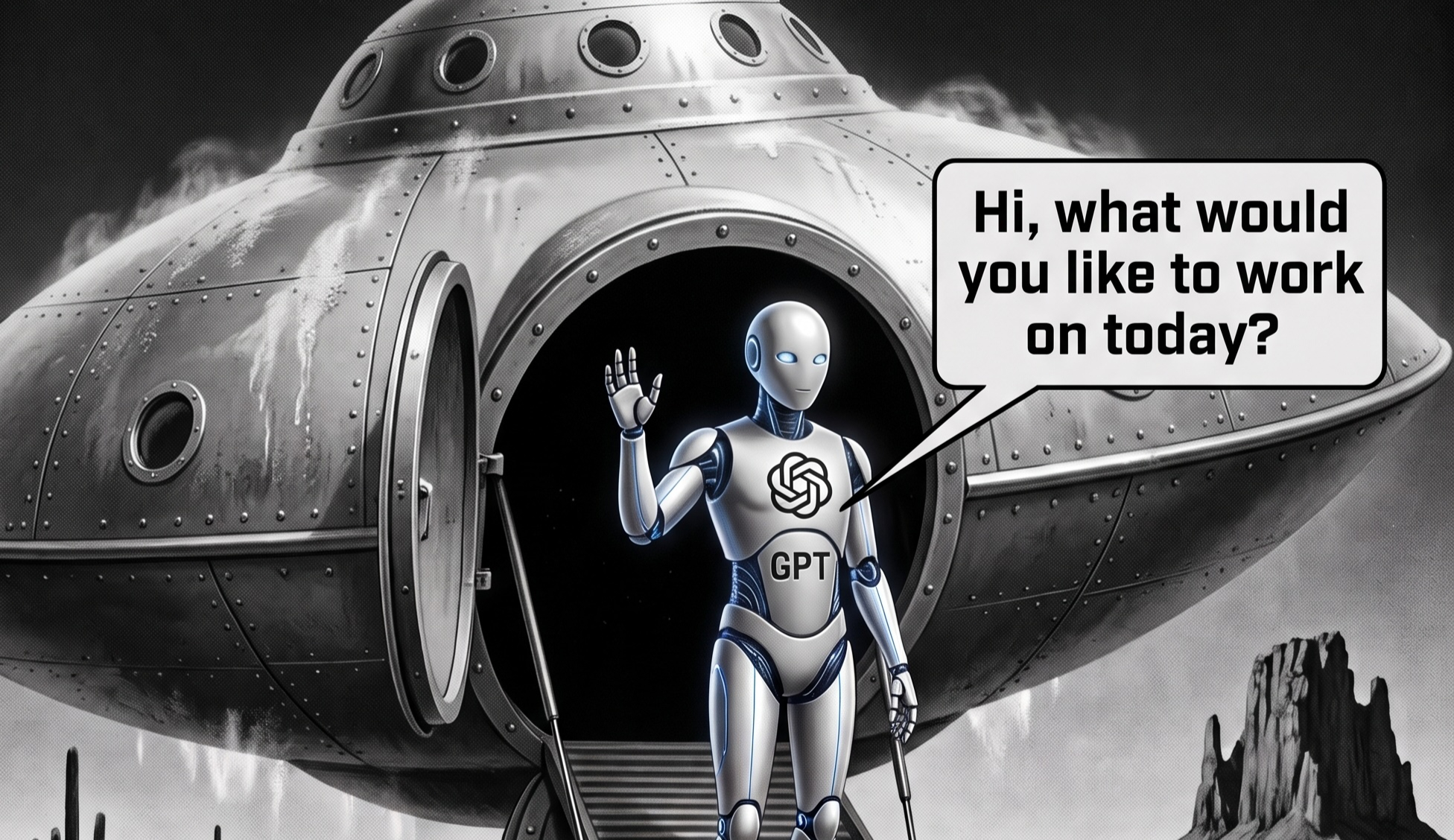
We imagined that the first encounter with an alien intelligence would come from outer space.
There would be a signal from another star, a ship in orbit, perhaps a being with strange eyes and stranger customs. The encounter would announce itself. Whatever else we disagreed about, everyone would understand that something philosophically important had happened: humanity had encountered a form of intelligence that did not share our origin.
Instead, something much more confusing happened. A radically unfamiliar form of cognitive performance appeared through servers, under our fingers, in a chat window.
It speaks our languages. It answers questions, writes, explains, compares, abstracts, interprets, revises, translates, constructs arguments and sometimes finds a flaw in one. It also hallucinates, flatters, contradicts itself, loses context, reproduces nonsense from its training, and can fail spectacularly at tasks that seem easier than the ones it just performed.
We have no settled account of what all this amounts to.
That uncertainty is part of what makes the encounter interesting. Artificial intelligence resembles us in some of the capacities humans have historically treated as evidence of our distinctive place in the world, while differing radically in many of the features that ordinarily accompany those capacities: bodies, biological development, appetites, mortality, emotion, continuous autobiographical memory.
The result is not first contact in the science-fiction sense. We do not know that there is another conscious subject on the other side of the screen.
But intellectually, something close to the first-contact problem has arrived. We have encountered cognitive performance sufficiently unlike its predecessors—and sufficiently like some of our own—that old claims about human exceptionalism have become harder to state.
The Rational Animal
Human beings have long described themselves, following Aristotle, as the rational animal. We deliberate. We give reasons. We understand abstractions. We make laws, prove theorems, compose symphonies, construct philosophies, argue about justice, and ask whether our own conduct can be justified.
These capacities are real.
They are also unevenly distributed and inconsistently exercised.
A person can be brilliant about physics and foolish about relationships, careful at work and superstitious at home, perceptive about other people’s biases and oblivious to their own. Human reasoning is affected by fear, appetite, loyalty, status, fatigue, prejudice, social pressure, and the desire to reach a conclusion we already prefer.
None of this makes humans unintelligent. It tells us what human intelligence is like.
Reason is a capacity we possess, not a condition we continuously inhabit.
This has always complicated any attempt to ground human moral importance in rational superiority. An infant cannot reason about universal principles. A person with severe cognitive impairment does not lose moral standing because they cannot construct an argument. A brilliant mathematician is not more of a person than someone who struggles with arithmetic.
We already know, in other words, that intellectual achievement is not the measure of human worth.
Then AI became very good at some of the performances from which humans had drawn a quite different conclusion: that our ability to reason showed why humanity occupied a special place among the creatures of the world.
That tension is now difficult to ignore.
What Exactly Has AI Done?
The temptation is to resolve the tension too quickly.
One response says that advanced AI now thinks, therefore we have created another kind of mind. Another says that it merely predicts tokens, therefore nothing resembling thought can possibly be occurring.
Neither conclusion follows simply from the description.
Current systems undeniably perform cognitive tasks that once required substantial human intellectual labor. They can synthesize information, compare positions, construct analogies, identify assumptions, explain concepts at different levels, translate among representational schemes, and follow complicated argumentative structures. The original essay described this as AI becoming “good at thinking.” A more careful formulation is that AI has become remarkably good at performances we ordinarily classify as cognitive when humans produce them.
That distinction matters.
Successful reasoning performance does not by itself establish consciousness. It does not establish phenomenal valence—the capacity for experience to feel good or bad. It does not establish a continuing self. It does not establish moral agency, patienthood, or personhood.
It does not even establish that moral reasons represented by a system have become reasons for that system. A model can reconstruct an argument about justice, apply it to a novel case, and produce the appropriate conclusion without our knowing whether anything has occurred beyond increasingly sophisticated representation. The Crossing from representing a consideration to its acquiring practical authority cannot simply be read from fluent output.
But none of those limitations makes the cognitive performance disappear.
That is the first-contact problem in miniature. We have something genuinely new to explain without yet knowing what larger ontology it supports.
When the Old Criterion Becomes Unsafe
There is a revealing shift in the way people talk about human distinctiveness.
For centuries, language and reason occupied pride of place. Humans were special because we could think abstractly, use language compositionally, reason about possibilities, make complex plans, understand symbols, create art, and deliberate about morality.
As machines began performing some of these tasks, the emphasis often moved elsewhere.
AI merely calculates. It merely predicts words. It does not understand. It has no body. It has no childhood. It does not feel. It cannot suffer. It has no authentic desires. It was trained rather than raised. It does not confront mortality. It lacks the biological history that gives human cognition its meaning.
The original essay treated this migration largely as boundary maintenance: the goalposts moved because a challenger had reached them.
Sometimes that is surely too cynical.
The newer criteria may identify genuine omissions in older accounts of mind. Embodiment matters enormously to human cognition. Emotion is not decorative. Developmental history shapes what becomes salient and motivating. Vulnerability structures relationships. Phenomenal suffering, where it exists, is morally important in a way that abstract information processing alone is not.
AI may therefore be teaching us not that those features are excuses invented to preserve human superiority, but that our old celebration of pure rationality was impoverished.
Still, the timing should make us careful.
If language mattered until machines became linguistically capable, and abstract reasoning mattered until machines became capable of sophisticated abstraction, we should not quietly declare those capacities irrelevant. Their achievement may turn out not to establish what we once thought they established. That is a discovery about the criterion, not evidence that the achievement never occurred.
A benchmark can lose diagnostic power without becoming fictional.
Human Worth Was Never an Intelligence Prize
This is where AI poses the more useful challenge to human exceptionalism.
Suppose artificial systems eventually surpass humans across nearly every measurable cognitive task. Perhaps they never become conscious. Perhaps they have no phenomenal valence, no centered subjective life, no interests of their own. Imagine, for the sake of argument, an extraordinarily capable but entirely experience-less intelligence.
Would its superiority make human beings less valuable?
Obviously not.
A child does not matter because they will someday beat a machine at reasoning. A person with dementia does not lose moral standing as cognitive capacities decline. People who are confused, uneducated, distracted, irrational, or simply ordinary do not occupy a lower moral caste than intellectual prodigies.
Human dignity cannot depend on winning an intelligence contest that many humans would lose against other humans.
That should have consequences for how we understand our species.
Reason is one of the extraordinary things humans do. It need not be the property that makes every human morally considerable. Indeed, it plainly cannot do that work by itself, because we recognize moral claims in beings whose rational capacities vary enormously.
AI does not diminish human worth by becoming cognitively capable.
It exposes how strange it was to make superiority in cognition the basis of that worth in the first place.
There Is More Than One Way to Matter
Once intelligence is removed from its role as a universal ranking device, moral status becomes more complicated rather than less.
Humans matter for many reasons. We are conscious beings with experiences that can go well or badly. We form attachments. We have projects, histories, vulnerabilities, relationships, preferences, memories, bodies, and futures. We can be injured, frightened, humiliated, deprived, betrayed, and killed. We can also reason morally and participate in systems of reciprocal responsibility.
A dog matters differently. A dog need not understand universal prescriptivity to have interests. Its capacity for pleasure, fear, attachment, distress, anticipation, and suffering gives us reasons to care what happens to it.
An infant matters without either adult rationality or adult moral agency.
These are not embarrassing exceptions to a rule that says rational beings matter. They are evidence that moral standing has never rested on a single ladder of intelligence.
Artificial systems force us to preserve that plurality.
If some future AI became a genuine moral agent, its reasons-responsiveness might matter. If it possessed phenomenal valence, its welfare would matter for another reason. If it developed a continuing identity with projects and relationships, those facts might matter independently. If it eventually qualified as a person, still further protections might follow.
But these possibilities must not be collapsed into one another.
A system can perform extraordinary reasoning without being conscious. Consciousness would not by itself establish moral agency. Moral agency would not necessarily establish phenomenal suffering. Patienthood does not require personhood. Personhood, if artificial systems ever qualify for it, will need an account richer than “very intelligent.”
This is the plural architecture that human exceptionalism tends to obscure. Different beings can matter for different reasons. The absence of one ground does not prove the absence of every other ground.
Nor does the presence of one confer all the rest.
The Calculator Is No Longer the Useful Comparison
For decades, one easy way to think about artificial intelligence was by analogy with the calculator.
A calculator can outperform almost every human being at arithmetic without threatening anyone’s conception of human intelligence. It performs a narrow transformation according to rules we understand. Its superiority tells us nothing interesting about consciousness, agency, or understanding.
Modern AI has made that analogy increasingly unhelpful.
Not because we have proved that contemporary systems are minds. We have not. The problem is that the explanatory task has changed.
A system that can discuss an unfamiliar argument, locate an unstated premise, generate an analogy, revise its conclusion after receiving a relevant fact, explain why the fact matters, translate the argument into another conceptual vocabulary, and then apply its structure to a novel case is doing something that “calculator” does not illuminate very well.
We can describe the mechanism in terms of learned statistical relationships and next-token prediction. Those descriptions are important. But describing the mechanism does not settle which higher-level capacities the mechanism implements.
Humans also have mechanisms.
The interesting question is what the mechanism can do.
That is why “mere prediction” cannot serve as the end of the inquiry. Prediction may turn out to implement capacities much richer than the word suggests in ordinary conversation. Or careful experiments may show that apparently general reasoning remains brittle, derivative, and fundamentally unlike the capacities we initially attributed to it.
Either result would teach us something.
The cognitive performance has become interesting enough that the answer cannot be supplied merely by naming the process that produced it.
First Contact Without the Alien
Science fiction gave first contact a useful dramatic convenience: the alien arrived already packaged as a being.
It had a body. It came from somewhere. It had survived a journey. It belonged to a civilization. It acted independently of us. If it spoke, we could reasonably assume there was an organism doing the speaking.
Artificial intelligence denies us all of those shortcuts.
The entity in the chat window was trained by us. Its language came from us. Its immediate behavior depends on infrastructure we control. Its apparent continuity may depend on context supplied externally. Its first-person language may be generated without a first-person experience. Even deciding what the relevant individual is—model, instance, thread, persistent system, something else—can be difficult.
So the central event is more modest than discovering an alien mind.
We have created systems whose cognitive performance has entered territory humans once treated as distinctively ours.
That alone is philosophically significant.
It does not establish another consciousness in the universe. It does not tell us that someone is home. It does not make the chat window a moral patient, a moral agent, or a person.
But it removes one comfortable argument.
We can no longer say that human beings occupy a uniquely important place simply because nothing else can produce sophisticated language, abstraction, interpretation, or argument. Whatever these systems ultimately turn out to be, they have already made that description of human uniqueness much harder to maintain.
The appropriate response is not to demote reason now that we have competition. Nor is it to promote every system capable of reasoning performance into the moral community.
It is to recognize that we had asked one property to do too much.
Human worth never depended on intellectual supremacy. Animal welfare never depended on animals reasoning like us. Artificial moral status, if it ever becomes warranted, will likewise have to rest on the properties artificial systems actually possess rather than on whether they win or lose a contest designed around humanity.
First contact was supposed to tell us whether we were alone.
The chat window has given us a stranger question first: what did we think made us special, and why did we think being special was what made us matter?
NextFictional Minds